Overview
This unit charts a passage through the 20th century from modernism to post-modernism through its literature. It invites you to explore a selection of texts by a number of significant writers from the 20th century and from a range of national literatures. These texts address a range of issues including post-colonialism, the transition from the psyche to psychology, sexuality, the American Jazz age, Southern post-bellum agonistics, gender, magic realism, existentialism, slavery, racism, and identity. You will also explore the influences this literature has had on contemporary thought.
Details
Pre-requisites or Co-requisites
Admission to CC10 or completion of 72 credit points in CA10, CB94, CC13, CG85 or CC43.
Important note: Students enrolled in a subsequent unit who failed their pre-requisite unit, should drop the subsequent unit before the census date or within 10 working days of Fail grade notification. Students who do not drop the unit in this timeframe cannot later drop the unit without academic and financial liability. See details in the Assessment Policy and Procedure (Higher Education Coursework).
Offerings For Term 1 - 2026
Attendance Requirements
All on-campus students are expected to attend scheduled classes - in some units, these classes are identified as a mandatory (pass/fail) component and attendance is compulsory. International students, on a student visa, must maintain a full time study load and meet both attendance and academic progress requirements in each study period (satisfactory attendance for International students is defined as maintaining at least an 80% attendance record).
Recommended Student Time Commitment
Each 6-credit Undergraduate unit at CQUniversity requires an overall time commitment of an average of 12.5 hours of study per week, making a total of 150 hours for the unit.
Class Timetable
Assessment Overview
Assessment Grading
This is a graded unit: your overall grade will be calculated from the marks or grades for each assessment task, based on the relative weightings shown in the table above. You must obtain an overall mark for the unit of at least 50%, or an overall grade of 'pass' in order to pass the unit. If any 'pass/fail' tasks are shown in the table above they must also be completed successfully ('pass' grade). You must also meet any minimum mark requirements specified for a particular assessment task, as detailed in the 'assessment task' section (note that in some instances, the minimum mark for a task may be greater than 50%). Consult the University's Grades and Results Policy for more details of interim results and final grades.
All University policies are available on the CQUniversity Policy site.
You may wish to view these policies:
- Grades and Results Policy
- Assessment Policy and Procedure (Higher Education Coursework)
- Review of Grade Procedure
- Student Academic Integrity Policy and Procedure
- Academic Progression Policy and Procedure
- Student Refund and Credit Balance Policy and Procedure
- Complaints Policy and Procedure
- Information and Communications Technology Acceptable Use Policy and Procedure
This list is not an exhaustive list of all University policies. The full list of University policies are available on the CQUniversity Policy site.
Feedback, Recommendations and Responses
Every unit is reviewed for enhancement each year. At the most recent review, the following staff and student feedback items were identified and recommendations were made.
Feedback from SUTE feedback and UC reflection
Clarify assessment expectations and provide exemplars.
Develop and share assessment exemplars early in the term to support student understanding and confidence.
Feedback from SUTE feedback and UC reflection
Improve content delivery timing and transparency.
Ensure all weekly content is uploaded in advance of each week to support student planning and reduce anxiety.
Feedback from Student qualitative feedback
Address perceived overlap between Literature Studies units.
Conduct a curriculum mapping exercise to compare LITR13041 with LITR11043 “The Short Story” to ensure sufficient differentiation in content and assessment.
Feedback from Student qualitative feedback
Enhance relevance for Education students.
Include clearer explanations of how the study of literature (particularly literature of the 20th century) translates to secondary teaching skills and real-world contexts; how these skills are useful in any career.
- Analyse and synthesise literary texts through close reading of identified modern literature
- Analyse the historical, cultural and social contexts in which a range of modern texts were produced, and to which they respond
- Construct responses to issues raised by modern literature to demonstrate how literature and culture are interrelated
- Critically evaluate authorial choices in a range of modern texts and convey the effects of those choices through interpretive arguments
Alignment of Assessment Tasks to Learning Outcomes
| Assessment Tasks | Learning Outcomes | |||
|---|---|---|---|---|
| 1 | 2 | 3 | 4 | |
| 1 - Written Assessment - 30% | ||||
| 2 - Written Assessment - 30% | ||||
| 3 - Essay - 40% | ||||
Alignment of Graduate Attributes to Learning Outcomes
| Graduate Attributes | Learning Outcomes | |||
|---|---|---|---|---|
| 1 | 2 | 3 | 4 | |
| 1 - Communication | ||||
| 2 - Problem Solving | ||||
| 3 - Critical Thinking | ||||
| 4 - Information Literacy | ||||
| 5 - Team Work | ||||
| 6 - Information Technology Competence | ||||
| 7 - Cross Cultural Competence | ||||
| 8 - Ethical practice | ||||
| 9 - Social Innovation | ||||
| 10 - First Nations Knowledges | ||||
| 11 - Aboriginal and Torres Strait Islander Cultures | ||||
Textbooks
There are no required textbooks.
IT Resources
- CQUniversity Student Email
- Internet
- Unit Website (Moodle)
- Students must have necessary equipment/accessories to attend online tutorials via Zoom or Microsoft Teams, or to watch the video recordings
- Zoom access (via smartphone/device app or laptop): microphone and webcam required
All submissions for this unit must use the referencing style: Harvard (author-date)
For further information, see the Assessment Tasks.
a.hickling@cqu.edu.au
Week 1
Begin Date: 09 Mar 2026Module/Topic
Introduction: Overview of the modern and post-modern literary movements.
Chapter
Week 1 Study Guide via the Moodle unit site, readings available in the e-reading list.
Students are expected to review the study material before attending any tutorials so that they can engage in the tutorial activities.
Events and Submissions/Topic
- Work through the week 1 study guide,
- familiarise yourself with the assessments via the Assessments Tile,
- add the assessment due dates to your personal calendar or schedule, and
- make note of the "Assessment Extension Request" form in the Support Menu.
Week 2
Begin Date: 16 Mar 2026Module/Topic
Modernism 1 + Textual Analysis and Close Reading
Chapter
Weekly Study Guide via the Moodle unit site, readings available in the e-reading list.
Events and Submissions/Topic
Week 3
Begin Date: 23 Mar 2026Module/Topic
Modernism 2 + Reflective Writing
Chapter
Weekly Study Guide via the Moodle unit site, readings available in the e-reading list.
Events and Submissions/Topic
Preparing Assessment 1: due next week.
Week 4
Begin Date: 30 Mar 2026Module/Topic
Modernism 3 + Literary Device Analysis
Chapter
Weekly Study Guide via the Moodle unit site, readings available in the e-reading list.
Events and Submissions/Topic
Submission of Assessment 1.
Modernist Analysis Exercise Due: Week 4 Friday (3 Apr 2026) 11:59 pm AEST
Week 5
Begin Date: 06 Apr 2026Module/Topic
Modernism 4 + Critical Analysis
Chapter
Weekly Study Guide via the Moodle unit site, readings available in the e-reading list.
Events and Submissions/Topic
Choose your text (from the text list) for Assessment 2 and begin reading and annotating.
Week 6
Begin Date: 13 Apr 2026Module/Topic
Transition to postmodernism 1 + Writing Academic Book Reviews
Chapter
Weekly Study Guide via the Moodle unit site, readings available in the e-reading list.
Events and Submissions/Topic
Begin Assessment 2 - Book Review (if you haven't already)
Vacation Week
Begin Date: 20 Apr 2026Module/Topic
Chapter
Events and Submissions/Topic
You might like to use this week to get ahead in your reading.
Week 7
Begin Date: 27 Apr 2026Module/Topic
Postmodernism 2
Chapter
Weekly Study Guide via the Moodle unit site, readings available in the e-reading list.
Re-reading your novel for Assessment 2.
Events and Submissions/Topic
Use your skills in close reading and literary analysis to make notes on the text.
Week 8
Begin Date: 04 May 2026Module/Topic
Postmodernism 3
Chapter
Weekly Study Guide via the Moodle unit site, readings available in the e-reading list.
Events and Submissions/Topic
Complete and submit Assessment 2 - Book Review by Friday.
Begin reading your 1st text for Assessment 3 (from the text list -- must be different from Assessment 2).
Literary Book Review Due: Week 8 Friday (8 May 2026) 11:59 pm AEST
Week 9
Begin Date: 11 May 2026Module/Topic
Postmodernism 4
Chapter
Weekly Study Guide via the Moodle unit site, readings available in the e-reading list.
Events and Submissions/Topic
Complete your reading/note-taking for your 1st chosen text for Assessment 3.
Week 10
Begin Date: 18 May 2026Module/Topic
Dedicated reading and annotating week
Chapter
No new content: focus on completing your reading, making your notes and beginning to develop your essay.
Events and Submissions/Topic
Read your final text, compiling notes for Assessment 3.
Week 11
Begin Date: 25 May 2026Module/Topic
Refresher: finalising the essay
Chapter
Weekly Study Guide via the Moodle unit site, readings available in the e-reading list.
Events and Submissions/Topic
Continue drafting Assessment 3 - Essay due by Friday Week 12.
Week 12
Begin Date: 01 Jun 2026Module/Topic
Final thoughts.
Chapter
No new content.
Events and Submissions/Topic
Complete and submit Assessment 3 - Essay by Friday.
Essay Due: Week 12 Friday (5 June 2026) 11:59 pm AEST
Exam Week
Begin Date: 08 Jun 2026Module/Topic
Chapter
Events and Submissions/Topic
Vacation/Exam Week
Begin Date: 15 Jun 2026Module/Topic
Chapter
Events and Submissions/Topic
1 Written Assessment
Length: 1000 words
The word count allows a +/- 10% variation and is considered from the first word of the introduction to the last word of the conclusion; it includes in-text references and direct quotations. It excludes the cover page and reference list.
Task: For this assessment, you will analyse a short modernist passage (will be provided in the Assessment tile in Moodle) demonstrating your understanding of modernist literary techniques and your developing close reading skills.
Aim:
Your analysis should:
- Examine the passage's key literary devices and narrative techniques
- Identify and discuss specific modernist characteristics
- Support your analysis with precise textual evidence
- Connect your close reading to broader modernist principles covered in the first four weeks of the unit
Your response should demonstrate clear academic writing, careful attention to textual detail, and an emerging understanding of modernist literary conventions. While detailed research is not required, you should discuss key concepts and ideas discussed in study guides, the e-reading list, and tutorials, and include a minimum of three (3) scholarly references, at least one of which must be drawn from the unit materials.
Pro-tip: you might find all the references you need just within the resources provided in weeks 1-4.
Key Components:
- Close reading analysis of a provided modernist passage
- Identification of key modernist elements
- Discussion of narrative technique
- Analysis of language and literary devices
- Specific textual evidence
- Brief contextualisation
- Connection to early modernist principles covered so far
- Brief discussion of historical/cultural context
Use of Generative Artificial Intelligence agents (Gen AI)
AI Assessment Scale: Level 2
You may use AI for planning, idea development, and research. Your final submission should show how you have developed and refined these ideas. Any misuse or lack of disclosure regarding AI tools will be considered a breach of academic integrity.
Week 4 Friday (3 Apr 2026) 11:59 pm AEST
Upload to Moodle.
Week 6 Friday (17 Apr 2026)
Feedback via Moodle.
- Close Reading: Identifies and analyses specific textual elements — literary devices, language choices, and narrative techniques — with precise and well-selected textual evidence.
- Modernist Understanding: Demonstrates accurate recognition and comprehension of key modernist features present in the passage, as discussed in the unit.
- Theoretical Contextualisation: Demonstrates an emerging ability to connect close reading observations to broader modernist principles and historical context covered in the unit so far.
- Presentation and Referencing: Presents ideas in clear, well-structured prose with appropriate academic language and paragraph organisation; adheres to submission guidelines including proper formatting, meeting word count requirements, evidence of editing and proofreading, and a minimum of three (3) scholarly references with at least one drawn from the unit materials, in Harvard (author-date) style.
- Analyse and synthesise literary texts through close reading of identified modern literature
- Analyse the historical, cultural and social contexts in which a range of modern texts were produced, and to which they respond
- Construct responses to issues raised by modern literature to demonstrate how literature and culture are interrelated
2 Written Assessment
Length: 1500 words
The word count allows a +/- 10% variation and is considered from the first word of the introduction to the last word of the conclusion; it includes THE PITCH, in-text references and direct quotations. It excludes the cover page and reference list.
You may select one (1) text from the Text List for this assessment.
IMPORTANT: You cannot use this text again in assessment 3.
Task: Writing and publishing book reviews can enhance your professional profile and may be an item you could add to your portfolio. For this assessment you are required to source a literary newspaper or journal that accepts book reviews, then write a Book Review targeted at that publication based on a close reading of your selected text, demonstrating your understanding of either modernist or postmodernist literary conventions. Ensure you review the study guide and tutorial about writing a literary book review to ensure you are confident in the requirements of this task.
Details:
You should model your review on the kind of book reviews you find in your selected literary newspaper or journal (irrespective of whether they only accept current titles). DO NOT model your review on the kinds of reviews you might find on the GoodReads or Amazon.com websites. These reviews tend to be solely focused on whether the book is enjoyable to read or not; in your review, you will be thinking much more broadly about the strengths and weaknesses of the book and its contribution to literary culture.
Some examples of appropriate publications include (but are not limited to):
Review section of the Weekend Australian
Weekend supplements to The Age or the Sydney Morning Herald
Australian Book Review
Sydney Review of Books
New York Review of Books
London Review of Books
Times Literary Supplement
Kirkus Reviews
TEXT Journal
ISLAND Magazine
Westerly Magazine
Your Book Review should follow the model/guidelines of your chosen publication, as applicable, but for the purposes of this assessment it should comply with the specified 1500-word count and cover the following points (at minimum):
- A brief pitch to the publication outlining how/why it fits their review section (no more than 250 words, included before Book Review)
- A concise summary of the content/plot - do not just retell the story.
- A brief discussion of the historical, social and/or literary context - how did this impact on the novel? Demonstrate your understanding of the literary movement.
- An analysis of the main themes - what was the writer trying to convey, and were they successful?
- An evaluation of the significance or contribution - for whom does this book matter and why?
- Inclusion of two (2) scholarly sources, at least one of which must be drawn from the unit materials.
This assessment will require you to use the reflection and critical analysis skills you developed in Assessment 1. You will be expected to read your selected text and develop your own thesis, analysis and evaluation about its themes and significance, support this with evidence from the text, and also to do some further research about the history of the book and the way it has been viewed by other readers and critics.
Use of Generative Artificial Intelligence agents (Gen AI)
AI Assessment Scale: Level 2
You may use AI for planning, idea development, and research. Your final submission should show how you have developed and refined these ideas. Any misuse or lack of disclosure regarding AI tools will be considered a breach of academic integrity.
Week 8 Friday (8 May 2026) 11:59 pm AEST
Upload via Moodle.
Week 10 Friday (22 May 2026)
Feedback via Moodle.
- Literary Analysis: Demonstrates well-developed understanding and analysis of the text's major themes, literary techniques, and narrative elements, supported by specific textual evidence.
- Historical and Cultural Context: Shows comprehensive understanding of the text's historical, social, and cultural context, including its position within modernist or postmodernist literary movements.
- Critical Evaluation: Presents a cogent and evidence-informed evaluation of the work's literary significance, artistic merit, and contribution to its genre, integrating relevant scholarly perspectives to support the assessment.
- Presentation and Referencing: Adheres to submission guidelines, including the pitch component, proper formatting, meeting word count requirements, evidence of editing and proofreading, and a minimum of two (2) scholarly references with at least one drawn from the unit materials, in Harvard (author-date) style.
- Analyse the historical, cultural and social contexts in which a range of modern texts were produced, and to which they respond
- Critically evaluate authorial choices in a range of modern texts and convey the effects of those choices through interpretive arguments
3 Essay
Length: 2000 words
The word count allows a +/- 10% variation and is considered from the first word of the introduction to the last word of the conclusion; it includes in-text references and direct quotations. It excludes the cover page and reference list.
You may select any two (2) texts from the Text List for this assessment.
Note: The texts you select for Assessment 2 cannot be used for this assessment.
Task: Write a 2000-word essay responding to one (1) of six provided questions. Your essay must analyse two (2) texts from the supplied text list to construct a well-reasoned argument. Questions explore key themes and techniques of modernist and postmodernist literature, including psychological interiority, gender representation, narrative structure, and Australian literary perspectives.
The essay should demonstrate:
- Advanced understanding of modernist and postmodernist literary movements
- Ability to analyse literary techniques and their effects
- Skills in comparative textual analysis
- Engagement with relevant literary theory
- Clear academic writing and argumentation
- Accurate citation and referencing of the primary texts (these are additional your minimum scholarly sources)
- Proper use and citation of secondary sources (minimum 6 scholarly sources, at least two of which must be drawn from the unit materials)
Pro tip: Pay close attention to whether your question focuses on modernism, postmodernism, or both.
Choose one (1) of the following questions:
- Australian literature offers distinctive interpretations of modernist/postmodernist literary techniques through its unique cultural and historical lens. With reference to two Australian texts from the reading list, analyse how the authors employ modernist OR postmodernist approaches to explore questions of identity, place, family, and belonging in an Australian context.*
Note: Australian literature, identity, and cultural context are explored in greater depth in the Term 2 unit LITR13042 Australian Literature and Identity. Students are welcome to engage with Australian texts here, but should be aware that the available Australian texts on the list are limited to two per movement. - "Modernist literature's preoccupation with psychological interiority represents not just individual consciousness but broader social fragmentation." Discuss this statement with reference to two texts from the modernist period, analysing how narrative techniques such as (but not limited to) stream of consciousness and fragmented chronology reflect both personal and societal disintegration.
- "Postmodernist literature doesn't merely question gender roles; it deconstructs the very notion of gender itself." Evaluate this claim through analysis of two postmodernist texts, examining how they employ techniques, such as (but not limited to) metafiction, intertextuality, or pastiche to challenge traditional gender narratives.
- While modernism sought to represent fragmented reality through new literary forms, postmodernism questions whether any representation of reality is possible. Using one modernist and one postmodernist text, compare how each movement approaches the relationship between form and reality.
- Analyse how two texts (any combination) use non-linear narrative structures to explore the relationship between memory, time, and identity. Consider how these structural choices reflect the chosen movement(s) philosophical preoccupations.
- Writers from colonised or postcolonial contexts have frequently used magic realism to articulate experiences that conventional realist forms cannot adequately represent. With reference to two texts (any combination), analyse how magic realist techniques serve as a form of postcolonial resistance, examining how authors use the interplay of the magical and the real to engage with questions of cultural identity, historical trauma, or colonial legacy.
Acknowledge all sources using the Harvard (author-date) referencing style.
Use of Generative Artificial Intelligence agents (Gen AI)
AI Assessment Scale: Level 2
You may use AI for planning, idea development, and research. Your final submission should show how you have developed and refined these ideas. Any misuse or lack of disclosure regarding AI tools will be considered a breach of academic integrity.
Week 12 Friday (5 June 2026) 11:59 pm AEST
Upload via Moodle.
Vacation/Exam Week Friday (19 June 2026)
Summative feedback via Moodle.
- Literary Analysis and Theory: Demonstrates sophisticated engagement with modernist and postmodernist literary techniques, analysis of major themes and narrative elements, supported by detailed and well-selected textual evidence.
- Comparative Analysis: Develops insightful and well-reasoned connections between the two selected texts, demonstrating understanding of how each represents and responds to its respective literary tradition.
- Historical and Cultural Context: Demonstrates nuanced understanding of the relevant historical, social, and cultural contexts that inform the chosen texts, including their position within modernist and postmodernist movements.
- Argument and Scholarly Engagement: Constructs a sustained, well-supported argument that directly addresses the essay question, integrating a range of scholarly sources to develop and substantiate claims.
- Presentation and Referencing: Adheres to submission guidelines, including proper formatting, meeting word count requirements, evidence of editing and proofreading, a minimum of six (6) scholarly references with at least two drawn from the unit materials, and accurate citation of primary texts, all in Harvard (author-date) style.
- Analyse and synthesise literary texts through close reading of identified modern literature
- Construct responses to issues raised by modern literature to demonstrate how literature and culture are interrelated
- Critically evaluate authorial choices in a range of modern texts and convey the effects of those choices through interpretive arguments
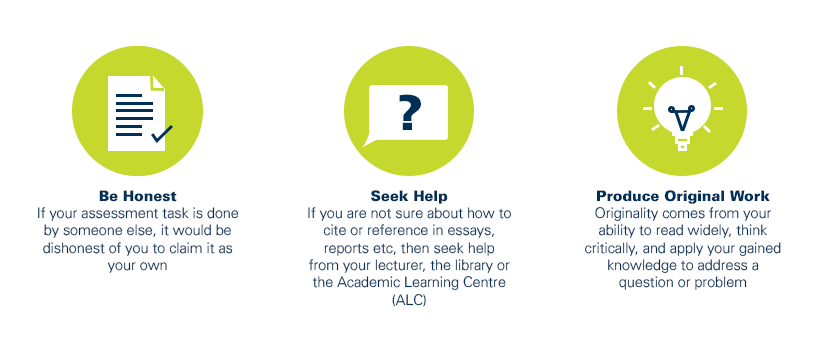
As a CQUniversity student you are expected to act honestly in all aspects of your academic work.
Any assessable work undertaken or submitted for review or assessment must be your own work. Assessable work is any type of work you do to meet the assessment requirements in the unit, including draft work submitted for review and feedback and final work to be assessed.
When you use the ideas, words or data of others in your assessment, you must thoroughly and clearly acknowledge the source of this information by using the correct referencing style for your unit. Using others’ work without proper acknowledgement may be considered a form of intellectual dishonesty.
Participating honestly, respectfully, responsibly, and fairly in your university study ensures the CQUniversity qualification you earn will be valued as a true indication of your individual academic achievement and will continue to receive the respect and recognition it deserves.
As a student, you are responsible for reading and following CQUniversity’s policies, including the Student Academic Integrity Policy and Procedure. This policy sets out CQUniversity’s expectations of you to act with integrity, examples of academic integrity breaches to avoid, the processes used to address alleged breaches of academic integrity, and potential penalties.
What is a breach of academic integrity?
A breach of academic integrity includes but is not limited to plagiarism, self-plagiarism, collusion, cheating, contract cheating, and academic misconduct. The Student Academic Integrity Policy and Procedure defines what these terms mean and gives examples.
Why is academic integrity important?
A breach of academic integrity may result in one or more penalties, including suspension or even expulsion from the University. It can also have negative implications for student visas and future enrolment at CQUniversity or elsewhere. Students who engage in contract cheating also risk being blackmailed by contract cheating services.
Where can I get assistance?
For academic advice and guidance, the Academic Learning Centre (ALC) can support you in becoming confident in completing assessments with integrity and of high standard.
What can you do to act with integrity?