Overview
In this unit, you will advance the evidence-based practice knowledge and skills you learned in ALLH12006 and apply them to speech pathology practice. Using real-world paediatric cases, you will develop literature search and critical appraisal skills to support clinical reasoning and effective clinical decision making. You will also learn about the strengths, limitations, and ethics of using generative artificial intelligence in speech pathology practice.
Details
Pre-requisites or Co-requisites
Pre-requisites: ALLH12006 Evidence Based Practice for Allied Health Co-requisites: SPCH13004 Language, Literacy, and Hearing in School Aged Children
Important note: Students enrolled in a subsequent unit who failed their pre-requisite unit, should drop the subsequent unit before the census date or within 10 working days of Fail grade notification. Students who do not drop the unit in this timeframe cannot later drop the unit without academic and financial liability. See details in the Assessment Policy and Procedure (Higher Education Coursework).
Offerings For Term 2 - 2026
Attendance Requirements
All on-campus students are expected to attend scheduled classes - in some units, these classes are identified as a mandatory (pass/fail) component and attendance is compulsory. International students, on a student visa, must maintain a full time study load and meet both attendance and academic progress requirements in each study period (satisfactory attendance for International students is defined as maintaining at least an 80% attendance record).
Recommended Student Time Commitment
Each 6-credit Undergraduate unit at CQUniversity requires an overall time commitment of an average of 12.5 hours of study per week, making a total of 150 hours for the unit.
Class Timetable
Assessment Overview
Assessment Grading
This is a graded unit: your overall grade will be calculated from the marks or grades for each assessment task, based on the relative weightings shown in the table above. You must obtain an overall mark for the unit of at least 50%, or an overall grade of 'pass' in order to pass the unit. If any 'pass/fail' tasks are shown in the table above they must also be completed successfully ('pass' grade). You must also meet any minimum mark requirements specified for a particular assessment task, as detailed in the 'assessment task' section (note that in some instances, the minimum mark for a task may be greater than 50%). Consult the University's Grades and Results Policy for more details of interim results and final grades.
All University policies are available on the CQUniversity Policy site.
You may wish to view these policies:
- Grades and Results Policy
- Assessment Policy and Procedure (Higher Education Coursework)
- Review of Grade Procedure
- Student Academic Integrity Policy and Procedure
- Academic Progression Policy and Procedure
- Student Refund and Credit Balance Policy and Procedure
- Complaints Policy and Procedure
- Information and Communications Technology Acceptable Use Policy and Procedure
This list is not an exhaustive list of all University policies. The full list of University policies are available on the CQUniversity Policy site.
Feedback, Recommendations and Responses
Every unit is reviewed for enhancement each year. At the most recent review, the following staff and student feedback items were identified and recommendations were made.
Feedback from SUTE comments
Students commented that they liked the structure and organisation of weeks 1 to 6 and would prefer weeks 7 to 12 to follow the same format.
It is recommended that the unit coordinator review the lecture and tutorials to ensure all weeks follow the same structure.
- Apply systematic evidence-search procedures to inform speech pathology practice.
- Describe the strengths, limitations, and ethics of using generative artificial intelligence within speech pathology practice.
- Critically appraise the quality of evidence within speech pathology practice.
- Justify decision-making in clinical contexts using evidence-based practice.
Alignment of Assessment Tasks to Learning Outcomes
| Assessment Tasks | Learning Outcomes | |||
|---|---|---|---|---|
| 1 | 2 | 3 | 4 | |
| 1 - Presentation - 50% | ||||
| 2 - Case Study - 50% | ||||
Alignment of Graduate Attributes to Learning Outcomes
| Graduate Attributes | Learning Outcomes | |||
|---|---|---|---|---|
| 1 | 2 | 3 | 4 | |
| 1 - Communication | ||||
| 2 - Problem Solving | ||||
| 3 - Critical Thinking | ||||
| 4 - Information Literacy | ||||
| 5 - Team Work | ||||
| 6 - Information Technology Competence | ||||
| 7 - Cross Cultural Competence | ||||
| 8 - Ethical practice | ||||
| 9 - Social Innovation | ||||
| 10 - First Nations Knowledges | ||||
| 11 - Aboriginal and Torres Strait Islander Cultures | ||||
Textbooks
There are no required textbooks.
IT Resources
- CQUniversity Student Email
- Internet
- Unit Website (Moodle)
All submissions for this unit must use the referencing style: American Psychological Association 7th Edition (APA 7th edition)
For further information, see the Assessment Tasks.
c.conlon@cqu.edu.au
Week 1
Begin Date: 13 Jul 2026Module/Topic
- The importance of research in speech pathology
- The five pillars of evidence based practice
- Approaching evidence based practice through a critical lens
Chapter
Readings will be outlined on Moodle
Events and Submissions/Topic
Week 2
Begin Date: 20 Jul 2026Module/Topic
- Navigating the different sources of external evidence available including:
- Peer reviewed studies
- Non-peer reviewed studies
- Social media
- Internet content
- Artificial Intelligence
Chapter
Readings will be outlined on Moodle
Events and Submissions/Topic
Week 3
Begin Date: 27 Jul 2026Module/Topic
- How to generate a research question for clinical topics in speech pathology
- Designing a search strategy including choosing databases and key terms
- Selecting external evidence to answer your research question
Chapter
Readings will be outlined on Moodle
Events and Submissions/Topic
Week 4
Begin Date: 03 Aug 2026Module/Topic
- The different types of artificial intelligence that can be beneficial to speech pathology
- When and how to use artificial intelligence ethically in speech pathology
Chapter
Readings will be outlined on Moodle
Events and Submissions/Topic
Week 5
Begin Date: 10 Aug 2026Module/Topic
- The pros and cons of artificial intelligence
- Comparing artificial intelligence to other sources of external evidence
Chapter
Readings will be outlined on Moodle
Events and Submissions/Topic
Week 6
Begin Date: 17 Aug 2026Module/Topic
No online content this week.
Face to face tutorial is optional and will focus on practical application of the content taught in weeks 1-5.
Chapter
Readings will be outlined on Moodle
Events and Submissions/Topic
Vacation Week
Begin Date: 24 Aug 2026Module/Topic
Chapter
Events and Submissions/Topic
Week 7
Begin Date: 31 Aug 2026Module/Topic
- Research design and methodology in speech pathology
- Research design considerations in clinical speech pathology practice
Chapter
Readings will be outlined on Moodle
Events and Submissions/Topic
Week 8
Begin Date: 07 Sep 2026Module/Topic
- Critically appraising external sources of evidence - part 1
Chapter
Readings will be outlined on Moodle
Events and Submissions/Topic
Week 9
Begin Date: 14 Sep 2026Module/Topic
- Critically appraising external sources of evidence - part 2
Chapter
Readings will be outlined on Moodle
Events and Submissions/Topic
Week 10
Begin Date: 21 Sep 2026Module/Topic
- Application of the five pillars of evidence based practice to clinical scenarios in speech pathology
Chapter
Readings will be outlined on Moodle
Events and Submissions/Topic
Week 11
Begin Date: 28 Sep 2026Module/Topic
- Using the five pillars of evidence based practice to justify clinical decision-making
Chapter
Readings will be outlined on Moodle
Events and Submissions/Topic
Week 12
Begin Date: 05 Oct 2026Module/Topic
No online content this week.
Face to face tutorial is optional and will focus on practical application of the content taught in weeks 7-11.
Chapter
Readings will be outlined on Moodle
Events and Submissions/Topic
Exam Week
Begin Date: 12 Oct 2026Module/Topic
Chapter
Events and Submissions/Topic
Vacation/Exam Week
Begin Date: 19 Oct 2026Module/Topic
Chapter
Events and Submissions/Topic
1 Presentation
For this assessment task, you are required to investigate a topic in speech pathology through a systematic search. You will then summarise your search strategy and results via a recorded presentation. Students must select a topic for this assessment task from the list on Moodle under the assessment tab. There is a restriction on the number of students who may select each topic. The topic list will be released for students to make their selection on Monday the 13th of July at 8:00am and will close on Friday the 17th of July at 5:00pm. Any student who has not selected a topic by Friday the 17th of July at 5:00pm will be allocated to a topic by the unit coordinator.
You are required to create and record a presentation. Your recorded presentation needs to be professional and engaging. Your recorded presentation must be no longer than 10 minutes. You will use the 'Video Record' function in PowerPoint to create your presentation. While the length of your presentation is not included in the marking rubric, the assessor will not watch or grade any content that exceeds 10 minutes.
Your presentation must outline the following:
1: Your research question
You must generate a question about the topic which follows the SPICE (Setting, Population or Perspective, Intervention, Comparison, Evaluation) or PICO (Population, Intervention, Comparison, Outcome) framework.
2: Your search strategy
You must design and execute a search strategy of peer-reviewed literature across at least two databases. Your two databases must be selected from the following list:
- Cinahl
- Eric
- PsycInfo
- Pubmed
- Scopus
- Medline
Your presentation should include information on:
- Search terms used
- Limiters applied
- Number of articles generated from each database
3: A summary of the two best research articles you identified on the topic
You must screen the articles identified as part of step 3 and select the two best articles which pertain to your topic. You must summarise each of the two articles including:
- Full citation in reference list
- Background of authors
- Research questions
- Method
- Main findings
- Strengths and limitations
- Relevance to your research question
4: A summary of response provided by CoPilot
Pose your question to CoPilot in the same format as the research question developed in Step 1. No prompts or further questions are to be used. Summarise the response provided by CoPilot. You are permitted to upload a copy of the response from CoPilot as an Appendix at the end of your PowerPoint slides.
5: A Comparison between CoPilot and the Peer-Reviewed literature
You must compare, contrast and critically analyse the information you received from the literature with the information provided by CoPilot.
6: Conclusion
Reflect on and explain what you would do differently when using GenAI to support research and clinical practice in the future.
Further information regarding the task requirements including a detailed rubric are provided on the Moodle page.
Week 6 Friday (21 Aug 2026) 9:00 am AEST
You must upload your recorded presentation to the Moodle assessment portal.
Week 8 Friday (11 Sept 2026)
Feedback will be uploaded to Moodle.
Criteria one will assess your ability to design a research question, execute a search strategy and summarise the results. It will also assess your ability to critically analyse information from peer-reviewed literature in comparison to information generated by artificial intelligence. Criteria one will be worth 90% of your grade for this assessment task.
Criteria two will assess your ability to communicate logically and effectively throughout the presentation including the use of appropriate terminology. This criterion will also assess your ability to create a presentation that is professional in appearance including the use of effective multi-media tools, correct spelling and grammar in the visual presentation as well as correct use of APA 7th edition referencing. This criteria two will be worth 10% of your grade for this assessment task.
- Apply systematic evidence-search procedures to inform speech pathology practice.
- Describe the strengths, limitations, and ethics of using generative artificial intelligence within speech pathology practice.
2 Case Study
You will be provided with case information on a child with speech pathology needs including assessment results as well as client preferences and circumstances. The case materials will also include a systematic review article evaluating interventions that could be used to support your client. For this assessment, you will be required to complete a critical appraisal of a systematic review following the evaluation model taught in this unit. You will then make a recommendation for an intervention for your allocated paediatric client. You will be provided a Word document template with headings to use for this assessment. Please see the Submission section below for important information on word count and formatting requirements.
There are two parts to this assessment:
Part A
For Part A, you will be required to consider external evidence by critically appraising the systematic review of interventions related to your assigned case study. For each of the 11 parameters to be appraised, you will:
- Select your decision of Yes, No, or Unclear to indicate if that requirement was demonstrated in the systematic review article
- Indicate the page number(s) in the systematic review article where you found the information relating to that requirement, and
- Justify your decision.
You will conclude Part A by identifying which of the interventions included in the systematic review should be considered for your client.
Part B
For Part B, you will be posed with a clinical question about your client within the case study documentation. You must respond to the question by making a recommendation and justifying the decision by weighing the external evidence from Part A against the internal evidence (assessment results) and client preferences and circumstances included in your case information. You will also indicate if any adaptations are required to the intervention and explain why or why not. The supplied Word document template includes headings to structure your analysis.
You will be provided a Word document template with headings to use for this assessment. You must not alter any headings or any formatting (i.e., margins, font size, font style, spacing). Your completed document must not exceed 2,100 words, which includes all the words already included on the blank template (e.g., headings throughout, question prompts for the appraisal in Part A). The word limit also includes in-text citations but excludes your reference list and cover page. Any words that exceed the limit will not be read or included in the material that is marked.
Level of GenAI use allowed:
- Level 3: You may use AI to assist with specific tasks such as drafting text, refining and evaluating your work. You must critically evaluate and modify any AI-generated content you use. Students must submit a GenAI declaration for this assessment task as specified in the task description.
Week 12 Thursday (8 Oct 2026) 9:00 am AEST
This assessment task must be uploaded to Moodle by the due date/time.
Vacation/Exam Week Thursday (22 Oct 2026)
Feedback will be uploaded to Moodle.
Criterion one focuses on the accuracy and justification of your critical appraisal of external evidence in Part A. Criterion one is worth 50% of this assessment grade.
Criterion two focuses on the accuracy of your analysis of external evidence compared to internal evidence and client preferences/circumstances and your resulting conclusion. Criterion two is worth 35% of this assessment grade.
Criterion three focuses on the clarity of your writing style (i.e., spelling, vocabulary choice, sentence formulation, paragraph formulation, coherence across paragraphs) and the accuracy and quality of your referencing. Criterion three is worth 10% of this assessment grade, however reduced writing clarity and/or inadequate referencing may additionally impact marks for criteria one and two.
Criterion four focusses on you use of APA 7th edition referencing and integration of high-quality literature. Criterion four is worth 5% of this assessment task.
- Critically appraise the quality of evidence within speech pathology practice.
- Justify decision-making in clinical contexts using evidence-based practice.
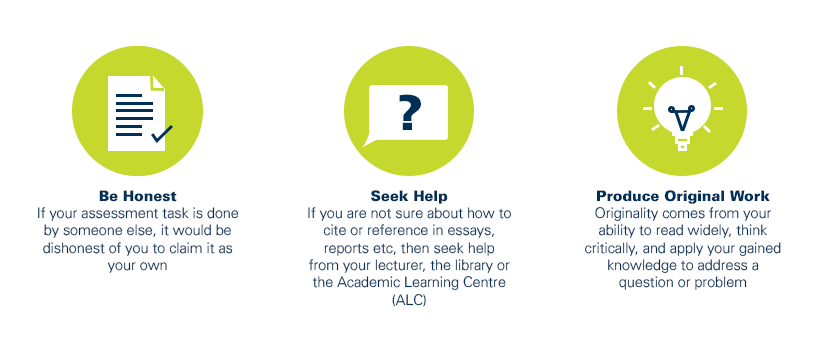
As a CQUniversity student you are expected to act honestly in all aspects of your academic work.
Any assessable work undertaken or submitted for review or assessment must be your own work. Assessable work is any type of work you do to meet the assessment requirements in the unit, including draft work submitted for review and feedback and final work to be assessed.
When you use the ideas, words or data of others in your assessment, you must thoroughly and clearly acknowledge the source of this information by using the correct referencing style for your unit. Using others’ work without proper acknowledgement may be considered a form of intellectual dishonesty.
Participating honestly, respectfully, responsibly, and fairly in your university study ensures the CQUniversity qualification you earn will be valued as a true indication of your individual academic achievement and will continue to receive the respect and recognition it deserves.
As a student, you are responsible for reading and following CQUniversity’s policies, including the Student Academic Integrity Policy and Procedure. This policy sets out CQUniversity’s expectations of you to act with integrity, examples of academic integrity breaches to avoid, the processes used to address alleged breaches of academic integrity, and potential penalties.
What is a breach of academic integrity?
A breach of academic integrity includes but is not limited to plagiarism, self-plagiarism, collusion, cheating, contract cheating, and academic misconduct. The Student Academic Integrity Policy and Procedure defines what these terms mean and gives examples.
Why is academic integrity important?
A breach of academic integrity may result in one or more penalties, including suspension or even expulsion from the University. It can also have negative implications for student visas and future enrolment at CQUniversity or elsewhere. Students who engage in contract cheating also risk being blackmailed by contract cheating services.
Where can I get assistance?
For academic advice and guidance, the Academic Learning Centre (ALC) can support you in becoming confident in completing assessments with integrity and of high standard.
What can you do to act with integrity?