Overview
On successful completion of this unit, you will have a sound understanding of the fundamental principles and concepts of physical and chemical sciences, with particular reference to applied science, health and safety. You will be able to use appropriate scientific units and notation, and explain the chemical principles relating to atoms, molecules, biomolecules, solutions, pH and chemical reactions. You will apply the physical principles associated with the behaviour of gases, electromagnetic radiation, sound, motion and forces to solve problems relevant to the workplace. You will also study aspects of science relevant to your specific discipline.
Details
Pre-requisites or Co-requisites
There are no requisites for this unit.
Important note: Students enrolled in a subsequent unit who failed their pre-requisite unit, should drop the subsequent unit before the census date or within 10 working days of Fail grade notification. Students who do not drop the unit in this timeframe cannot later drop the unit without academic and financial liability. See details in the Assessment Policy and Procedure (Higher Education Coursework).
Offerings For Term 1 - 2026
Attendance Requirements
All on-campus students are expected to attend scheduled classes - in some units, these classes are identified as a mandatory (pass/fail) component and attendance is compulsory. International students, on a student visa, must maintain a full time study load and meet both attendance and academic progress requirements in each study period (satisfactory attendance for International students is defined as maintaining at least an 80% attendance record).
Recommended Student Time Commitment
Each 6-credit Undergraduate unit at CQUniversity requires an overall time commitment of an average of 12.5 hours of study per week, making a total of 150 hours for the unit.
Class Timetable
Assessment Overview
Assessment Grading
This is a graded unit: your overall grade will be calculated from the marks or grades for each assessment task, based on the relative weightings shown in the table above. You must obtain an overall mark for the unit of at least 50%, or an overall grade of 'pass' in order to pass the unit. If any 'pass/fail' tasks are shown in the table above they must also be completed successfully ('pass' grade). You must also meet any minimum mark requirements specified for a particular assessment task, as detailed in the 'assessment task' section (note that in some instances, the minimum mark for a task may be greater than 50%). Consult the University's Grades and Results Policy for more details of interim results and final grades.
All University policies are available on the CQUniversity Policy site.
You may wish to view these policies:
- Grades and Results Policy
- Assessment Policy and Procedure (Higher Education Coursework)
- Review of Grade Procedure
- Student Academic Integrity Policy and Procedure
- Academic Progression Policy and Procedure
- Student Refund and Credit Balance Policy and Procedure
- Complaints Policy and Procedure
- Information and Communications Technology Acceptable Use Policy and Procedure
This list is not an exhaustive list of all University policies. The full list of University policies are available on the CQUniversity Policy site.
Feedback, Recommendations and Responses
Every unit is reviewed for enhancement each year. At the most recent review, the following staff and student feedback items were identified and recommendations were made.
Feedback from SUTE and Personal Reflection
The relevance of this unit, and the usefulness of the knowledge and skills gained, to Public Health and Occupational Health, and Safety should be clearly demonstrated.
The Case Study assessment should be aligned with the specific courses students are enrolled in to ensure relevance and meaningful application.
- Explain the basic chemical principles relating to atoms and molecules, solutions, pH, chemical bonding and reactions with particular reference to applied health
- Apply the concepts of scientific measurement to the presentation of quantitative data and use appropriate scientific units and scientific and logarithmic notation
- Explain the basic physical principles associated with the behaviour of gases, electromagnetic radiation and sound with particular reference to applied health
- Apply the principles of motion and forces in the context of applied health and safety
- Explain introductory scientific principles pertaining to your area of specialisation with either a physics or environmental focus.
Alignment of Assessment Tasks to Learning Outcomes
| Assessment Tasks | Learning Outcomes | ||||
|---|---|---|---|---|---|
| 1 | 2 | 3 | 4 | 5 | |
| 1 - Online discussion forum - 20% | |||||
| 2 - Presentation - 30% | |||||
| 3 - Case Study - 50% | |||||
Alignment of Graduate Attributes to Learning Outcomes
| Graduate Attributes | Learning Outcomes | ||||
|---|---|---|---|---|---|
| 1 | 2 | 3 | 4 | 5 | |
| 1 - Communication | |||||
| 2 - Problem Solving | |||||
| 3 - Critical Thinking | |||||
| 4 - Information Literacy | |||||
| 5 - Team Work | |||||
| 6 - Information Technology Competence | |||||
| 7 - Cross Cultural Competence | |||||
| 8 - Ethical practice | |||||
| 9 - Social Innovation | |||||
| 10 - First Nations Knowledges | |||||
| 11 - Aboriginal and Torres Strait Islander Cultures | |||||
Textbooks
There are no required textbooks.
Additional Textbook Information
None
IT Resources
- CQUniversity Student Email
- Internet
- Unit Website (Moodle)
All submissions for this unit must use the referencing styles below:
For further information, see the Assessment Tasks.
n.english@cqu.edu.au
Week 1
Begin Date: 09 Mar 2026Module/Topic
Matter: elements and atomic structure
Chapter
Module 1
Events and Submissions/Topic
Assesment 1: Week 1 Online Discussion Forum Post and comment due Sunday 11:59PM AEST
Week 2
Begin Date: 16 Mar 2026Module/Topic
Compounds: molecules and chemical bonds
Chapter
Module 2
Events and Submissions/Topic
Assesment 1: Week 2 Online Discussion Forum Post and comment due Sunday 11:59PM AEST
Week 3
Begin Date: 23 Mar 2026Module/Topic
Presenting data: numbers, units and graphs
Chapter
Module 3
Events and Submissions/Topic
Assesment 1: Week 3 Online Discussion Forum Post and comment due Sunday 11:59PM AEST
Week 4
Begin Date: 30 Mar 2026Module/Topic
Solutions: composition and concentrations
Chapter
Module 4
Events and Submissions/Topic
Assesment 1: Week 4 Online Discussion Forum Post and comment due Sunday 11:59PM AEST
Week 5
Begin Date: 06 Apr 2026Module/Topic
Electrolytes, acids, bases and buffers
Chapter
Module 5
Events and Submissions/Topic
Assesment 1: Week 5 Online Discussion Forum Post and comment due Sunday 11:59PM AEST
Sign up for a Week 11 Presentation time on Moodle. The link can be found with Assessment 2 in the Assessment tile on Moodle.
Week 6
Begin Date: 13 Apr 2026Module/Topic
An introduction to organic chemistry and biomolecules
Chapter
Module 6
Events and Submissions/Topic
Sign up for a Week 11 Presentation time on Moodle. The link can be found with Assessment 2 in the Assessment tile on Moodle.
Vacation Week
Begin Date: 20 Apr 2026Module/Topic
Chapter
Events and Submissions/Topic
Week 7
Begin Date: 27 Apr 2026Module/Topic
Gases and the respiratory system
Chapter
Module 7
Events and Submissions/Topic
Week 8
Begin Date: 04 May 2026Module/Topic
Waves, sight and sounds, and nuclear radiation
Chapter
Module 8
Events and Submissions/Topic
Week 9
Begin Date: 11 May 2026Module/Topic
Motion kinematics
Chapter
Module 9
Events and Submissions/Topic
Week 10
Begin Date: 18 May 2026Module/Topic
Forces and motion
Chapter
Module 10
Events and Submissions/Topic
Week 11
Begin Date: 25 May 2026Module/Topic
Option A: Work, energy and momentum
Option B: Climate, weather, and the water and carbon cycles
Chapter
Module 11A or Module 11B
Events and Submissions/Topic
Assessment 2: Presentation As scheduled in Moodle. It is your responsibility to secure a presentation time on Moodle. The link can be found with Assessment 2 in the Assessment tile on Moodle.
Week 12
Begin Date: 01 Jun 2026Module/Topic
Option A: Electricity
Option B: Geology and erosion
Chapter
Module 12A or Module 12B
Events and Submissions/Topic
Exam Week
Begin Date: 08 Jun 2026Module/Topic
Chapter
Events and Submissions/Topic
Vacation/Exam Week
Begin Date: 15 Jun 2026Module/Topic
Chapter
Events and Submissions/Topic
1 Online discussion forum
This assessment requires you to participate in online group discussions during Weeks 1 to 5 of the term. A Discussion Board will be set up on Moodle for this task. The Unit Coordinator will post the weekly discussion topic or question on the Discussion Board on the Monday of each week. You are required to contribute to the discussion by the end of that week (Sunday). You must respond to the topic or question posed by the Unit Coordinator with 1 post and also respectfully comment on at least 1 post by another student. Your comment must be substantive, positive or constructive and adhere to the CQUniversity Code of Conduct. Other posts will not be visible until you have posted your own post.
The word limit for each post or comment is 200 words (±10%).
Level of GenAI use allowed will vary between Level 1 and Level 4 by question based on content, please be aware of what you can and can't do. Look for the "Level of GenAI use Allowed" tag on each question.
The 72 hour grace period does not apply to any portion of this assessment.
Your responses to each Online Discussion Forum (ODF) question will be due by Sunday, 11:59PM AEST (i.e. one week to complete each task)
Assessment Criteria:
A minimum of 1 post and 1 reply per week, resulting in a total of ten (10) interactions over the five-week period, must be submitted on the Moodle Discussion Board and:
- Each post is no more than 200±10% words long;
- Each post is relevant to the question asked or weekly topic of discussion;
- Each post is factually correct and written with very few spelling or grammatical errors;
- Each reply to other posts is substantive, positive or constructive and delivered in a professional manner in line with the CQUniversity Code of Conduct.
- Explain the basic chemical principles relating to atoms and molecules, solutions, pH, chemical bonding and reactions with particular reference to applied health
- Apply the concepts of scientific measurement to the presentation of quantitative data and use appropriate scientific units and scientific and logarithmic notation
2 Presentation
Your task is to explain a basic concept of physics or chemistry presented in Week 6 to Week 10 to the unit coordinator on Zoom. You will choose which concept to teach from the list provided on Moodle. The 3-minute live presentation will be delivered to the unit coordinator with 2 minutes for questions drawn from a question bank and responses. We strongly suggest you practice your presentation with others before you deliver it live online. The presentation schedule will be available on moodle.
It is your responsibility to secure a scheduled presentation time using the presentation schedule link on moodle. Students who do not schedule a time slot will not be marked and fail the assessment.
The 72-hour Grace period does not apply.
Level of GenAI use allowed:
Level 2: You may use Al for planning, idea development, and research. Your final submission should show how you have developed and refined these ideas.
Sign up for a Week 11 Presentation time on Moodle. The link can be found with Assessment 2 in the Assessment tile on Moodle.
Week 12 Monday (1 June 2026)
The following criteria will be used to mark your assessment:
- The content is what was selected and is taught correctly and the student is the presenter.
- The content must not be read from a screen or paper script (eye contact with the camera, don't put a script behind the camera...).
- The response to the question is prompt and correct (you will not have time to look up the answer).
- The student has followed the instructions for video presentation (student's face is clearly visible, blank/unobtrusive background, control of the space, professional dress and sound quality).
- Apply the concepts of scientific measurement to the presentation of quantitative data and use appropriate scientific units and scientific and logarithmic notation
- Explain the basic physical principles associated with the behaviour of gases, electromagnetic radiation and sound with particular reference to applied health
- Apply the principles of motion and forces in the context of applied health and safety
3 Case Study
Author a report on the case study of your choice, either Option A or Option B, using the Assessment Brief in each module and learning materials from Week 11 and 12. Your report must be less than 800 words ±10% not including figures, tables, equations and citations. You must include at least one correctly referenced scientific journal article including a linked Digital Object Identifier (doi).
Once your case study is complete, you must create a 5-minute video discussing your authorship of the case study, including:
- What you learned authoring the case study (a surprising fact, interesting trivia, etc.);
- How you would change the way you created the report if you had to do it again (you can include how you might use GenAI or not for example);
- What was most difficult about completing the case study;
- Did the case study help you to better understand the topics? If not, what would you change?
These answers should reflect the assessment brief study and should not be scripted. More detail on the case studies, the reflective presentation and marking criteria will be available on Moodle.
Level of GenAI use allowed:
Level 2: You may use Al for planning, idea development, and research. You are permitted to use Generative Artificial Intelligence (Gen AI) models as supplementary or complementary resources to aid your learning and idea development in this unit. However, assessments must be written in your own words. Any ideas or text obtained using Gen AI or other sources must be paraphrased and referenced accordingly. Guidelines for referencing Gen AI in your assessments can be accessed via the link: https://delivery-cqucontenthub.stylelabs.cloud/api/public/content/Guidelines_referencing_Artificial_Intelligence?v=7f19c75d. Your final submission should show how you have developed and refined these ideas by attaching the Assessment AI Declaration with your submission.
Week 12 Friday (5 June 2026) 11:59 pm AEST
Vacation/Exam Week Friday (19 June 2026)
Written Case Study (60% of Assessment 3)
- Communication and organisation
- Correct quantitative scientific and technical facts
- Completion of the entire assessment brief
- Publication quality equations, tables and figures
- Correct citation of at least one scientific journal article including doi
Case Study Reflective Recording (40% of Assessment 3)
- Addresses all four topics
- Within the 5-minute time limit
- Answers consistent with the case study submitted by the student and are of sufficient detail to indicate the student's familiarity with the case study.
- The student has followed the instructions for video presentations (student's face is clearly visible, blank/unobtrusive background, control of the space, professional dress and sound quality).
- Explain the basic physical principles associated with the behaviour of gases, electromagnetic radiation and sound with particular reference to applied health
- Apply the principles of motion and forces in the context of applied health and safety
- Explain introductory scientific principles pertaining to your area of specialisation with either a physics or environmental focus.
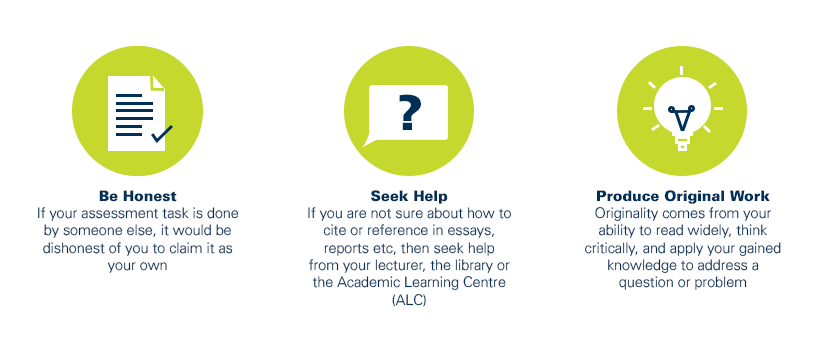
As a CQUniversity student you are expected to act honestly in all aspects of your academic work.
Any assessable work undertaken or submitted for review or assessment must be your own work. Assessable work is any type of work you do to meet the assessment requirements in the unit, including draft work submitted for review and feedback and final work to be assessed.
When you use the ideas, words or data of others in your assessment, you must thoroughly and clearly acknowledge the source of this information by using the correct referencing style for your unit. Using others’ work without proper acknowledgement may be considered a form of intellectual dishonesty.
Participating honestly, respectfully, responsibly, and fairly in your university study ensures the CQUniversity qualification you earn will be valued as a true indication of your individual academic achievement and will continue to receive the respect and recognition it deserves.
As a student, you are responsible for reading and following CQUniversity’s policies, including the Student Academic Integrity Policy and Procedure. This policy sets out CQUniversity’s expectations of you to act with integrity, examples of academic integrity breaches to avoid, the processes used to address alleged breaches of academic integrity, and potential penalties.
What is a breach of academic integrity?
A breach of academic integrity includes but is not limited to plagiarism, self-plagiarism, collusion, cheating, contract cheating, and academic misconduct. The Student Academic Integrity Policy and Procedure defines what these terms mean and gives examples.
Why is academic integrity important?
A breach of academic integrity may result in one or more penalties, including suspension or even expulsion from the University. It can also have negative implications for student visas and future enrolment at CQUniversity or elsewhere. Students who engage in contract cheating also risk being blackmailed by contract cheating services.
Where can I get assistance?
For academic advice and guidance, the Academic Learning Centre (ALC) can support you in becoming confident in completing assessments with integrity and of high standard.
What can you do to act with integrity?