Overview
This unit forms the capstone project of the Master of Clinical Psychology and Master of Clinical Psychology (Advanced Entry) courses. In this unit, you will conduct a clinical psychology project in which you will engage a community-based partner to conduct a project. The project may involve research or an intervention to be evaluated. You will design and conduct the project, evaluate the project by collecting relevant data, and produce a written report of your project and evaluation.
Details
Pre-requisites or Co-requisites
There are no requisites for this unit.
Important note: Students enrolled in a subsequent unit who failed their pre-requisite unit, should drop the subsequent unit before the census date or within 10 working days of Fail grade notification. Students who do not drop the unit in this timeframe cannot later drop the unit without academic and financial liability. See details in the Assessment Policy and Procedure (Higher Education Coursework).
Offerings For Term 2 - 2026
Attendance Requirements
All on-campus students are expected to attend scheduled classes - in some units, these classes are identified as a mandatory (pass/fail) component and attendance is compulsory. International students, on a student visa, must maintain a full time study load and meet both attendance and academic progress requirements in each study period (satisfactory attendance for International students is defined as maintaining at least an 80% attendance record).
Recommended Student Time Commitment
Each 12-credit Postgraduate unit at CQUniversity requires an overall time commitment of an average of 25 hours of study per week, making a total of 300 hours for the unit.
Class Timetable
Assessment Overview
Assessment Grading
This is a pass/fail (non-graded) unit. To pass the unit, you must pass all of the individual assessment tasks shown in the table above.
All University policies are available on the CQUniversity Policy site.
You may wish to view these policies:
- Grades and Results Policy
- Assessment Policy and Procedure (Higher Education Coursework)
- Review of Grade Procedure
- Student Academic Integrity Policy and Procedure
- Academic Progression Policy and Procedure
- Student Refund and Credit Balance Policy and Procedure
- Complaints Policy and Procedure
- Information and Communications Technology Acceptable Use Policy and Procedure
This list is not an exhaustive list of all University policies. The full list of University policies are available on the CQUniversity Policy site.
Feedback, Recommendations and Responses
Every unit is reviewed for enhancement each year. At the most recent review, the following staff and student feedback items were identified and recommendations were made.
Feedback from Student feedback (in-class).
Students appreciated the resources provided on the Moodle site that supported each stage of their community engagement project.
Maintain and continue to improve the Moodle site to ensure comprehensive, well-organised resources are available for all components of the project.
Feedback from Student feedback (in-class).
Some students expressed concern about presenting multiple sessions as part of their community engagement project, particularly the need to design new resources for each session.
Work closely with students to help them structure their projects and timelines in a way that best fits their community partner setting. Encourage the use of existing resources where appropriate, while supporting the development of new materials when necessary.
- Apply advanced knowledge and skills professionally, ethically, and in a culturally appropriate manner, to design and complete a community-based project that is applicable to clinical psychology.
- Apply assessment and evaluation skills to clinical problems including the acquisition and interpretation of data to inform practice in clinical psychology.
- Communicate project evaluation findings professionally, ethically, and in a culturally appropriate manner fit for a range of audiences.
Alignment of Assessment Tasks to Learning Outcomes
| Assessment Tasks | Learning Outcomes | ||
|---|---|---|---|
| 1 | 2 | 3 | |
| 1 - Research Proposal - 0% | |||
| 2 - Report - 0% | |||
Alignment of Graduate Attributes to Learning Outcomes
| Graduate Attributes | Learning Outcomes | ||
|---|---|---|---|
| 1 | 2 | 3 | |
| 1 - Knowledge | |||
| 2 - Communication | |||
| 3 - Cognitive, technical and creative skills | |||
| 4 - Research | |||
| 5 - Self-management | |||
| 6 - Ethical and Professional Responsibility | |||
| 7 - Leadership | |||
| 8 - First Nations Knowledges | |||
| 9 - Aboriginal and Torres Strait Islander Cultures | |||
Textbooks
There are no required textbooks.
Additional Textbook Information
There are no required textbooks for this unit. All readings and learning resources will be provided through CQU Library holdings and will be listed on the Moodle site.
IT Resources
- CQUniversity Student Email
- Internet
- Unit Website (Moodle)
All submissions for this unit must use the referencing style: American Psychological Association 7th Edition (APA 7th edition)
For further information, see the Assessment Tasks.
a.gerace@cqu.edu.au
Week 1
Begin Date: 13 Jul 2026Module/Topic
Overview and Project Planning
Chapter
Please see selected readings and activities on Moodle
Events and Submissions/Topic
Zoom Tutorial: Week 1 Friday (17 July 2026) 10:00 am-12:00 pm AEST
Week 2
Begin Date: 20 Jul 2026Module/Topic
Initial Brainstorming and Partner Engagement
Chapter
Please see selected readings and activities on Moodle
Events and Submissions/Topic
Week 3
Begin Date: 27 Jul 2026Module/Topic
Proposal Development: Literature Review and Project Design
Chapter
Please see selected readings and activities on Moodle
Events and Submissions/Topic
Zoom Tutorial: Week 3 Friday (31 July, 2026) 10:00 am-12:00 pm AEST
Week 4
Begin Date: 03 Aug 2026Module/Topic
Proposal Development: Project Design
Chapter
Please see selected readings and activities on Moodle
Events and Submissions/Topic
Assessment 1
Project Proposal Due: Week 4 Friday (7 Aug 2026) 5:00 pm AEST
Week 5
Begin Date: 10 Aug 2026Module/Topic
Finalise Project Design and Approvals
Chapter
Please see selected readings and activities on Moodle
Events and Submissions/Topic
Zoom Tutorial: Week 5 Friday (14 August, 2026) 10:00 am-12:00 pm AEST
Week 6
Begin Date: 17 Aug 2026Module/Topic
Project Implementation
Chapter
Please see selected readings and activities on Moodle
Events and Submissions/Topic
Assessment 2: Part A Project Approval
Due: Week 6 Friday (21 Aug 2026) 5:00 pm AEST
Vacation Week
Begin Date: 24 Aug 2026Module/Topic
Project Implementation
Chapter
Please see selected readings and activities on Moodle
Events and Submissions/Topic
Week 7
Begin Date: 31 Aug 2026Module/Topic
Project Implementation
Chapter
Please see selected readings and activities on Moodle
Events and Submissions/Topic
Zoom Tutorial: Week 7 Friday (4 September, 2026) 10:00 am-12:00 pm AEST
Week 8
Begin Date: 07 Sep 2026Module/Topic
Project Implementation
Chapter
Please see selected readings and activities on Moodle
Events and Submissions/Topic
Week 9
Begin Date: 14 Sep 2026Module/Topic
Project Implementation
Chapter
Please see selected readings and activities on Moodle
Events and Submissions/Topic
Zoom Tutorial: Week 9 Friday (18 September, 2026) 10:00 am -12:00 pm AEST
Week 10
Begin Date: 21 Sep 2026Module/Topic
Data Analysis and Report Writing
Chapter
Please see selected readings and activities on Moodle
Events and Submissions/Topic
Week 11
Begin Date: 28 Sep 2026Module/Topic
Data Analysis and Report Writing
Chapter
Please see selected readings and activities on Moodle
Events and Submissions/Topic
Zoom Tutorial: Week 11 Friday (2 October, 2026) 10:00 am-12:00 pm AEST
Week 12
Begin Date: 05 Oct 2026Module/Topic
Finalise Report
Chapter
Please see selected readings and activities on Moodle
Events and Submissions/Topic
Assessment 2: Part B
Report Due: Week 12 Friday (9 Oct 2026) 5:00 pm AEST
Exam Week
Begin Date: 12 Oct 2026Module/Topic
There are no examinations for this unit
Chapter
Events and Submissions/Topic
Vacation/Exam Week
Begin Date: 19 Oct 2026Module/Topic
Chapter
Events and Submissions/Topic
1 Research Proposal
For this assessment, you must complete a proposal for a community-based clinical psychology engagement and evaluation project.
The proposal is a detailed plan outlining the design, implementation, and evaluation of your project. Your proposal must include:
- An overview of the topic or area of focus, including a clear justification for why the identified practice issue or need is important to address
- Discussion of relevant theory and prior research informing the project, including consideration of psychological disorders, biopsychosocial factors, and factors influencing mental health across the lifespan where relevant to the project
- Research question(s)
- Proposed methods, including identification and role of the community partner, and how the project design (e.g., activity/intervention and evaluation components) is informed by relevant clinical psychology knowledge
- Consideration of ethical obligations
- Consideration of cultural factors, including how culturally responsive and culturally safe practice will be incorporated into the project design, appropriate to the context (e.g., client group, service setting, or workforce).
- A Gantt chart outlining project tasks and timelines.
Maximum word count: 2000 words (+/- 10%). This word limit includes in-text citations but excludes any reference section, tables, or appendices.
Further task details for the project proposal will be available on the unit Moodle site.
Level of GenAI use allowed:
Level 2: You may use AI for planning, idea development, and research. Your final submission should show how you have developed and refined these ideas.
Please refer to the unit Moodle site for further details on permissible uses of generative AI tools for this assessment task.
Week 4 Friday (7 Aug 2026) 5:00 pm AEST
Week 6 Friday (21 Aug 2026)
Feedback and grade for this assessment will be provided within 2 weeks of submission.
This is a non-graded Pass/Fail assessment. If a pass is not achieved, you will have one (1) opportunity to resubmit.
You will be assessed on:
- A clear rationale and theoretical/research background demonstrating the need for the project
- Discussion of proposed project partners, including details of services or organisations involved and how permissions will be sought and documented
- Formulation of proposed methods, including setting, participants, proposed activities or interventions, and how these are informed by relevant clinical psychology knowledge
- Formulation of an evaluation plan, including measures to be used and how data will be analysed
- Consideration of ethical issues
- Consideration of cultural factors, including how culturally responsive and culturally safe practice is incorporated into the project design, delivery, and evaluation
- A project timeline for project tasks (Gantt chart)
- Quality of written communication, including correct APA referencing and adherence to word count.
- Your use of appropriate, peer-reviewed, and reputable sources will be assessed across all criteria.
Written approval from the community partner is required and is assessed as part of Assessment 2.
Detailed information regarding assessment requirements and criteria can be found on Moodle.
- Apply advanced knowledge and skills professionally, ethically, and in a culturally appropriate manner, to design and complete a community-based project that is applicable to clinical psychology.
- Apply assessment and evaluation skills to clinical problems including the acquisition and interpretation of data to inform practice in clinical psychology.
2 Report
For this assessment, you are required to complete a written report for your community-based clinical psychology engagement and evaluation project.
This assessment comprises two parts.
Part A: Project Approval
You must obtain and upload written approval from your community partner, confirming agreement to the project.
Approval must:
- confirm that the project has been discussed and agreed in principle with the partner
- indicate that the proposed activities are appropriate to proceed
- be obtained prior to commencing substantive project work
Part B: Final Project Report
You will submit a written report documenting the undertaking, outcomes, and evaluation of your project.
Your report must include:
- Discussion of the topic or area of focus, including the practice issue or need that guided the project
- Discussion of the underlying theory and prior research used to inform the project aims, including consideration of psychological disorders, biopsychosocial factors, and factors influencing mental health across the lifespan where relevant
- Description of the methods, including participants, activity/intervention, procedures, and evaluation measures, and how these are informed by relevant clinical psychology knowledge
- Presentation and analysis of data gathered to evaluate the project
- Discussion of findings, including how results can be interpreted in relation to previous research and implications for future research, service delivery, and clinical practice where relevant
- Consideration of reflective practice, including what went well, what could be improved, and what you learned through undertaking the project
- Copies of the activity/intervention and evaluation measures.
Cultural responsiveness should be demonstrated throughout the project and should reflect consideration of diversity, context, and service settings relevant to the project.
Maximum word count 4000 (+/- 10%) words. This word limit includes in-text citations but excludes any reference section, tables, or appendices.
Further task details for the project report will be available on the unit Moodle site.
Level of GenAI use allowed:
Level 2: You may use AI for planning, idea development, and research. Your final submission should show how you have developed and refined these ideas.
Please refer to the unit Moodle site for further details on permissible uses of generative-AI tools for this assessment task.
Week 12 Friday (9 Oct 2026) 5:00 pm AEST
Part A is due by Week 6 Friday 21 August 2026 at 5PM. Part B is due Week 12 Friday 9 October 2026.
Vacation/Exam Week Monday (19 Oct 2026)
Feedback and grade for this assessment will be provided within 2 weeks of submission.
This is a non-graded Pass/Fail assessment item.
If the required standard is not achieved, you will have one (1) opportunity to revise and resubmit Part B (the final report).
You will be assessed on:
- A clear rationale and theoretical/research background for the project
- Discussion of the methods, including the setting, participants, activities/intervention, implementation, involvement of the project partner, and how these are informed by relevant clinical psychology knowledge
- Consideration of ethical issues
- Demonstration of culturally responsive practice, including how cultural context was considered and addressed across the project's design, delivery, evaluation, and reflection, appropriate to the project setting, including reflection on how cultural factors influenced project decisions or outcomes
- Application of clinical psychology knowledge across project design, implementation, and evaluation
- Evaluation of the project, including presentation and analysis of collected data and interpretation of outcomes using psychological or clinical reasoning where relevant
- Interpretation of findings in relation to previous research, and implications for future research and practice
- Consideration of reflective practice, including what went well, what could be improved, and what was learned through planning and undertaking the project
- Quality of written communication, including correct APA referencing and adherence to word count.
Your use of appropriate, peer‑reviewed, and reputable sources will be assessed across all criteria.
You are also required to upload a copy of your raw data and associated data files used in the evaluation of your project.
Detailed information regarding assessment requirements and criteria for assessment can be found on Moodle.
- Apply advanced knowledge and skills professionally, ethically, and in a culturally appropriate manner, to design and complete a community-based project that is applicable to clinical psychology.
- Apply assessment and evaluation skills to clinical problems including the acquisition and interpretation of data to inform practice in clinical psychology.
- Communicate project evaluation findings professionally, ethically, and in a culturally appropriate manner fit for a range of audiences.
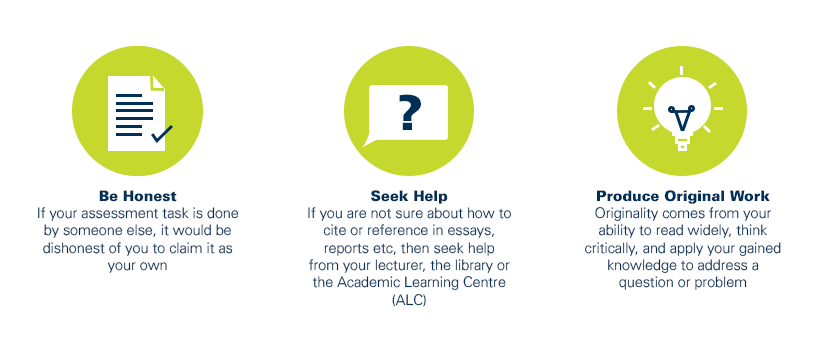
As a CQUniversity student you are expected to act honestly in all aspects of your academic work.
Any assessable work undertaken or submitted for review or assessment must be your own work. Assessable work is any type of work you do to meet the assessment requirements in the unit, including draft work submitted for review and feedback and final work to be assessed.
When you use the ideas, words or data of others in your assessment, you must thoroughly and clearly acknowledge the source of this information by using the correct referencing style for your unit. Using others’ work without proper acknowledgement may be considered a form of intellectual dishonesty.
Participating honestly, respectfully, responsibly, and fairly in your university study ensures the CQUniversity qualification you earn will be valued as a true indication of your individual academic achievement and will continue to receive the respect and recognition it deserves.
As a student, you are responsible for reading and following CQUniversity’s policies, including the Student Academic Integrity Policy and Procedure. This policy sets out CQUniversity’s expectations of you to act with integrity, examples of academic integrity breaches to avoid, the processes used to address alleged breaches of academic integrity, and potential penalties.
What is a breach of academic integrity?
A breach of academic integrity includes but is not limited to plagiarism, self-plagiarism, collusion, cheating, contract cheating, and academic misconduct. The Student Academic Integrity Policy and Procedure defines what these terms mean and gives examples.
Why is academic integrity important?
A breach of academic integrity may result in one or more penalties, including suspension or even expulsion from the University. It can also have negative implications for student visas and future enrolment at CQUniversity or elsewhere. Students who engage in contract cheating also risk being blackmailed by contract cheating services.
Where can I get assistance?
For academic advice and guidance, the Academic Learning Centre (ALC) can support you in becoming confident in completing assessments with integrity and of high standard.
What can you do to act with integrity?