Overview
This unit will introduce you to the principles, processes, applications, and issues pertaining to the development and use of psychological assessment. This unit is presented through a number of themes, covering topics such as origins, ethics and uses of psychological testing; testing in adults, children and vulnerable populations; neuropsychological testing and testing for industry and career development. The psychometric basis of psychological assessment and testing is emphasised. You will focus on a variety of common psychological procedures and tests measuring individual differences. Consideration of individual differences and assessment in an Australian context will be a key component of your studies in this unit.
Details
Pre-requisites or Co-requisites
96 credit points in CC43, CF59, CL51, CL55, CM62, CC13, CG85, CG93 or CA10, OR admission to CC10 and completion of PSYC11010.
Important note: Students enrolled in a subsequent unit who failed their pre-requisite unit, should drop the subsequent unit before the census date or within 10 working days of Fail grade notification. Students who do not drop the unit in this timeframe cannot later drop the unit without academic and financial liability. See details in the Assessment Policy and Procedure (Higher Education Coursework).
Offerings For Term 2 - 2026
Attendance Requirements
All on-campus students are expected to attend scheduled classes - in some units, these classes are identified as a mandatory (pass/fail) component and attendance is compulsory. International students, on a student visa, must maintain a full time study load and meet both attendance and academic progress requirements in each study period (satisfactory attendance for International students is defined as maintaining at least an 80% attendance record).
Recommended Student Time Commitment
Each 6-credit Undergraduate unit at CQUniversity requires an overall time commitment of an average of 12.5 hours of study per week, making a total of 150 hours for the unit.
Class Timetable
Assessment Overview
Assessment Grading
This is a graded unit: your overall grade will be calculated from the marks or grades for each assessment task, based on the relative weightings shown in the table above. You must obtain an overall mark for the unit of at least 50%, or an overall grade of 'pass' in order to pass the unit. If any 'pass/fail' tasks are shown in the table above they must also be completed successfully ('pass' grade). You must also meet any minimum mark requirements specified for a particular assessment task, as detailed in the 'assessment task' section (note that in some instances, the minimum mark for a task may be greater than 50%). Consult the University's Grades and Results Policy for more details of interim results and final grades.
All University policies are available on the CQUniversity Policy site.
You may wish to view these policies:
- Grades and Results Policy
- Assessment Policy and Procedure (Higher Education Coursework)
- Review of Grade Procedure
- Student Academic Integrity Policy and Procedure
- Academic Progression Policy and Procedure
- Student Refund and Credit Balance Policy and Procedure
- Complaints Policy and Procedure
- Information and Communications Technology Acceptable Use Policy and Procedure
This list is not an exhaustive list of all University policies. The full list of University policies are available on the CQUniversity Policy site.
Feedback, Recommendations and Responses
Every unit is reviewed for enhancement each year. At the most recent review, the following staff and student feedback items were identified and recommendations were made.
Feedback from Marker feedback on student assessments.
Some students experience difficulty critically comparing psychometric properties of psychological tests.
Further integration of explicit instruction and practice in critically comparing psychometric properties is recommended within live workshops.
Feedback from Student evaluation qualitative responses; Unit Coordinator
The blended delivery format, combining pre-recorded lectures with live workshops, supports flexible access to content while providing opportunities for interaction, clarification, and applied learning.
Continue the blended delivery format combining pre-recorded lectures with live workshops.
- Articulate the purposes and principles of psychological assessment and testing
- Identify and articulate the knowledge of test construction processes and basic statistics to develop and validate a test of a psychological construct
- Apply knowledge of psychometric principles to evaluate the reliability, validity and other relevant features of psychological assessment processes and tests
- Locate and use professional standards, ethical codes and sources of information relevant to developers and users of psychological assessments and tests, including First Nations Peoples
This unit addresses Foundational Competencies as specified by the Australian Psychology Accreditation Council (APAC) (2025) standards and specifically aligns to:
1.1 Comprehend and apply a broad and coherent body of knowledge of psychology, with depth of understanding of underlying principles, theories and concepts in the discipline, using a scientific approach, including the following topics:
(i) the history and philosophy underpinning the science of psychology and the social, cultural, historical and professional influences on the practice of psychology
(ii) critical thinking and identification of bias to promote inclusivity
(iii) psychological health and well-being
(iv) psychological disorders and evidence-based interventions
(v) learning and memory
(vi) cognition, language and perception
(xi) culturally appropriate psychological assessment and measurement
(xii) research methods and statistics.
1.2 Apply knowledge and skills of psychology in a manner that is reflexive, culturally appropriate and sensitive to the diversity of individuals.
1.3 Analyse and critique theory and research in the discipline of psychology and communicate these in written and oral formats.
1.4 Demonstrate an understanding of appropriate values and ethics in psychology including those relevant to professional conduct (for example, the PsyBA Code of conduct for psychologists)
1.5 Demonstrate interpersonal skills and teamwork, including, including establishing and maintaining respectful and culturally safe working relationships with others
Alignment of Assessment Tasks to Learning Outcomes
| Assessment Tasks | Learning Outcomes | |||
|---|---|---|---|---|
| 1 | 2 | 3 | 4 | |
| 1 - Online Quiz(zes) - 20% | ||||
| 2 - Written Assessment - 45% | ||||
| 3 - Presentation - 35% | ||||
Alignment of Graduate Attributes to Learning Outcomes
| Graduate Attributes | Learning Outcomes | |||
|---|---|---|---|---|
| 1 | 2 | 3 | 4 | |
| 1 - Communication | ||||
| 2 - Problem Solving | ||||
| 3 - Critical Thinking | ||||
| 4 - Information Literacy | ||||
| 5 - Team Work | ||||
| 6 - Information Technology Competence | ||||
| 7 - Cross Cultural Competence | ||||
| 8 - Ethical practice | ||||
| 9 - Social Innovation | ||||
| 10 - First Nations Knowledges | ||||
| 11 - Aboriginal and Torres Strait Islander Cultures | ||||
Textbooks
Psychological testing and assessment
- 3rd Edition (2017)
- Authors: David Shum, John O'Gorman, Peter Creed, Brett Myors
- Oxford University Press
- Melbourne Melbourne , Victoria , Australia
- ISBN: 9780190305208
This textbook is available in hard copy and eBook versions.
- Binding: Paperback
Publication Manual of the American Psychological Association (APA)
- 7th Edition (2019)
- Authors: American Psychological Association
- American Psychological Association
- Washington Washington , DC , USA
- ISBN: 9781433832161
- Binding: Paperback
IT Resources
- CQUniversity Student Email
- Internet
- Unit Website (Moodle)
- Zoom (both microphone and webcam capability)
All submissions for this unit must use the referencing style: American Psychological Association 7th Edition (APA 7th edition)
For further information, see the Assessment Tasks.
c.clarke2@cqu.edu.au
Week 1
Begin Date: 13 Jul 2026Module/Topic
Introduction to Psychological Testing and Assessment
Chapter
Chapter 1: Psychological Tests: What Are They and Why Do We Need Them? (pp. 14-19)
Chapter 2: Psychological Testing and Assessment: Processes, Best Practice and Ethics (pp. 22-26)
Events and Submissions/Topic
Week 2
Begin Date: 20 Jul 2026Module/Topic
Origins, Ethics and Best Practice
Chapter
Chapter 1: Psychological Tests: What Are They and Why Do We Need Them? (pp. 3-13)
Chapter 2: Psychological Testing and Assessment: Processes, Best Practice and Ethics (pp. 27-45)
Events and Submissions/Topic
Week 3
Begin Date: 27 Jul 2026Module/Topic
Norms and Reliability
Chapter
Chapter 3: Test Scores and Norms
Chapter 4: Reliability
Events and Submissions/Topic
Week 4
Begin Date: 03 Aug 2026Module/Topic
Validity and Test Construction
Chapter
Chapter 5: Validity
Chapter 6: Test Construction
Events and Submissions/Topic
Week 5
Begin Date: 10 Aug 2026Module/Topic
Clinical Psychology Assessment
Preparing for your Oral Presentation (Sharing Assessment Findings)
Chapter
Chapter 9: Clinical and Mental Health Testing and Assessment
Events and Submissions/Topic
Quiz 1 Opens Week 5 Friday (14 Aug 2026) 9:00 am AEST
Week 6
Begin Date: 17 Aug 2026Module/Topic
Intelligence Testing
Chapter
Chapter 7: Intelligence
Events and Submissions/Topic
Quiz 1 Due Week 6 Monday (17 Aug 2026) 9:00 am AEST
Vacation Week
Begin Date: 24 Aug 2026Module/Topic
Chapter
Events and Submissions/Topic
Week 7
Begin Date: 31 Aug 2026Module/Topic
Assessment of Children and Adolescents
Preparing for your Psychological Test Evaluation Report
Chapter
Chapter 13: Educational Testing and Assessment (pp. 306-315)
Events and Submissions/Topic
Week 8
Begin Date: 07 Sep 2026Module/Topic
Neuropsychology Testing and Assessment
Chapter
Chapter 11: Neuropsychological Testing and Assessment
Events and Submissions/Topic
Week 9
Begin Date: 14 Sep 2026Module/Topic
Educational Testing and Assessment
Chapter
Chapter 13: Educational Testing and Assessment (pp. 294-304)
Events and Submissions/Topic
Week 10
Begin Date: 21 Sep 2026Module/Topic
Forensic Psychology Testing and Assessment
Chapter
Chapter 12: Forensic Psychological Testing and Assessment
Events and Submissions/Topic
Week 11
Begin Date: 28 Sep 2026Module/Topic
Personality Testing
Chapter
Chapter 8: Personality
Events and Submissions/Topic
Week 12
Begin Date: 05 Oct 2026Module/Topic
Occupational Testing and Assessment
Chapter
Chapter 10: Organisational Testing and Assessment
Events and Submissions/Topic
Quiz 2 Opens Week 12 Friday (9 Oct 2026) 9:00 am AEST
Exam Week
Begin Date: 12 Oct 2026Module/Topic
Chapter
Events and Submissions/Topic
Quiz 2 Due Exam Week Monday (12 Oct 2026) 9:00 am AEST
Vacation/Exam Week
Begin Date: 19 Oct 2026Module/Topic
Chapter
Events and Submissions/Topic
1 Online Quiz(zes)
This assessment task requires the completion of 2 online quizzes (open book), conducted via the PSYC13020 Moodle site. Each quiz contains 40 multiple-choice questions. You will have 90 minutes (1.5 hours) to complete each quiz. Only one attempt per quiz is permitted. Please see below details of content and due dates for each quiz:
Quiz 1 assesses weeks 1 to 5. It opens Friday 14th August at 9:00am [AEST] and closes Monday 17th August at 9:00am [AEST].
Quiz 2 assesses weeks 6 to 12. It opens Friday 9th October at 9:00am [AEST] and closes Monday 12th October at 9:00am [AEST].
Level of GenAI Use Allowed
Level 1: You must not use Al at any point during the assessment. You must demonstrate your core skills and knowledge.
Quiz 1 closes Week 6, Monday 17th August at 9:00am [AEST]. Quiz 2 closes Exam Week, Monday 12th October at 9:00am. The 72-hour grace period does not apply to this assessment.
Students will be able to view their grade for each quiz upon completion. Correct responses to each quiz will be released as soon as possible after the quiz has closed.
For each quiz, one (1) mark will be awarded for each quiz question answered correctly. There will be no negative marking penalty for incorrect answers.
Each quiz is marked out of 40 and weighted at 10% of the final grade.
Note. The 72-hour grace period does not apply to this assessment.
- Identify and articulate the knowledge of test construction processes and basic statistics to develop and validate a test of a psychological construct
- Apply knowledge of psychometric principles to evaluate the reliability, validity and other relevant features of psychological assessment processes and tests
2 Presentation
Task Overview
An important final step in completing a psychological assessment is to share the assessment results with the client, patient or employee you have been working with. This assessment is comprised of two parts. In Part A, you will apply your knowledge of best practice principles in psychological testing through the demonstration of your ability to interpret the results and verbally communicate the findings from a psychological assessment. In Part B you will submit a self-reflection. Your submission for this assessment with therefore consist of both Part A (video file) and Part B (Word document).
Task Description
Part A: Role Play (20%)
In Part A of this assessment task, you are required to provide a video recording of you sharing and integrating a series of assessment findings with a 'client' in a simulated role play. You will be presented with a case study comprising results from a number of assessments. Your job will be to interpret these results, integrate them into a summary, and present this to a person using language and a communication style that is warm, professional and appropriate to the individual who has been assessed.
To assist you with this process, you will be allocated into small groups during Week 4 of term. You will be provided with example case studies and a skills checklist that will give you clear steps to follow in feeding back assessment findings. Using the skills checklist and example case studies, you can work in your small group to practice the process of feeding back assessment findings via role plays. You can also practice the role play for the case study allocated for the assessment. You will then need to video record the final role play for the assessment, with one of your group members acting as the 'client', and submit this via Moodle (ensuring the audio and video is of an acceptable quality). The role play should be between 7 to 9 minutes.
Note that Zoom is usually the most efficient and compact recording method. Because of the limited allowable file size in Moodle (100mb), please use CQUniversity's ECHO360 system to upload your video by following these instructions on Moodle.
Part B: Self-Reflection (15%)
Following completion of the video role-play, you will construct a written self-reflection responding to three guided questions. The reflection asks you to evaluate your performance against the Sharing Assessment Findings Skills Checklist, consider the application of the guided participation approach in the context of psychological assessment feedback, and examine how professional and ethical standards in psychology informed your practice during the role-play.
Through this reflective process, you are encouraged to move beyond the mechanics of the role-play to engage with broader questions about the purpose of psychological assessment feedback and its significance for clients. Together, the role-play and reflection are designed to support students in developing the self-awareness and critical thinking skills that underpin effective, ethical, and client-centred psychological practice.
Level of GenAI Use Allowed
Level 2: You may use Al for planning, idea development, and initial research. Your final submission should show how you have developed and refined these ideas.
Week 9 Monday (14 Sept 2026) 9:00 am AEST
Week 12 Monday (5 Oct 2026)
Marks and feedback will be available 2 to 3 weeks after the due date.
The criteria for this assessment is broken down into the two main components. Together, Part A and Part B will be worth 35% of your final grade.
Part A: The role play will be marked out of 20. Your mark for Part A will be based on:
Adherence to skills checklist (15 marks)
Communication and interpersonal skills (5 marks)
Part B: The written reflection will be marked out of 15
Remember that it is plagiarism to directly copy and paste material produced by Generative AI tools into assessments. For guidance on using Generative AI in assessments, please access the resources developed by the Academic Learning Centre (ALC): GenAI Student Resources (ALC) and Referencing Guidelines for Large Language Models or AI in Assignments (ALC). If you have questions about Generative AI material and plagiarism, please speak with your unit coordinator and/or contact an ALC advisor.
- Articulate the purposes and principles of psychological assessment and testing
- Locate and use professional standards, ethical codes and sources of information relevant to developers and users of psychological assessments and tests, including First Nations Peoples
3 Written Assessment
Task Overview
This assessment involves you applying your knowledge of best practice principles in psychological testing through the demonstration of your ability to select and evaluate psychometrically sound and appropriate psychological tests in an applied context. The task requires you to apply your knowledge of professional standards and ethical codes relevant to psychological testing, as well as to use your knowledge of psychometric principles to evaluate the normative sample, reliability, and validity of psychological tests.
Task Description
In this assessment, you will imagine you have been contracted by a hypothetical workplace (e.g., clinic, organisation, agency or educational institution) to provide a written report evaluating and recommending psychometric tests to be used with their clients or employees. Two workplace scenarios will be provided on Moodle, and you can choose one of those scenarios to base your report. Each scenario will present a psychological construct the workplace wants to measure. Your task is to select, describe and critically compare three psychometric tests that measure that psychological construct.
You will prepare a written report for the workplace that critically evaluates and compares the psychometric properties and applicability of the selected psychometric tests, considers the cross-cultural applicability of the tests and discusses relevant ethical and professional issues in the administration of the tests. Your report should conclude with recommendations regarding the implementation of the tests in the workplace.
The report should be presented in a professional manner, using clear and concise language, well-structured and logical paragraphs, grammatically correct and coherent sentences and APA 7 formatting. The word count for the report is 1500 words (+/- 10%), and you should include a minimum of 8 references (inclusive of the references for the 3 tests included in your report). The report should include the following sections:
Introduction
Test Description and Administration
Normative Samples
Psychometric Properties
Cross-Cultural Applicability
Ethical and Professional Considerations
Conclusions and Recommendations
Level of GenAI Use Allowed
Level 2: You may use Al for planning, idea development, and initial research. Your final submission should show how you have developed and refined these ideas.
Remember that it is plagiarism to directly copy and paste material produced by Generative AI tools into assessments. For guidance on using Generative AI in assessments, please access the resources developed by the Academic Learning Centre (ALC): GenAI Student Resources (ALC) and Referencing Guidelines for Large Language Models or AI in Assignments (ALC). If you have questions about Generative AI material and plagiarism, please speak with your unit coordinator and/or contact an ALC advisor.
Week 11 Monday (28 Sept 2026) 9:00 am AEST
Vacation/Exam Week Monday (19 Oct 2026)
Marks and feedback will be available 2 to 3 weeks after the due date.
The assessment will be marked out of 100 and will be worth 45% of your final grade. A detailed marking rubric is available on Moodle. Your mark will be based on:
Introduction (10 marks): provide a description of the purpose and context of the report; a definition of the construct to be measured; and statement of the tests selected for evaluation in the report.
Description of Psychometric Tests and their Administration (15 marks): provide a comparison of the selected tests including: a) their purpose, intended use, target population and structure; b) their administration procedures; and c) any costs or fees attached to the tests.
Normative Sample (10 marks): provide a description and critical comparison of the normative sample/s of the selected tests, with consideration of the context for test administration.
Psychometric Properties (20 marks): provide a critical comparison of the evidence for the reliability and validity of the selected tests.
Cross-Cultural Applicability (10 marks): evaluate and compare the selected tests in terms of their applicability for use with diverse cultural groups or contexts, through consideration of relevant normative or psychometric information.
Ethical and Professional Considerations (10 marks): discuss relevant ethical and professional issues for test administration, scoring and interpretation, with consideration of the context for test administration.
Conclusion and Recommendations (10 marks): provide a summary of the key findings of the evaluation with consideration of the benefits and limitations of each test and provide recommendations for the use of the tests in the workplace.
Quality of written communication skills, presentation style and adherence to word count (10 marks).
Adherence to APA 7th ed. formatting (5 marks).
- Articulate the purposes and principles of psychological assessment and testing
- Identify and articulate the knowledge of test construction processes and basic statistics to develop and validate a test of a psychological construct
- Apply knowledge of psychometric principles to evaluate the reliability, validity and other relevant features of psychological assessment processes and tests
- Locate and use professional standards, ethical codes and sources of information relevant to developers and users of psychological assessments and tests, including First Nations Peoples
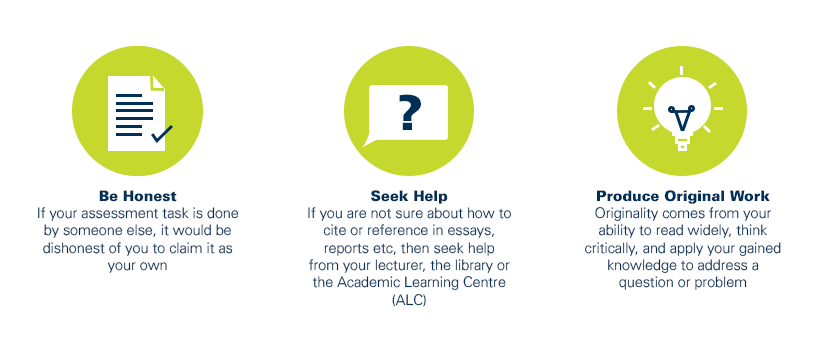
As a CQUniversity student you are expected to act honestly in all aspects of your academic work.
Any assessable work undertaken or submitted for review or assessment must be your own work. Assessable work is any type of work you do to meet the assessment requirements in the unit, including draft work submitted for review and feedback and final work to be assessed.
When you use the ideas, words or data of others in your assessment, you must thoroughly and clearly acknowledge the source of this information by using the correct referencing style for your unit. Using others’ work without proper acknowledgement may be considered a form of intellectual dishonesty.
Participating honestly, respectfully, responsibly, and fairly in your university study ensures the CQUniversity qualification you earn will be valued as a true indication of your individual academic achievement and will continue to receive the respect and recognition it deserves.
As a student, you are responsible for reading and following CQUniversity’s policies, including the Student Academic Integrity Policy and Procedure. This policy sets out CQUniversity’s expectations of you to act with integrity, examples of academic integrity breaches to avoid, the processes used to address alleged breaches of academic integrity, and potential penalties.
What is a breach of academic integrity?
A breach of academic integrity includes but is not limited to plagiarism, self-plagiarism, collusion, cheating, contract cheating, and academic misconduct. The Student Academic Integrity Policy and Procedure defines what these terms mean and gives examples.
Why is academic integrity important?
A breach of academic integrity may result in one or more penalties, including suspension or even expulsion from the University. It can also have negative implications for student visas and future enrolment at CQUniversity or elsewhere. Students who engage in contract cheating also risk being blackmailed by contract cheating services.
Where can I get assistance?
For academic advice and guidance, the Academic Learning Centre (ALC) can support you in becoming confident in completing assessments with integrity and of high standard.
What can you do to act with integrity?