Overview
This unit is designed to help you, as a university student studying psychology, to build a set of evidence-based strategies to prepare you for your academic and professional life. You will receive practical instruction on how to effectively study at university; develop your written and oral communication skills; work effectively in groups; navigate the scientific literature; and apply American Psychological Association (APA) referencing conventions. Your communication, teamwork and research skills will be utilised in the design and preparation of a group presentation. You will also be introduced to career pathways in psychology-related disciplines, and given insight into the personal skills, capabilities and knowledge relevant to a career in psychology. The creation of a career portfolio will help you identify and market the transferable knowledge and skills that you will acquire throughout your degree.
Details
Pre-requisites or Co-requisites
There are no requisites for this unit.
Important note: Students enrolled in a subsequent unit who failed their pre-requisite unit, should drop the subsequent unit before the census date or within 10 working days of Fail grade notification. Students who do not drop the unit in this timeframe cannot later drop the unit without academic and financial liability. See details in the Assessment Policy and Procedure (Higher Education Coursework).
Offerings For Term 1 - 2026
Attendance Requirements
All on-campus students are expected to attend scheduled classes - in some units, these classes are identified as a mandatory (pass/fail) component and attendance is compulsory. International students, on a student visa, must maintain a full time study load and meet both attendance and academic progress requirements in each study period (satisfactory attendance for International students is defined as maintaining at least an 80% attendance record).
Recommended Student Time Commitment
Each 6-credit Undergraduate unit at CQUniversity requires an overall time commitment of an average of 12.5 hours of study per week, making a total of 150 hours for the unit.
Class Timetable
Assessment Overview
Assessment Grading
This is a graded unit: your overall grade will be calculated from the marks or grades for each assessment task, based on the relative weightings shown in the table above. You must obtain an overall mark for the unit of at least 50%, or an overall grade of 'pass' in order to pass the unit. If any 'pass/fail' tasks are shown in the table above they must also be completed successfully ('pass' grade). You must also meet any minimum mark requirements specified for a particular assessment task, as detailed in the 'assessment task' section (note that in some instances, the minimum mark for a task may be greater than 50%). Consult the University's Grades and Results Policy for more details of interim results and final grades.
All University policies are available on the CQUniversity Policy site.
You may wish to view these policies:
- Grades and Results Policy
- Assessment Policy and Procedure (Higher Education Coursework)
- Review of Grade Procedure
- Student Academic Integrity Policy and Procedure
- Academic Progression Policy and Procedure
- Student Refund and Credit Balance Policy and Procedure
- Complaints Policy and Procedure
- Information and Communications Technology Acceptable Use Policy and Procedure
This list is not an exhaustive list of all University policies. The full list of University policies are available on the CQUniversity Policy site.
Feedback, Recommendations and Responses
Every unit is reviewed for enhancement each year. At the most recent review, the following staff and student feedback items were identified and recommendations were made.
Feedback from Student feedback during lectures; staff observation.
Ongoing student uncertainty around how to use generative AI appropriately and ethically in assessments.
Continue to reinforce the message that AI should serve as a support tool, not a replacement for student thinking, and clarify this distinction early in the term. Ensure appropriate AI use is discussed in relation to academic integrity expectations, and include more practical, task-specific examples linked to assessments.
Feedback from Student feedback via emails and SUTE comments; staff observation of group assignment issues.
Some student groups experience difficulty with collaboration, including unequal contributions and disengaged group members.
Continue current proactive strategies: forming slightly larger groups to account for potential dropouts, early-term and consistent group check-ins by teaching staff, monitoring engagement, notifying groups when members drop out, and contacting non-engaged students. Maintain the groupwork-focused lectures and recommended use of the Memorandum of Understanding (MOU) to support time management, shared expectations, and conflict resolution.
Feedback from Staff reflection.
Other portfolio formats are required after Portfolium was discontinued as a university supported platform.
Consider adopting a LinkedIn profile as an alternative or complementary option to the Word-based portfolio, to enhance authenticity and provide students with a real-world professional presence.
- Locate, evaluate and use scholarly sources of information in adherence with the American Psychological Association (APA) style.
- Communicate ideas effectively in written and oral form.
- Work collaboratively as part of a team.
- Create a professional ePortfolio that synthesises knowledge of self, careers and psychology disciplines to map academic, career and learning paths.
Alignment of Assessment Tasks to Learning Outcomes
| Assessment Tasks | Learning Outcomes | |||
|---|---|---|---|---|
| 1 | 2 | 3 | 4 | |
| 1 - Annotated bibliography - 30% | ||||
| 2 - Group Work - 50% | ||||
| 3 - Portfolio - 20% | ||||
Alignment of Graduate Attributes to Learning Outcomes
| Graduate Attributes | Learning Outcomes | |||
|---|---|---|---|---|
| 1 | 2 | 3 | 4 | |
| 1 - Communication | ||||
| 2 - Problem Solving | ||||
| 3 - Critical Thinking | ||||
| 4 - Information Literacy | ||||
| 5 - Team Work | ||||
| 6 - Information Technology Competence | ||||
| 7 - Cross Cultural Competence | ||||
| 8 - Ethical practice | ||||
| 9 - Social Innovation | ||||
| 10 - First Nations Knowledges | ||||
| 11 - Aboriginal and Torres Strait Islander Cultures | ||||
Textbooks
Publication Manual of the American Psychological Association
- 7th Edition (APA 7) (2019)
- Authors: American Psychological Association
- American Psychological Association
- US
- ISBN: 9781433832161
- Binding: Paperback
IT Resources
- CQUniversity Student Email
- Internet
- Unit Website (Moodle)
- Zoom
All submissions for this unit must use the referencing style: American Psychological Association 7th Edition (APA 7th edition)
For further information, see the Assessment Tasks.
b.p.smith@cqu.edu.au
Week 1
Begin Date: 09 Mar 2026Module/Topic
Studying psychology
Chapter
Refer to Moodle website for required reading material and activities
Events and Submissions/Topic
Week 2
Begin Date: 16 Mar 2026Module/Topic
Groupwork theory and applications
Chapter
Refer to Moodle website for required reading material and activities
Events and Submissions/Topic
Groups will be allocated.
Week 3
Begin Date: 23 Mar 2026Module/Topic
Applying your psychology superpowers
Chapter
Refer to Moodle website for required reading material and activities
Events and Submissions/Topic
Week 4
Begin Date: 30 Mar 2026Module/Topic
Career pathways in psychology
Chapter
Refer to Moodle website for required reading material and activities
Events and Submissions/Topic
Week 5
Begin Date: 06 Apr 2026Module/Topic
Appropriate sources of information and how to find them
Chapter
Refer to Moodle website for required reading material and activities
Events and Submissions/Topic
Week 6
Begin Date: 13 Apr 2026Module/Topic
Reading, critiquing, and integrating scientific literature
Chapter
Refer to Moodle website for required reading material and activities
Events and Submissions/Topic
Vacation Week
Begin Date: 20 Apr 2026Module/Topic
There is no online content or scheduled classes this week. Please prioritise your health and wellbeing. If you feel able, you can also use this time to consolidate your learning and catch up on readings and assessment tasks.
Chapter
Events and Submissions/Topic
Week 7
Begin Date: 27 Apr 2026Module/Topic
The APA citation style
Chapter
Refer to Moodle website for required reading material and activities
Events and Submissions/Topic
Week 8
Begin Date: 04 May 2026Module/Topic
Writing for psychology- Part 1
Chapter
Refer to Moodle website for required reading material and activities
Events and Submissions/Topic
Week 9
Begin Date: 11 May 2026Module/Topic
Science communication (oral presentations and podcasts)
Chapter
Refer to Moodle website for required reading material and activities
Events and Submissions/Topic
Week 10
Begin Date: 18 May 2026Module/Topic
Writing for psychology - Part 2
Chapter
Refer to Moodle website for required reading material and activities
Events and Submissions/Topic
Week 11
Begin Date: 25 May 2026Module/Topic
Writing for psychology - Part 3
Chapter
Refer to Moodle website for required reading material and activities
Events and Submissions/Topic
Group Podcast Due: Week 11 Wednesday (27 May 2026) 11:59 pm AEST
Week 12
Begin Date: 01 Jun 2026Module/Topic
Reflective practice and professional identity
Chapter
Refer to Moodle website for required reading material and activities
Events and Submissions/Topic
Group work self-and peer-evaluation (3B) Due: Week 12, Wednesday (3 June 2026) 11:59 pm AEST
Individual Critical Reflection (3C) Due: Week 12, Friday (5 June 2026) 11:59 pm AEST
Exam Week
Begin Date: 08 Jun 2026Module/Topic
This unit does not include an exam
Chapter
Events and Submissions/Topic
Vacation/Exam Week
Begin Date: 15 Jun 2026Module/Topic
Chapter
Events and Submissions/Topic
A major component of this unit involves working in a small group. Active participation in the group task is expected throughout the term to meet the unit learning outcomes. Your contribution to the group task and your ability to work within the group will be assessed by your peers and the unit coordinator. Please make sure you are prepared for this, and actively contribute and respectfully communicate with your group members throughout the term.
1 Portfolio
This assessment is designed to help you reflect on your skills, explore career possibilities, and understand how your psychology degree supports your future goals. You will craft a personal portfolio that tells the story of your academic and professional development. The presentation is up to you! Some suggestions include as a Word document, Poster, Blog, LinkedIn page (or similar professional network site), or a personalised website.
The format is flexible, but your portfolio needs to cover a set criteria, outlined below. Think of this portfolio as your ‘career blueprint’—a chance to reflect, plan, and present the best version of yourself and your future as a graduate of psychology. Use real experiences, insights, and creativity as much as possible.
Much of the content will be useful for your personal career planning, as well as for job applications during your degree or after. As such, please write as much as you think necessary (the word limits below are a guide only).
1. Your psychology story (100-300 words)
Imagine you’re introducing yourself at a psychology networking event. How would you describe your journey into psychology?
- What are you currently doing?
- What have you done, and where have you come from?
- What inspired you to study psychology?
- What excites you most about the field?
- Where do you hope to go from here (aspirations for the future)?
Suggestion: You could present this as a short personal essay, a letter to your future self, or even a mini blog post.
2. Your skills inventory (100-300 words)
Think about your strengths and growth areas. If you were designing a "Psychologist Starter Pack" for yourself, what skills would you include?
- Identify at least two key skills you already have that will help you in psychology.
- Identify at least two skills you want to develop further.
Describe these skills, provide examples, and be sure to relate them to the field of psychology.
These can be soft skills (e.g., communication, empathy) or technical skills (e.g., statistics). For inspiration, see Week 3 content, where we discuss the many skills and knowledge gained from an undergraduate degree.
Suggestion: Consider adding or presenting this in a visual way (e.g. use a chart, table, or skills ‘progress bar’ to track where you are and where you want to be).
3. Your psychology toolkit: Education and learning
Imagine explaining your psychology degree to a friend who knows nothing about it.
- List your degree name and course code (e.g., Bachelor of Psychological Science - CC43).
- Summarise all of the course learning outcomes (these are all listed in the CQU handbook for your particular course/degree).
- List at least one unit/subject you have taken (e.g., it can be this unit - PSYC11011).
- Include the unit name, a short description, and key learning outcomes.
Suggestion: Draw a flowchart showing the units that make up the degree, or how these units will connect to your future career.
4. Work experience, volunteering, or accomplishments
Every job, volunteer experience, or personal project teaches you something.
Choose at least one of the following:
- A job experience
- A volunteer role
- A major personal achievement (from sport, or study, or family)
Describe what you did, when you did it, what you learned, and how it relates to psychology and/or your future career.
Suggestion: Try and tell a short story rather than just listing tasks, perhaps describe a memorable moment. Pictures and other visuals will likely enhance this.
5. Showcasing your work (100-300 words)
Imagine you’re applying for a research assistant role, and they ask you to “Show us something that demonstrates your skills”.
Include in this document or attach to this document, one academic piece, or personal project or paid work that highlights psychology-related skills. You can include an academic assessment, a personal project, or even a draft of something you're working on. If you don’t have a completed project, describe a task that demonstrates key psychology-related skills.
Explain:
- What the task was
- What skills it demonstrated
- What you learned
Suggestion: Make a mini case study so that you can show rather than just tell.
*Important note: Please do not use the same example for criteria 4 and 5.
6. Professional insights- Learning from a psychologist (100-300 words)
For this criterion, I want you to identify a psychology-related career you are interested in (ideally the one you identified in part 1), then conduct a mock interview with a leading psychologist working in that area. This task is designed to help you understand the real-world pathway into the role, what the day-to-day work looks like, and what advice experienced psychologists give to students starting out.
Important rules:
- This is a mock interview conducted using AI (for example, ChatGPT or Copilot).
- Do not contact or interview any real people for this task.
- Choose a currently practising psychologist (not an historical figure).
- Your write-up should be based on the interview and written in your own words.
Step 1. Ask AI to suggest several well-known, currently active psychologists in your chosen career area, with brief notes on why they are notable.
Example prompt: "I am an Australian undergraduate psychology student. I’m interested in a career in [career area]. Help me identify a shortlist of current leading psychologists working in this area. Then help me select one and run a mock interview with them about their career pathway and what the job is like."
Step 2. Select a person from the list, and then carry out the interview (AI will use all its knowledge of that person and their career to answer). Aim for 6–10 questions. If needed, ask AI to suggest questions, for example:
- “What does a [career area] psychologist actually do week to week?”
- “What qualifications did you need?”
- “What extra training or supervision did you complete?”
- “How did you get your first role in this area?”
- “What types of clients do you typically work with?”
- “How do you measure whether you’re helping?”
- “What would you do differently if you were starting again today?”
Step 3. After the interview, write a concise summary of what you learned that will help you move toward that career. Your summary must cover all three points below.
Write a concise summary (100-300 words) of what you learned from the interview that will help you move toward that career. Your summary must include all of the following:
Identify the name of the psychologist you interviewed, their position/job/career area, and the AI tool you used to interview them.
Career pathway (qualifications and training)
- What degrees/registrations and endorsements were needed?
- What extra training, placements, supervision, or professional development mattered?
Clients and core work
- Who do they typically work with? (client types, settings)
- What kinds of problems or goals are common?
- What does the work look like in practice? (assessment, interventions, teamwork, travel, reporting, etc.)
Specific advice for that discipline (make it usable)
- Summarise 1–3 pieces of advice the psychologist gave.
- Include at least two concrete actions you could take in the next 1-5 years (for example, specific placements to seek, skills to build, PD to pursue, networking steps, reading, volunteering, coursework focus).
7. Mapping your career pathway (100-300 words)
Let’s time-travel to your graduation day. You’re thinking about what’s next.
In this section, you will create a brief career plan that maps how you could move from being an undergraduate psychology student to working in the career area you identified in Criterion 6. Your plan should be realistic and should build directly on what you learned from your mock interview.
Career direction
- What psychology-related career are you aiming for
Key steps and milestones
- What steps will you need to take after graduation?
(for example: further study, registration pathway, supervised practice, specialist training, experience)
Include approximate milestones (for example: “in the next 12 months…”, “within 2–3 years…”)
Experience and professional development
- What experiences will help you get there?
(for example: internships, volunteering, student roles, research experience, coaching/industry exposure)
Professional networks and organisations
- What professional organisations, networks, or communities would you join or follow
- Who could you learn from (mentors, supervisors, professionals in the area)?
Suggestion: You may include a simple “Career Roadmap” diagram or dot-point timeline with 4–6 milestones.
Artificial Intelligence use - Level 4 (Full AI).
You may use AI tools extensively to support any elements of this portfolio (for example brainstorming, structuring sections, drafting, editing, and generating ideas). Focus on directing AI to achieve your goals while demonstrating critical thinking and ensuring the final portfolio reflects your own voice, personality, and insights.
Because this is a personal portfolio, you must ensure the content is authentic. Do not use AI to invent or exaggerate personal experiences, achievements, work history, or skills. You are responsible for ensuring accuracy, originality, and adherence to academic integrity requirements. If AI suggests factual information (for example qualification pathways, registration steps, or career details), you must check it against reputable sources such as Australian Psychological Society, AHPRA, and CQUniversity course information, where relevant.
Specific requirement for Criterion 6 (mock interview): This interview must be conducted using AI (for example ChatGPT or Microsoft Copilot). The interview is a simulated activity and must not be presented as an actual interview with a real person. Write up your insights in your own words and avoid including “direct quotes” as if they were verified statements from the psychologist. Where you refer to biographical facts (for example role, location, qualifications, or public work), verify these using reputable public information and clearly frame the interaction as a mock interview.
You do not need to label or highlight every instance of AI assistance. However, you must identify the AI tool used in Criterion 6, and you may optionally include a short AI-use note at the end of your portfolio (for example: tool(s) used and what you used them for). Instructions and examples will be provided on Moodle.
The 72-hour grace period does apply to this task. Submissions later than 72-hours must obtain an approved extension or be subject to a 5% per day penalty.
Week 6 Wednesday (15 Apr 2026) 11:59 pm AEST
Submit via Moodle
Week 8 Wednesday (6 May 2026)
Assessments will be returned as soon as possible after submission, typically within two weeks.
This assessment will be graded out of 20 marks. Marks will be allocated according to each of the following criteria:
- Psychology Story (Personal Statement) (3 marks)
- Skills Inventory (3 marks)
- Education & Learning Outcomes (2 marks)
- Work/Volunteer Experience or Accomplishments (2 marks)
- Personal or Academic Project Showcase (3 marks)
- Professional Insight: Learning from a Psychologist (3 marks)
- Career Pathway Exploration (4 marks)
A more detailed marking criteria is provided on Moodle.
Important note: Unit Learning Outcome 4 of this unit is only assessed by this assessment. As such, to meet the learning outcomes, a minimum mark of 10/20 (50%) has been set for this task. That is, to pass the unit, you must achieve this minimum mark.
- Communicate ideas effectively in written and oral form.
- Create a professional ePortfolio that synthesises knowledge of self, careers and psychology disciplines to map academic, career and learning paths.
2 Annotated bibliography
The objective of this task is to explore the impact and applications of AI in psychology and how these advancements are shaping research, therapy, and our understanding of human behaviour. You are required to select a research question relevant to your career aspirations (e.g., if you intend to work as a clinical psychologist, select a research question relevant to the Australian Psychological Society area of endorsement).
Completing this task as an annotated bibliography provides an opportunity to demonstrate your research skills by:
- Developing a focused research question
- Locating current and relevant peer-reviewed journal articles
- Explaining their relevance and application to psychology
- Applying APA 7th referencing and academic writing conventions
You will create an annotated bibliography of three (3) peer-reviewed journal articles related to your research question. For each article, you will write an annotation that summarises the article and explains its relevance to your question. You will then synthesise the three articles and reflect on how AI influenced your research process.
To complete this assessment, you will:
- Develop a clear research question relevant to psychology and your career interests.
- Identify three (3) peer-reviewed journal articles related to your question (published within the last 10 years, unless a seminal article is justified).
- Provide a correct APA 7th citation for each article.
- Write a 150–300 word annotation per article that summarises the article’s aims, methods, and key findings, and explains the article’s relevance to your research question (including what it contributes toward answering your research question).
- Write a 200–400 word synthesis that compares the three articles and explains their collective significance to your research question and the broader implications for psychology in relation to AI. In your synthesis, you should note key limitations or gaps and explain what the combined evidence suggests for psychology in the context of AI.
- Write a 300–500 word reflection on your experience using AI to complete this task and, more generally, the role of AI in the research process. Your reflection must identify at least one AI tool used, describe how you used it, and include at least one sentence explaining how you verified the accuracy of AI outputs.
Clear step-by-step instructions for completing the task will be provided on Moodle.
Artificial Intelligence use - Level 3 (AI Collaboration).
You may use generative AI tools to support this assessment. Focus on directing AI to achieve your goals while demonstrating your own critical thinking and understanding.
AI is an integral part of this assessment and may be used to assist with developing your research question, generating search terms, summarising articles, and supporting synthesis and writing clarity. However, you remain responsible for the accuracy, relevance, and appropriate interpretation of all content you submit. You must read and interpret the journal articles yourself and ensure your annotations and synthesis are written in your own words.
Because this task includes a reflection on your AI use, you must identify at least one AI tool you used and describe how you used it. Your reflection must also include at least one sentence explaining how you verified the accuracy of AI outputs (e.g., checking claims against the article PDF, verifying citations in library databases, or cross-checking key points against the original text). You are not required to provide formal references for AI tools in your reflection, although you may do so if you wish.
The 72-hour grace period applies to this task. Submissions later than 72 hours must obtain an approved extension or will be subject to a 5% per day penalty (calculated after the grace period).
Week 9 Friday (15 May 2026) 11:59 pm AEST
Submit via Moodle
Week 11 Friday (29 May 2026)
Assessments will be returned as soon as possible after submission, typically within two weeks.
This assessment will be graded out of 30 marks. Marks will be allocated according to each of the following criteria:
Annotations (20 marks)
- Appropriate topic and focused research question (2 marks)
- Literature search and selection of three relevant, peer-reviewed journal articles (3 marks)
- APA 7th citations and presentation (2 marks)
- Annotations: For each article, summarise the aims, methods, and key findings, and explain its relevance to the research question (9 marks)
- Synthesis paragraph: Integrate and compare findings across the three articles, explain their collective significance to the research question, and outline implications for psychology in relation to AI (4 marks)
AI Reflection (10 marks)
- Identification and description of at least one AI tool used (e.g., tool name, purpose, how it generates outputs, and how references/sources were identified and verified) (2 marks)
- Description of how AI was used in your research process (e.g., what tasks AI supported, the types of prompts/instructions you used, and what you completed independently) (2 marks)
- Evaluation of AI’s role in conducting research (e.g., ethical implications, benefits, limitations, bias/hallucinations, impact on learning, and at least one sentence describing how the accuracy of AI outputs was verified) (5 marks)
- Clarity, coherence and adherence to word count (1 mark)
You do not have to provide references for the reflection, although you may wish to do so. A more detailed marking rubric and instructions will be provided on Moodle.
- Locate, evaluate and use scholarly sources of information in adherence with the American Psychological Association (APA) style.
- Communicate ideas effectively in written and oral form.
3 Group Work
The group task is a major component of this unit and represents 50% of the overall assessment. There are three elements to this task, one is a group project (3A) and the other two are tasks to be completed independently (3B and 3C):
Part 3A: Group podcast (20/50)
In your small groups, which will be allocated in week 2, you must work together to prepare a podcast exploring a topic or answering a research question of your groups choosing.
As a group, you must select one of the APS discipline areas that the group would like to investigate further (e.g., Clinical psychology, forensic psychology - see Moodle for more detail). After deciding on the discipline area, you will then work together to decide on a specific research topic or question related to the group’s chosen 'area of practice endorsement'.
Your podcast must have a clear identity. This includes:
- A podcast name (e.g., "The Mind Matters Show")
- A format (e.g., interview-style, narrative, panel discussion)
- A target audience (e.g., university students, parents, mental health professionals)
- Branding elements (e.g., an intro jingle, podcast cover image or poster/handout)
- A short episode summary (this must be submitted with your transcript)
The podcast episode must demonstrate your science communication skills, including a clear podcast identity and summary, structured content, research-based credibility, engaging delivery, high-quality audio, and strong group collaboration. These elements are directly assessed in the marking rubric.
You can record your podcast using Zoom, MS Teams, your mobile phone/s, webcam, specialised recording software (e.g. Quicktime, iMovie, Audacity), or using PowerPoint. A list of free and suitable methods for recording and editing your podcast will be provided. You are not expected to purchase any equipment or spend any money on the production of this presentation.
In your podcast, your group will need to use language that is clear and appropriate for the intended audience, present your topic in a way that is engaging, shows a clear ‘narrative’ (and structure), and enhances the audience’s understanding and knowledge of the topic.
You must utilise information from at least six (6) peer-reviewed scientific sources to support your discussion. These sources should be used to provide background information, discuss psychological interventions, and support your arguments.
Your script must include in-text citations and a reference list to properly acknowledge these sources. This ensures that your podcast is evidence-based while maintaining a natural conversational style. As a result, you do not need to spend time explaining or citing references, sources, or studies during the podcast (although it may be appropriate to do so at times). This will make the conversations more realistic and natural.
ALL members of the group need to be featured in the podcast in some way. It is expected that all group members should make a valuable (and equal) contribution to the final product (e.g., background research, scriptwriting, filming, editing, and graphic design). Group contributions will be assessed as part of Assessment 3B.
Groups work best when all members understand and agree to expectations. As such, groups will be encouraged to complete a Memorandum of Understanding (MoU) or group charter before beginning their group work to clearly articulate the aim of the project, the role of members, a communication plan, a code of conduct (e.g., plagiarism), and timelines. The MoU does not need to be submitted formally but will be checked by the unit coordinator in one of the group check-ins. It may also be something you reflect upon in your individual reflection piece. An MOU template is provided on the ‘Assessment 3’ Tile on Moodle. This should be adapted as required, or your group may wish to design your own (there are many exemplars online).
There will be several 'group check-ins' scheduled throughout the term, where the unit coordinator will contact groups to offer support, guidance, check suitability of topic, answer questions, check MoU, ensure group members are participating, and resolve conflicts. However, if any issues arise outside of these check-ins, it is important to let the unit coordinator know.
Artificial Intelligence use - Level 3 (AI Collaboration). AI tools may be used to support this task (e.g., brainstorming topics/questions, generating search terms, summarising peer-reviewed articles, improving clarity of a draft script, and assisting with simple design elements such as cover art or a poster). However, the podcast must reflect your group’s own reasoning and science communication, and AI must not replace your group’s work in structuring the episode, developing arguments, or deciding what the evidence means. You must not use AI to fabricate or “fill in” references, quotations, study details, or statistics. Your group remains responsible for fact-checking any AI-assisted content against the original sources and ensuring all cited references are accurate and correctly formatted. If AI made a substantial contribution to a specific element (e.g., initial script draft, case vignette, or artwork), include a brief acknowledgement in your transcript (e.g., “Developed with assistance from [software]”).
Further details and guides for completing this task (including the APS areas of endorsement, deciding upon a research question, developing podcasts, and a step-by-step guide) are provided in an assessment handout on Moodle.
The podcast is to be completed and submitted as a group (that is, by one member only).
Part 3B: Group work self- and peer-evaluation (15/50)
Your ability to work in a group setting (contribution, communication, teamwork, reliability, work quality) will be assessed by yourself and your peers (group members). This will enable your group work skills to be evaluated and help ensure accountability relating to your role and contribution to the group task. This feedback will be used to evaluate teamwork skills and the eligibility of group members to pass the unit. As such, it is important to be as fair and honest as possible in your assessment. An evaluation form assessing five criteria will be made available on Moodle for completing this task.
The evaluation form is to be completed and submitted independently from the group. Individual evaluations will remain anonymous to the group.
Artificial Intelligence use - Level 1 (No AI). AI must not be used for Part 3B. This task requires your own observations and judgement about group member contributions, and using AI to generate ratings may compromise fairness and integrity. Your ratings and any comments must be honest, specific, and based on your genuine experience working with the group.
Part 3C: Individual critical reflection (15/50)
For this assessment, you will be required to submit a 600-word (accepted range 400-800) reflective essay relating to your experience working in a group during this task. Your experiences, insights and learnings from the group task (Assessment 3A) will need to draw upon (reference) relevant theory and evidence on group dynamics and interpersonal skills covered during the unit.
The reflection is to be completed independently from the group.
Summary of key expectations:
- Word count: 400-800 words (excluding the reference list).
- Structure: Essay-style reflection, with a brief introduction and conclusion.
- Use of personal pronouns: Allowed (e.g., "I," "we").
- Academic references: Minimum of two academic sources in APA format.
- Assessment criteria: Covers personal contribution, group experience, personal development, connection to academic concepts, and presentation.
- Submission format: Word document with APA-style formatting.
Artificial Intelligence use - Level 2 (AI Planning/Editing): AI may be used to support writing quality only (e.g., spelling/grammar checks, improving sentence clarity, and helping organise an outline). AI must not generate new reflective content, personal experiences, or analysis, and it must not write paragraphs that you submit as your own reflection. Your reflection must be your own work, written in your own voice, and must demonstrate your personal learning supported by the required academic sources. If you use AI editing support, you remain responsible for ensuring the final submission is accurate, appropriately referenced, and genuinely reflects your experience.
Presentation:
The individual critical reflection should be prepared as a Word document and include a cover sheet and reference list. The document needs to be presented using the guidelines for ‘student papers’ as established in the APA publication manual (7th edition).
An appropriate APA style template has been prepared for you, and it is recommended that you use this template to complete your assessment. For further information and guidance on APA style, refer to the APA Publication Manual, or online university library guides from the World Wide Web. See also the content for week 8 of this unit, which covers APA style.
Level of GenAI use:
Each of the assessments 3 A-C have varying levels of AI use allowed. Refer to the specific descriptions above.
The 72-hour grace period does apply to the individually submitted components (3B, 3C) of this task. Submissions later than 72-hours must obtain an approved extension or be subject to a 5% per day penalty.
The 72-hour grace period does apply to the group component (3A) of the task. However, no submissions (even with a 5% per day late penalty) can be accepted after this period. Please ensure the group submits on time.
Part 3A due in week 11, Wednesday 27 May 2026 11.59PM AEST. Part 3B due in week 12, Wednesday 3 June 11.59PM AEST. Part 3C, due in week 12, Friday 5 June 11.59PM AEST.
Assessments will be returned as soon as possible after submission, typically within two weeks.
This assessment will be graded out of 50 marks. Your overall mark for this assessment will be calculated by adding together the marks from 3A, 3B and 3C. The assessment criteria for each part are provided below, with additional instructions and details provided on Moodle.
Part 3A: Group podcast
This component will be graded out of 20 marks. You will be judged as a group. That is, all members of the group will receive the same mark. Marks will be allocated according to each of the following criteria:
- Podcast identity and episode summary (1 mark)
- Organisation, signposting, and wrap up (2 marks)
- Psychology content accuracy and coverage (8 marks)
- Research quality and credibility of sources (2 marks)
- Synthesis, critical thinking and application (4 marks)
- Delivery and production (2 marks)
- Group cohesion, collaboration and time management (1 mark)
Part 3B: Group work self- and peer-evaluation
This component will be graded out of 15 marks. You will evaluate each member of your group and yourself on five criteria. Each criterion is worth 3 marks and will be based on a rating scale from 0.0 to 3.0. The unit coordinator will take the self and peer scores into account, and provide a weighted score for each criterion.
Criteria:
- Contribution and follow-through (e.g., did the member complete agreed tasks and contribute a fair share of the workload?)
- Communication and responsiveness (e.g., did the member communicate clearly, respond in a timely way, and participate in decisions?)
- Teamwork and respect (e.g., did the member listen, cooperate, and support a constructive group climate?)
- Planning, reliability and time management (e.g., did the member help plan the work, meet deadlines, and attend/participate as agreed?)
- Work standard and initiative (e.g., was the member’s work usable and accurate, and did they show initiative such as proposing ideas, improving drafts, helping solve gaps?)
Rating scale:
- 0= Did not meet expectations
- 1= Mostly did not meet expectations
- 2= Met expectations
- 3= Exceeded expectations
Any rating of 0 must include a brief explanation.
Part 3C: Individual critical reflection
This component will be graded out of 15 marks. Marks will be allocated according to each of the following criteria:
- Summary and reflection on personal contribution (3 marks)
- Assessment of the group experience (3 marks)
- Evidence of personal development (3 marks)
- Connection to academic concepts (4 marks)
- Adherence to word count and presentation (2 marks)
Presentation:
Prepare your reflection using the APA 7th edition template for student papers and submit it as a Word document (a template will be provided to you in Moodle). This includes a cover page and reference list. Beyond this, the presentation of your reflection is flexible (e.g., the number and nature of headings/subtitles, paragraphs), so long as you are able to meet the marking criteria.
Important note: Unit Learning Outcome 3 is assessed only through Assessment 3. To demonstrate competency in group work, you must achieve a minimum of 25/50 (50%) across Parts 3A–3C. Supplementary Assessment (SA) is not available due to the nature of the task (group work).
Peer-evaluation scores may be moderated by the unit coordinator where there is evidence of collusion, bias, or inconsistency with available evidence.
- Locate, evaluate and use scholarly sources of information in adherence with the American Psychological Association (APA) style.
- Communicate ideas effectively in written and oral form.
- Work collaboratively as part of a team.
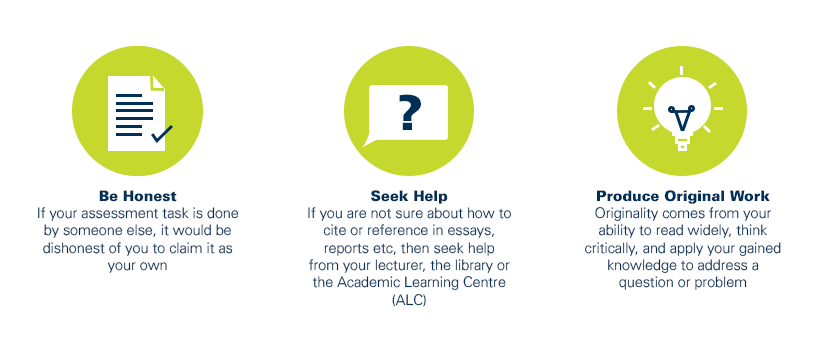
As a CQUniversity student you are expected to act honestly in all aspects of your academic work.
Any assessable work undertaken or submitted for review or assessment must be your own work. Assessable work is any type of work you do to meet the assessment requirements in the unit, including draft work submitted for review and feedback and final work to be assessed.
When you use the ideas, words or data of others in your assessment, you must thoroughly and clearly acknowledge the source of this information by using the correct referencing style for your unit. Using others’ work without proper acknowledgement may be considered a form of intellectual dishonesty.
Participating honestly, respectfully, responsibly, and fairly in your university study ensures the CQUniversity qualification you earn will be valued as a true indication of your individual academic achievement and will continue to receive the respect and recognition it deserves.
As a student, you are responsible for reading and following CQUniversity’s policies, including the Student Academic Integrity Policy and Procedure. This policy sets out CQUniversity’s expectations of you to act with integrity, examples of academic integrity breaches to avoid, the processes used to address alleged breaches of academic integrity, and potential penalties.
What is a breach of academic integrity?
A breach of academic integrity includes but is not limited to plagiarism, self-plagiarism, collusion, cheating, contract cheating, and academic misconduct. The Student Academic Integrity Policy and Procedure defines what these terms mean and gives examples.
Why is academic integrity important?
A breach of academic integrity may result in one or more penalties, including suspension or even expulsion from the University. It can also have negative implications for student visas and future enrolment at CQUniversity or elsewhere. Students who engage in contract cheating also risk being blackmailed by contract cheating services.
Where can I get assistance?
For academic advice and guidance, the Academic Learning Centre (ALC) can support you in becoming confident in completing assessments with integrity and of high standard.
What can you do to act with integrity?