Overview
In this unit you will build upon previous learning and skills related to research methods, by planning and conducting a supervised group research project. You will be required to collaborate with your assigned research group to deliver key outcomes related to your group research project. You will learn how to effectively and professionally communicate your research findings using the structure of an academic journal manuscript, and you will collaborate to design and deliver a group oral presentation. You will learn essential research skills that will be useful in your development as an autonomous evidence-based practitioner.
Details
Pre-requisites or Co-requisites
To enrol in this Unit you must meet the following pre-requisites: ALLH11009 Research Methods for Health Professionals ALLH12006 Evidence Based Practice for Health Professionals PSIO13007 Musculoskeletal Physiotherapy 3 PSIO13006 Physiotherapy Management of the Complex Patient PSIO13001 Neurological Physiotherapy 2 ALLH13011 Rural and Remote Practice for Health Professionals
Important note: Students enrolled in a subsequent unit who failed their pre-requisite unit, should drop the subsequent unit before the census date or within 10 working days of Fail grade notification. Students who do not drop the unit in this timeframe cannot later drop the unit without academic and financial liability. See details in the Assessment Policy and Procedure (Higher Education Coursework).
Offerings For Term 1 - 2026
Attendance Requirements
All on-campus students are expected to attend scheduled classes - in some units, these classes are identified as a mandatory (pass/fail) component and attendance is compulsory. International students, on a student visa, must maintain a full time study load and meet both attendance and academic progress requirements in each study period (satisfactory attendance for International students is defined as maintaining at least an 80% attendance record).
Recommended Student Time Commitment
Each 12-credit Undergraduate unit at CQUniversity requires an overall time commitment of an average of 25 hours of study per week, making a total of 300 hours for the unit.
Class Timetable
Assessment Overview
Assessment Grading
This is a graded unit: your overall grade will be calculated from the marks or grades for each assessment task, based on the relative weightings shown in the table above. You must obtain an overall mark for the unit of at least 50%, or an overall grade of 'pass' in order to pass the unit. If any 'pass/fail' tasks are shown in the table above they must also be completed successfully ('pass' grade). You must also meet any minimum mark requirements specified for a particular assessment task, as detailed in the 'assessment task' section (note that in some instances, the minimum mark for a task may be greater than 50%). Consult the University's Grades and Results Policy for more details of interim results and final grades.
All University policies are available on the CQUniversity Policy site.
You may wish to view these policies:
- Grades and Results Policy
- Assessment Policy and Procedure (Higher Education Coursework)
- Review of Grade Procedure
- Student Academic Integrity Policy and Procedure
- Academic Progression Policy and Procedure
- Student Refund and Credit Balance Policy and Procedure
- Complaints Policy and Procedure
- Information and Communications Technology Acceptable Use Policy and Procedure
This list is not an exhaustive list of all University policies. The full list of University policies are available on the CQUniversity Policy site.
Feedback, Recommendations and Responses
Every unit is reviewed for enhancement each year. At the most recent review, the following staff and student feedback items were identified and recommendations were made.
Feedback from In Class
Students enjoyed the recorded lectures being made available at the start of Term 1.
It is recommended that the recorded lectures remain available at the start of Term 1 to enable students to work this Unit around their clinical placements.
- Design and conduct a research project using appropriate research methodologies and frameworks in consideration of the ethical issues related to the research topic.
- Perform a comprehensive search and critique of published academic literature to identify relevant evidence on a defined research topic.
- Synthesise, analyse, critically evaluate, and interpret research findings in an evidence-based manner to draw reasoned conclusions and make recommendations for clinical practice.
- Effectively and professionally communicate research findings using the format of an academic journal manuscript and an oral presentation.
The Learning Outcomes and Assessment tasks have been mapped against and aligned with the Australian Physiotherapy Council’s Physiotherapy Practice Thresholds.
Alignment of Assessment Tasks to Learning Outcomes
| Assessment Tasks | Learning Outcomes | |||
|---|---|---|---|---|
| 1 | 2 | 3 | 4 | |
| 1 - Research Assignment - 65% | ||||
| 2 - Group Work - 35% | ||||
Alignment of Graduate Attributes to Learning Outcomes
| Graduate Attributes | Learning Outcomes | |||
|---|---|---|---|---|
| 1 | 2 | 3 | 4 | |
| 1 - Communication | ||||
| 2 - Problem Solving | ||||
| 3 - Critical Thinking | ||||
| 4 - Information Literacy | ||||
| 5 - Team Work | ||||
| 6 - Information Technology Competence | ||||
| 7 - Cross Cultural Competence | ||||
| 8 - Ethical practice | ||||
| 9 - Social Innovation | ||||
| 10 - First Nations Knowledges | ||||
| 11 - Aboriginal and Torres Strait Islander Cultures | ||||
Textbooks
There are no required textbooks.
IT Resources
- CQUniversity Student Email
- Internet
- Unit Website (Moodle)
- Microsoft Office (Word, Excel, PowerPoint)
- EndNote (bibliographical software). You MUST use EndNote bibliographic software to format your references for the dissertation. This software is available to all students and is available for Windows and Mac users.
- Covidence or Rayyan (this will be discussed with you during the term)
All submissions for this unit must use the referencing style: Vancouver
For further information, see the Assessment Tasks.
l.heales@cqu.edu.au
Week 1
Begin Date: 09 Mar 2026Module/Topic
Introduction to Research Project
Module 1: Developing a Research Question
Chapter
Refer to the Unit Moodle site for prescribed readings and resources.
Events and Submissions/Topic
Week 2
Begin Date: 16 Mar 2026Module/Topic
Module 2: Developing a Research Protocol
Module 3: Developing a Search Strategy
Chapter
Refer to the Unit Moodle site for prescribed readings and resources.
Events and Submissions/Topic
Week 3
Begin Date: 23 Mar 2026Module/Topic
Module 4: Screening and Selecting Studies
Module 5: Assessing the Quality
Chapter
Refer to the Unit Moodle site for prescribed readings and resources.
Events and Submissions/Topic
Week 4
Begin Date: 30 Mar 2026Module/Topic
Module 6: Extracting the Data
Module 7: Synthesising the Evidence
Chapter
Refer to the Unit Moodle site for prescribed readings and resources.
Events and Submissions/Topic
Week 5
Begin Date: 06 Apr 2026Module/Topic
Module 8: Assessing the Certainty of the Evidence
Module 9: Reporting the Findings
Chapter
Refer to the Unit Moodle site for prescribed readings and resources.
Events and Submissions/Topic
Week 6
Begin Date: 13 Apr 2026Module/Topic
Module 10: Disseminating the Results
Chapter
Refer to the Unit Moodle site for prescribed readings and resources.
Events and Submissions/Topic
Vacation Week
Begin Date: 20 Apr 2026Module/Topic
Chapter
Events and Submissions/Topic
Week 7
Begin Date: 27 Apr 2026Module/Topic
Working on your Systematic Review
Chapter
Events and Submissions/Topic
Week 8
Begin Date: 04 May 2026Module/Topic
Working on your Systematic Review
Chapter
Events and Submissions/Topic
Week 9
Begin Date: 11 May 2026Module/Topic
Working on your Systematic Review
Chapter
Events and Submissions/Topic
Week 10
Begin Date: 18 May 2026Module/Topic
Working on your Systematic Review
Chapter
Events and Submissions/Topic
Week 11
Begin Date: 25 May 2026Module/Topic
Working on your Systematic Review
Chapter
Events and Submissions/Topic
Week 12
Begin Date: 01 Jun 2026Module/Topic
Working on your Systematic Review
Chapter
Events and Submissions/Topic
Exam Week
Begin Date: 08 Jun 2026Module/Topic
Chapter
Events and Submissions/Topic
Vacation/Exam Week
Begin Date: 15 Jun 2026Module/Topic
Chapter
Events and Submissions/Topic
1 Research Assignment
You will be allocated and assigned a group research topic and academic supervisor by the Unit Coordinator. You will work in groups of three or four students to conduct and report a systematic review on your allocated topic. As a group you will complete all components of the systematic review with some guidance from your academic supervisor. You will submit your systematic review as your research assignment in the format similarly required of an academic journal. The Introduction, Methods, Results, and Discussion/Conclusion of your systematic review will be identical for all group members and will contribute to the group component of your mark. One student from each group will submit your Systematic Review through Moodle. The Abstract will be individually written and individually submitted and will contribute to the individual component of your mark.
- The systematic review must be submitted as a Microsoft Word document (.docx), with a maximum word count of 4000 (excluding tables, figures, and reference list). A template is provided on Moodle.
- The Abstract must be submitted as a Microsoft Word document (.docx), with a maximum word count of 250 (including all subheadings). A template is provided on Moodle.
EndNote Reference Manager must be used for citation and reference listing for your systematic review, and Vancouver Referencing Style must be used for referencing. You must include the PSIO14006 Research Project Declaration at the start of your Systematic Review Research Assignment and Abstract.
More detailed information about the formatting requirements of the assignment is available on Moodle.
Level of Gen AI use allowed: Level 3 AI Collaboration: You may use AI to assist with specific tasks such as drafting text, refining and evaluating your work. You must critically evaluate and modify and AI-generated content you use. You must also cite all Gen AI work used within your assignment (using the LLM and Gen AI Guidelines).
Failure to reference AI-generated content appropriately may result in a case being raised for the suspicion of academic misconduct. You are reminded that your submission should reflect your understanding and synthesis of ideas, and all content must be reviewed for accuracy. Over-reliance on AI-generated content may impact the quality of work, impacting on your grade.
The Systematic Review - Research Assignment is due 4th September 2026 at 4:00pm.
Results will be provided within two weeks of completion of the assessment.
Assessment Criteria: The Research Assignment will be marked and moderated by members of the academic staff using a rubric with the below categories.
Abstract (5%)
Introduction (20%)
Methods (20%)
Results (20%)
Discussion and Conclusions (Individual Component) (20%)
Academic writing, organisation/structure, formatting, and referencing (15%)
- Design and conduct a research project using appropriate research methodologies and frameworks in consideration of the ethical issues related to the research topic.
- Perform a comprehensive search and critique of published academic literature to identify relevant evidence on a defined research topic.
- Synthesise, analyse, critically evaluate, and interpret research findings in an evidence-based manner to draw reasoned conclusions and make recommendations for clinical practice.
- Effectively and professionally communicate research findings using the format of an academic journal manuscript and an oral presentation.
2 Group Work
As a group of three or four students, you will present the findings of your systematic review to peers, academic staff, clinicians, and members of the community at the Physiotherapy Research Symposium. This conference style oral presentation will be a maximum of 15-minutes duration, plus up to 5-minutes of question time. All members of the group are required to present for an equivalent duration (for example in a group of 3 students, each member will present for ~5 minutes). This presentation must be prepared in Microsoft PowerPoint and should include the following sections: Introduction, Methods, Results, Discussion, Take Home Message(s), and References. Your group will be marked on the entire presentation, with an individual component being your specific communication (e.g., clear and engaging tone, appropriate eye contact, steady and consistent pace). For more information regarding formatting please refer to Moodle.
All students must attend on your respective campus and in person with your entire group. All students must be attired in your full clinical uniform. The Physiotherapy Research Symposium will start promptly at 8:00am, with students expected to arrive at 7:40am for set up.
Level of Gen AI use allowed: Level 3 AI Collaboration: You may use AI to assist with specific tasks such as drafting text, refining and evaluating your work. You must critically evaluate and modify and AI-generated content you use. You must also cite all Gen AI work (using the LLM and Gen AI Guidelines).
Failure to reference AI-generated content appropriately may result in a case being raised for the suspicion of academic misconduct. You are reminded that your submission should reflect your understanding and synthesis of ideas, and all content must be reviewed for accuracy. Over-reliance on AI-generated content may impact the quality of work, impacting on your grade.
72-Hour Grace Period: The 72-hour grace period does not apply to this assessment.
Late Arrival: You should aim to arrive at least 20-minutes prior to the official assessment commencement time. In the extraordinary circumstance that you are late you will be permitted late entry to your assessment of up to 10 minutes after the official assessment commencement time. The period of lateness will be deducted from your overall assessment time. If you are denied access to the assessment due to lateness (i.e. arriving beyond the permitted late entry period), you should make an online application for deferred assessment (which may or may not be granted in line with CQU policy). If your application for deferred assessment is denied, you will receive a score of zero percent (0%) for your assessment item.
The Physiotherapy Research Symposium will be held on the 25th of September 2026 (Friday Week 10 of Term 2) from 8:00am.
Results and feedback will be made available within two weeks of the Symposium.
The Group Presentation will be marked and moderated by members of the academic staff using a rubric with the following categories:
Introduction (20%)
Methods (20%)
Results (20%)
Discussion and Take-Home Message (20%)
Visual presentation, organisation/structure, grammar and referencing (10%)
Communication (Individual Component) (10%)
- Design and conduct a research project using appropriate research methodologies and frameworks in consideration of the ethical issues related to the research topic.
- Perform a comprehensive search and critique of published academic literature to identify relevant evidence on a defined research topic.
- Synthesise, analyse, critically evaluate, and interpret research findings in an evidence-based manner to draw reasoned conclusions and make recommendations for clinical practice.
- Effectively and professionally communicate research findings using the format of an academic journal manuscript and an oral presentation.
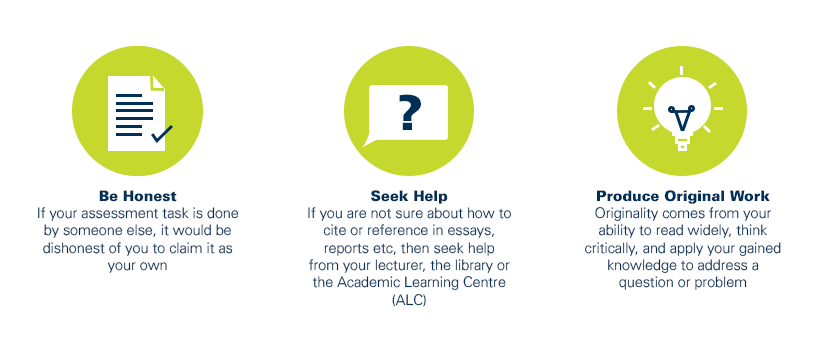
As a CQUniversity student you are expected to act honestly in all aspects of your academic work.
Any assessable work undertaken or submitted for review or assessment must be your own work. Assessable work is any type of work you do to meet the assessment requirements in the unit, including draft work submitted for review and feedback and final work to be assessed.
When you use the ideas, words or data of others in your assessment, you must thoroughly and clearly acknowledge the source of this information by using the correct referencing style for your unit. Using others’ work without proper acknowledgement may be considered a form of intellectual dishonesty.
Participating honestly, respectfully, responsibly, and fairly in your university study ensures the CQUniversity qualification you earn will be valued as a true indication of your individual academic achievement and will continue to receive the respect and recognition it deserves.
As a student, you are responsible for reading and following CQUniversity’s policies, including the Student Academic Integrity Policy and Procedure. This policy sets out CQUniversity’s expectations of you to act with integrity, examples of academic integrity breaches to avoid, the processes used to address alleged breaches of academic integrity, and potential penalties.
What is a breach of academic integrity?
A breach of academic integrity includes but is not limited to plagiarism, self-plagiarism, collusion, cheating, contract cheating, and academic misconduct. The Student Academic Integrity Policy and Procedure defines what these terms mean and gives examples.
Why is academic integrity important?
A breach of academic integrity may result in one or more penalties, including suspension or even expulsion from the University. It can also have negative implications for student visas and future enrolment at CQUniversity or elsewhere. Students who engage in contract cheating also risk being blackmailed by contract cheating services.
Where can I get assistance?
For academic advice and guidance, the Academic Learning Centre (ALC) can support you in becoming confident in completing assessments with integrity and of high standard.
What can you do to act with integrity?