Overview
This unit is Part B of a two-unit learning series which will provide you the opportunity to consolidate and practically apply all of the knowledge, skills and attitudes developed during your learning journey in the OHS course. There is a specific emphasis on developing higher order skills and understandings which are representative of the holistic application of core skills that occurs when the professional understands the interaction between core disciplinary domains in solving complex problems. In addition, you will explore professional practice through the lens of OHS professional practice models, critical reflection, applied research methodology and project management. During this unit (Part B), you will complete project work with your industry sponsor and will prepare appropriate dissemination documentation and a seminar presentation. You will create and submit a professional portfolio of your work which will include a critique of the OHS Body of Knowledge. This unit has a strong emphasis on evidence-informed practice which will require guided and independent research activity to successfully complete this unit.
Details
Pre-requisites or Co-requisites
Pre-requisite: OCHS13010 Applied Worksite Analysis or OCHS13020 Future Paradigms in OHS A
Important note: Students enrolled in a subsequent unit who failed their pre-requisite unit, should drop the subsequent unit before the census date or within 10 working days of Fail grade notification. Students who do not drop the unit in this timeframe cannot later drop the unit without academic and financial liability. See details in the Assessment Policy and Procedure (Higher Education Coursework).
Offerings For Term 2 - 2026
Attendance Requirements
All on-campus students are expected to attend scheduled classes - in some units, these classes are identified as a mandatory (pass/fail) component and attendance is compulsory. International students, on a student visa, must maintain a full time study load and meet both attendance and academic progress requirements in each study period (satisfactory attendance for International students is defined as maintaining at least an 80% attendance record).
Recommended Student Time Commitment
Each 6-credit Undergraduate unit at CQUniversity requires an overall time commitment of an average of 12.5 hours of study per week, making a total of 150 hours for the unit.
Class Timetable
Assessment Overview
Assessment Grading
This is a graded unit: your overall grade will be calculated from the marks or grades for each assessment task, based on the relative weightings shown in the table above. You must obtain an overall mark for the unit of at least 50%, or an overall grade of 'pass' in order to pass the unit. If any 'pass/fail' tasks are shown in the table above they must also be completed successfully ('pass' grade). You must also meet any minimum mark requirements specified for a particular assessment task, as detailed in the 'assessment task' section (note that in some instances, the minimum mark for a task may be greater than 50%). Consult the University's Grades and Results Policy for more details of interim results and final grades.
All University policies are available on the CQUniversity Policy site.
You may wish to view these policies:
- Grades and Results Policy
- Assessment Policy and Procedure (Higher Education Coursework)
- Review of Grade Procedure
- Student Academic Integrity Policy and Procedure
- Academic Progression Policy and Procedure
- Student Refund and Credit Balance Policy and Procedure
- Complaints Policy and Procedure
- Information and Communications Technology Acceptable Use Policy and Procedure
This list is not an exhaustive list of all University policies. The full list of University policies are available on the CQUniversity Policy site.
Feedback, Recommendations and Responses
Every unit is reviewed for enhancement each year. At the most recent review, the following staff and student feedback items were identified and recommendations were made.
Feedback from Student Unit and Teaching Evaluation data
Students appreciate being challenged and made to think deeply about how to improve Occupational Health and Safety (OHS) practice and by extension the profession.
Continue to present provocative Ponder Points to encourage thinking and discussion on challenging aspects of OHS.
- Explore and develop over-the-horizon solutions to unique problems in OHS
- Evaluate the synergies between designed systems within socio-technical environments
- Problem solve and create appropriate artefacts to disseminate learning in OHS
- Critically review the Body of Knowledge for OHS Professionals with particular attention to the Model for Professional Practice
- Critically reflect on your knowledge, skills and attitudes and contrast them against the guidance produced by the Australian OHS Education Accreditation Board and international professional groups such as the American Society of Safety Engineers
- Critically reflect and evaluate your preparedness for OHS professional practice
- Communicate how you will contribute to creating future paradigms for professional and ethical OHS practice.
Alignment of Assessment Tasks to Learning Outcomes
| Assessment Tasks | Learning Outcomes | ||||||
|---|---|---|---|---|---|---|---|
| 1 | 2 | 3 | 4 | 5 | 6 | 7 | |
| 1 - Portfolio - 30% | |||||||
| 2 - Portfolio - 40% | |||||||
| 3 - Presentation and Written Assessment - 30% | |||||||
Alignment of Graduate Attributes to Learning Outcomes
| Graduate Attributes | Learning Outcomes | ||||||
|---|---|---|---|---|---|---|---|
| 1 | 2 | 3 | 4 | 5 | 6 | 7 | |
| 1 - Communication | |||||||
| 2 - Problem Solving | |||||||
| 3 - Critical Thinking | |||||||
| 4 - Information Literacy | |||||||
| 5 - Team Work | |||||||
| 6 - Information Technology Competence | |||||||
| 7 - Cross Cultural Competence | |||||||
| 8 - Ethical practice | |||||||
| 9 - Social Innovation | |||||||
| 10 - First Nations Knowledges | |||||||
| 11 - Aboriginal and Torres Strait Islander Cultures | |||||||
Textbooks
There are no required textbooks.
Additional Textbook Information
All recommended readings will be available on Moodle, in the eReading List.
IT Resources
- CQUniversity Student Email
- Internet
- Unit Website (Moodle)
- Video recording capabilities
All submissions for this unit must use the referencing style: Harvard (author-date)
For further information, see the Assessment Tasks.
e.crawford@cqu.edu.au
Week 1
Begin Date: 13 Jul 2026Module/Topic
Unit Overview
Chapter
Events and Submissions/Topic
Say hello in the Arrivals Lounge.
Lecture: Assessment Overview
Week 2
Begin Date: 20 Jul 2026Module/Topic
Module 1: Your placement
Optimising your placement experience
Chapter
- Reflective practice (AIHS 2018)
- National Statement on Ethical Conduct in Human Research (NHMRC 2018)
Events and Submissions/Topic
2 OHS Placement Project (40%) Due: 2 Weeks after project Completion.
Lecture: Critical Reflection
Week 3
Begin Date: 27 Jul 2026Module/Topic
Module 1: Your Placement
Applied research methods
Chapter
- Chapter 39.1 OHS BoK Critical consumer of research
- Chapter 10.2.1B OHS BoK Thematic analysis
- Central Tendency (Bhandari 2022)
- Content Analysis (Columbia Public Health 2022)
Events and Submissions/Topic
Lecture: Data Analysis Overview
Week 4
Begin Date: 03 Aug 2026Module/Topic
Module 1: Your Placement
Project Finalisation
Chapter
- How to write a project closeout report (Indeed Editorial Team 2021)
Events and Submissions/Topic
Lecture: Writing the Closeout Report
Week 5
Begin Date: 10 Aug 2026Module/Topic
Module 2: You and the OHS Profession
Where are you now?
Chapter
- Guide to Hiring the Right OHS Professional (ASSE n.d.)
- Global OHS Professional Capability Framework (INSHPO 2026)
Events and Submissions/Topic
Lecture: Gap analysis and career development
Week 6
Begin Date: 17 Aug 2026Module/Topic
Module 2: You and the OHS Profession
Where are you going?
Chapter
- Curriculum for OSH: Key to becoming a profession (Ramsay & Hartz 2017)
Events and Submissions/Topic
Lecture: Digital Tattoos and Social Media
Vacation Week
Begin Date: 24 Aug 2026Module/Topic
Chapter
Events and Submissions/Topic
Week 7
Begin Date: 31 Aug 2026Module/Topic
Module 3 Project Dissemination
Contributing in Communities of Practice
Chapter
Learning in Landscapes of Practice (Chapter 1: Wenger-Trayner et al. 2015)
Events and Submissions/Topic
Lecture: Exploring the Landscapes of Practice
Advancing Your OHS Career Due: Week 7 Friday (4 Sept 2026) 11:45 pm AEST
Week 8
Begin Date: 07 Sep 2026Module/Topic
Module 3 Project Dissemination
Scientific Abstracts
Chapter
How to write an abstract for your paper (Ellis 2022)
Events and Submissions/Topic
Lecture: Writing a Scientific Abstract
Week 9
Begin Date: 14 Sep 2026Module/Topic
Module 3 Project Dissemination
Presentation Preparation
Chapter
19 Ideas for more compelling and effective presentations (Asimos 2020)
Events and Submissions/Topic
Lecture: Presentation rehearsals upon request.
Week 10
Begin Date: 21 Sep 2026Module/Topic
Module 3 Project Dissemination
Presentation Preparation
Chapter
Public Speaking - 5 Tips for Using Your Voice Effectively (Bonanno 2011)
Managing Stress for Oral Presentations (UoM, n.d. )
Events and Submissions/Topic
Lecture: Presentation rehearsals upon request.
Week 11
Begin Date: 28 Sep 2026Module/Topic
Module 3 Project Dissemination
Online Student Symposium 1
Chapter
Events and Submissions/Topic
Student Symposium: Registration via Moodle.
Week 12
Begin Date: 05 Oct 2026Module/Topic
Module 3 Project Dissemination
Online Student Symposium 2
Chapter
Events and Submissions/Topic
Student Symposium: Registration via Moodle.
Student Symposium (30%) Due: Week 12 Friday (9 Oct 2026) 11:45 pm AEST
Exam Week
Begin Date: 12 Oct 2026Module/Topic
Chapter
Events and Submissions/Topic
Vacation/Exam Week
Begin Date: 19 Oct 2026Module/Topic
Chapter
Events and Submissions/Topic
1 Portfolio
Purpose
The purpose of this assessment item is to help you advance your OHS professional Career. There are two items in this portfolio:
- Item 1: A 5-year strategic plan for professional development
- Item 2: Perspectives on the OHS Body of Knowledge
Item 1: A 5-year strategic plan for professional development (10%)
Learning to advance as an OHS professional does not stop at the end of your bachelor's degree. The world of work is dynamic and continually evolving and the OHS profession needs to meet new challenges as they arise if the profession is to remain relevant into the future. Once you identify with the OHS profession, you join the living body of knowledge for this profession. The advancement of this profession relies on continual growth of its body of knowledge. As part of this advancement, you are to continually shape and grow your own professional practice. Therefore, reflexive practice is important for not only your professional develop, but also for the OHS Profession.
Your task is to conduct a gap analysis of your current OHS skills. The following resources are useful frameworks for this self-reflection. From this list, use one approach that resonates with you.
Based on this analysis, you are to develop and submit a 5-year strategic plan for developing at least two skills that will advance your desired career path. Aim to be detailed, measurable, time bound and realistic to support the achievement of your plan.
Item 2: Perspectives on the OHS Body of Knowledge (20%)
As members of the Living Body of Knowledge of the OHS field, you will not only be learning from others, but contributing to the growth of knowledge in this field. This task helps you comprehend one way in which new knowledge is conceived. This task is broken into two separate but linked parts.
Part 1 One Forum post - Critique of the OHS BoK in 150 words and One Response post in 100 words) (10%)
- In part one you will put forward your 150 word critique an aspect of the OHS Body of Knowledge, highlighting noted gaps related to the suitability of this resource to support early career OHS professional practice.
- In the same forum and in 100 words, you are to respond to another student's critique, explaining where your findings resonate or differ to theirs and why.
Part 2 - Opinion Piece (300 words) (10%)
- After reviewing the critique posts and based on the broader perspective you now have, write an opinion piece on the OHS BoK as a support mechanism for early career OHS professionals. Your opinion piece is to be presented in 300 words and supported with appropriate literature. Do not include copied and pasted forum posts.
Resource Material
In developing your assessment piece, you should consult peer-reviewed journals, relevant textbooks and the OHS Body of Knowledge. Extensive use of non-peer-reviewed information is strongly discouraged.
Level of Generative AI use allowed
Level 2 - You may use AI for planning, idea development and research. Your final submission should show how you have developed and refined these ideas.
Week 7 Friday (4 Sept 2026) 11:45 pm AEST
Due date and time are AEST.
Week 9 Friday (18 Sept 2026)
A detailed assessment rubric is provided on Moodle.
The assessment criteria for each item are summarised below:
Item 1: A 5-year strategic plan for professional development (10%)
For 10 marks which represents 10% of the overall grade for the unit.
- Two skills addressed in the 5-year plan
- Clear and specific goals for short (one-year), interim (three-year) and long term (five-year) periods (5 marks)
- Sets measurable and achievable goals , time-bound and logical (5 marks)
Item 2: Perspectives on the OHS Body of Knowledge (20%)
Allocated 20 marks representing 20% of the overall grade for the unit.
- Demonstrates knowledge and skills required of an OHS Professional (5 marks)
- Effectively evaluates and simulates alternative perspectives (5 marks)
- Argument is clear, well written (5 marks)
- Supported with highly reputable sources (5 marks)
- Explore and develop over-the-horizon solutions to unique problems in OHS
- Evaluate the synergies between designed systems within socio-technical environments
- Critically review the Body of Knowledge for OHS Professionals with particular attention to the Model for Professional Practice
- Critically reflect on your knowledge, skills and attitudes and contrast them against the guidance produced by the Australian OHS Education Accreditation Board and international professional groups such as the American Society of Safety Engineers
- Critically reflect and evaluate your preparedness for OHS professional practice
- Communicate how you will contribute to creating future paradigms for professional and ethical OHS practice.
2 Portfolio
During this unit, you will undertake the 120-hour project which you negotiated as part of OCHS13020 Future Paradigms in OHS A. During this project, you are to be supervised/mentored by an approved and tertiary qualified OHS professional. As a result of this project, you will assemble a project portfolio which will include the following:
- Part A - Completed and Signed Mentor Evaluation Form (10%)
- Part B - Professional Reflective Journal (10%)
- Part C - Project Closeout Report (20%)
The submission area in Moodle will permit multiple documents. So you can submit each Part separately, or each within a larger OHS Placement Project Portfolio. Failure to complete each part and the 120 hours of placement will result in failure of this assessment item, and this Unit.
Part A - Mentor Evaluation Form (10%)
At the end of your placement, your mentor/supervisor will evaluate your performance by completing the Mentor Evaluation Form. Before you meet to discuss, complete this form yourself. As confirmation of your participation in industry placement, your mentor is expected to discuss the attributes within the form with you, sign it and provide you a copy for submission. It is your responsibility to organise a time to meet with your mentor and to ensure you obtain a copy of the signed form at the end of your project placement.
Submit the signed evaluation form from your mentor/supervisor(s) as part of your portfolio. A separate scanned PDF of the form is appropriate. Alternatively, it can be appended to the collated OHS Placement Project Portfolio document.
Part B - Professional Reflective Journal (10%)
During placement, you are required to keep a daily log of your activities which your mentor/supervisor is to review and initial each day of placement. This serves as a touch point between you and your mentor, a time to resolve issues, request clarification, etc. The daily log is a simple record of the dates, times and activities of your placement that has been reviewed by your mentor/supervisor and signed off each day. Based on work done each day, you are to reflect on your performance, and keep a professional reflective journal.
A useful approach is to reflect on the effectiveness of your professional performance for each day’s activities. Spend about 5-10 minutes each day considering and noting down what worked well, what could be improved, what could have been done differently and what you learned. Your responses to yourself should be thoughtful, self-evaluating and constructive. Additionally, reflect on your mentor's evaluation of your performance. Together, use these reflections to develop a Professional Reflective Journal, with entries categorised under topics, rather than each day's experiences.
When developing your Professional Reflective Journal respond to these questions:
- What did you learn from the placement (e.g., technical OHS knowledge, skills, leadership, influencing, other)?
- Did the project fulfil your expectations? Explain your answer with examples.
- If you were to do the project again, what would you do differently and why?
- What areas of development have you identified because of your project placement and how do you intend to address them?
- What aspects of OHS professional practice would you like to explore further because of what you learned in your project?
The expected format for the Professional Reflective Journal is as follows:
- Title page
- Professional Reflective Journal (1000 words)
- References (Not mandatory. Though if you do use literature to support your points, please use the CQUni Harvard Referencing Style Guide located in our Unit Profile.
- Append a confidential sample of your project, the signed (initials) daily logs (and Mentor Evaluation Form if not already submitted) to your Professional Reflective Journal (Scanned copies of handwritten files are acceptable if legible)
Please use the same format if submitting within the larger OHS Placement Portfolio. The final document is to be submitted in either Word or PDF format.
Part C - Project Closeout Report (20%)
At the end of every project, it is good professional practice to complete a closeout report and provide it to your client or employer. Such reports should always be timely, that is, within 2 weeks of the end of the project.
Therefore, at the end of your project placement, write a detailed project closeout report addressed to your project sponsor. This will be a factual, objective report of how well the project was planned, what changed, and how might the project be done differently in the future. The closeout report also contains the activities you carried out, outcomes of these activities and a list of deliverables provided.
Within the report, address the following key points:
- A summary of your project, including purpose and scope
- Outline the project methodology, and whether it was followed or needed to be changed. Explain the reasons for these changes.
- State whether the outcomes of the project meet the intended project aim and objectives
- Include additional activities that may have been added to your project
- Describe how well the project was managed and what lessons you learned
- Outline any loose ends, or next steps your sponsor may need to take bring your project to a close
- Provide a list of the deliverables that you supplied to your project sponsor during the project
A Closeout Report template is available in Moodle which includes the following:
- Cover page
- Letter of transmittal addressed to your client
- Project title page
- Table of Contents
- General Project Information
- Scope changes
- Method alterations
- Management effectiveness
- Lessons learned
- Resource review
- Administrative closure (to tie off loose ends or identify next steps)
- Information distribution & archive
- Appendices - Project closeout approval; samples of work completed during placement
- Professional Formatting
Note: All reports will be treated in the strictest confidence. However, if specific information cannot be included for client confidentiality reasons, use XYZ Company (or similar), or water mark the document as 'Confidential'.
The report should be submitted in Word or PDF format.
Resource Material
In developing your assessment piece, you should consult peer-reviewed journals, relevant textbooks and the OHS Body of Knowledge. Extensive use of non-peer-reviewed information is strongly discouraged.
Level of Generative AI use allowed
Level 2 - You may use AI for planning, idea development and research. Your final submission should show how you have developed and refined these ideas.
Students must submit their OHS Placement Portfolio two weeks after completion of their placement.
Within three weeks of submission.
A detailed assessment rubric is provided on Moodle. All components of the Portfolio are compulsory. Omission of any element of the Portfolio will result in a Fail grade for this assessment. Failure to complete 120 hours of placement will result in failure of the Portfolio 2 assessment.
The assessment criteria for each Part is as follows:
- Part A - Completed and Signed Mentor Evaluation Form (10%)
- Part B - Professional Reflective Journal (10%)
- Part C - Closeout Report (20%)
Part A - Completed and Signed Mentor Evaluation Form (10 marks)
- Initiative
- Project execution
- Ability to learn
- Dependability
- Responsiveness to supervisor/mentor
- Professional communication
- Safety attitude
- Quality of work
- Overall performance
- General Behaviour
Part B - Professional Reflective Journal (10 marks)
- Clearly explains lessons learned from the placement (e.g., technical OHS knowledge, skills, leadership, influencing, other)
- Critically evaluates whether the project met expectations with examples
- Devises useful ways to improve the project for future events
- Skilfully identifies areas for development and how these areas will be addressed
- Identifies aspects of OHS professional practice to explore further because of your project
- Daily logs are signed and appended
Part C - Project Closeout Report (20 marks)
You will be assessed against the following criteria:
- Outlines general project information including all deliverables (2 marks)
- Clearly explains any scope changes or methodology alterations and implications on the project (5 marks)
- Critically evaluates the success of the project (management effectiveness) and provides insightful lessons learned (5 marks)
- Closure details are clearly set out (resources, administrative, information distribution and archive, and signatures) (5 marks)
- Structure, expression, grammar, and formatting are professionally presented (3 marks)
- Explore and develop over-the-horizon solutions to unique problems in OHS
- Evaluate the synergies between designed systems within socio-technical environments
- Problem solve and create appropriate artefacts to disseminate learning in OHS
- Critically reflect and evaluate your preparedness for OHS professional practice
3 Presentation and Written Assessment
During Weeks 11 and 12, you will attend one online student symposium where you will present for 10 minutes on a topic from your placement project. This assessment consists of three parts.
- Part 1 - Project Abstract (150 words) (10%)
- Part 2 - Project Slide Deck (10 or less slides) (10%)
- Part 3 - Online (live) Project Presentation (10%)
Item 1 - Project Abstract (10%)
Your task is to write a 150-word Project Abstract on your chosen topic that you will present during one Student Symposium:
- Choose a topic from your placement that would be of interest to your classmates and OHS professionals
- Write a written Project Abstract (often referred to as a Scientific Abstract) suitable for inclusion within the proceedings of a symposium
- Develop a set of supporting slides which will enable you to present the key points of your symposium topic
Within the Project Abstract (often also the structure for the presentation), you should include:
- Title and your name
- Keywords (about 3)
- Abstract (summarise the following in 150 words or less)
- Introduction, aim of the project, and contextual detail
- Background to the problem, or purpose for the project
- Methods employed
- Findings, outcomes and/or lessons learned
- Implications of these findings or outcomes OR offer future directions
Submit in word or PDF format.
Item 2 - Project Slide Deck (10%)
Your task is to develop a set of presentation slides that mirror the information in the abstract and designed in line with human factors design principles. Aim to limit your slide deck to ten or less slides. Submit the slide deck in Power Point, or PDF format.
Item 3 - Online Project Presentation (10%)
Your task is to deliver your presentation at one of the two symposiums. On Moodle you will be able to register (self-select) to present at a Symposium in the final weeks of term. Ten minutes is allocated to each presentation, so allow 2-minutes for questions. During the symposium, you will also be asked to introduce and field questions for another student. You will be provided with the opportunity to practice your presentation delivery during the term. Constructive feedback will be provided during these sessions to assist you in practicing for your Final Presentation.
Please note, as part of the assessment process, CQU may record your presentation.
Resource Material
In developing your assessment piece, you should consult peer-reviewed journals, relevant textbooks and the OHS Body of Knowledge. Extensive use of non-peer-reviewed information is strongly discouraged.
level of Generative AI use allowed
Level 2 - You may use AI for planning, idea development and research. Your final submission should show how you have developed and refined these ideas.
Week 12 Friday (9 Oct 2026) 11:45 pm AEST
Submission date and time are AEST. Submit the abstract and slide deck together as a pdf.
Exam Week Friday (16 Oct 2026)
A detailed assessment rubric is provided on Moodle.
The total marks allocated for this assessment is 30. This represents 30% of the overall grade for the unit.
Part 1 - Project Abstract (10 marks)
- Introduction, aim of the project, and contextual detail
- Background to the problem, or purpose for the project
- Methods employed
- Findings, outcomes and/or lessons learned
- Implications of these findings or outcomes, future directions
- Written expression, grammar, formatting and word count
Part 2 - Project Slide Deck (10 marks)
- Well-designed slides from a human factors perspective
- Limited text to a few dot points per slide
- Utilised graphics, tables, and images to illustrate points
- Appropriate font size and colour usages
- Structure of the presentation is logical and reflects the content in the abstract
Part 3 - Online Project Presentation (10 marks)
- Professional delivery
- Vocal variety and enthusiasm
- Effective use of 'pace' and 'pause'
- Avoids reading, and nervous distractions (e.g. pen clicking)
- Professionally responds to questions
- Professionally introduces another presenter
In developing your assessment piece you should consult peer-reviewed journals, relevant textbooks and the OHS Body of Knowledge. Extensive use of non-peer-reviewed information is strongly discouraged.
Students are permitted to use Generative AI for the assessment in the following ways:
- developing literature search strategies
- guidance on developing arguments
- assistance in formatting and grammar
If Generative AI is used in any way it must be cited as per the CQU Guidelines (Academic Learning Centre). The following statement must be completed and included on the front page of the uploaded assessment:
"I have used (insert technology) to (insert how you used this) in accordance with the requirements of this unit. The reason I used this was to (explain why you used it). The details of how I used it are (insert how). I hereby declare that the submission is an appropriate representation of my individual skills and abilities to meet the requirements of the task/s."
As per academic writing requirements and assessment criteria, citations of information should be of the primary source (e.g. statistics returned by AI must be fact-checked and referenced from their original source as well as the AI source. Failure to cite primary sources as well as AI sources are considered to be a breach of academic integrity.
Your use of Generative AI must be clearly outlined in an appendix including the prompt used and Generative AI response. Failure to include an appendix may result in academic integrity investigation.
- Explore and develop over-the-horizon solutions to unique problems in OHS
- Evaluate the synergies between designed systems within socio-technical environments
- Problem solve and create appropriate artefacts to disseminate learning in OHS
- Communicate how you will contribute to creating future paradigms for professional and ethical OHS practice.
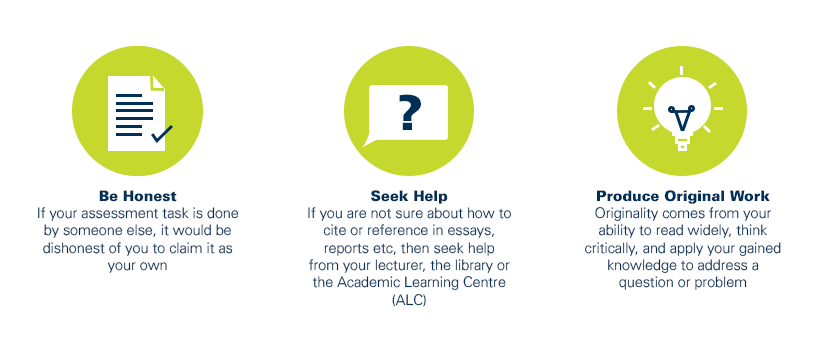
As a CQUniversity student you are expected to act honestly in all aspects of your academic work.
Any assessable work undertaken or submitted for review or assessment must be your own work. Assessable work is any type of work you do to meet the assessment requirements in the unit, including draft work submitted for review and feedback and final work to be assessed.
When you use the ideas, words or data of others in your assessment, you must thoroughly and clearly acknowledge the source of this information by using the correct referencing style for your unit. Using others’ work without proper acknowledgement may be considered a form of intellectual dishonesty.
Participating honestly, respectfully, responsibly, and fairly in your university study ensures the CQUniversity qualification you earn will be valued as a true indication of your individual academic achievement and will continue to receive the respect and recognition it deserves.
As a student, you are responsible for reading and following CQUniversity’s policies, including the Student Academic Integrity Policy and Procedure. This policy sets out CQUniversity’s expectations of you to act with integrity, examples of academic integrity breaches to avoid, the processes used to address alleged breaches of academic integrity, and potential penalties.
What is a breach of academic integrity?
A breach of academic integrity includes but is not limited to plagiarism, self-plagiarism, collusion, cheating, contract cheating, and academic misconduct. The Student Academic Integrity Policy and Procedure defines what these terms mean and gives examples.
Why is academic integrity important?
A breach of academic integrity may result in one or more penalties, including suspension or even expulsion from the University. It can also have negative implications for student visas and future enrolment at CQUniversity or elsewhere. Students who engage in contract cheating also risk being blackmailed by contract cheating services.
Where can I get assistance?
For academic advice and guidance, the Academic Learning Centre (ALC) can support you in becoming confident in completing assessments with integrity and of high standard.
What can you do to act with integrity?