Overview
In this unit, you will be introduced to the evolving concept of occupational justice and explore situations where people are deprived of meaningful occupation. You will use an occupational justice lens to look from a local and global perspective at situations where people are experiencing challenges with occupational participation and engagement. The role of the occupational therapist as a facilitator of occupational justice will be examined, using both an occupational justice framework and also occupational therapy practice models. You will develop an understanding of how occupational justice sits with social justice concepts and considerations, including concepts such as social innovation.
Details
Pre-requisites or Co-requisites
Successful completion of the following units as essential pre-requisites: OCCT11002 OCCT12006
Important note: Students enrolled in a subsequent unit who failed their pre-requisite unit, should drop the subsequent unit before the census date or within 10 working days of Fail grade notification. Students who do not drop the unit in this timeframe cannot later drop the unit without academic and financial liability. See details in the Assessment Policy and Procedure (Higher Education Coursework).
Offerings For Term 2 - 2026
Attendance Requirements
All on-campus students are expected to attend scheduled classes - in some units, these classes are identified as a mandatory (pass/fail) component and attendance is compulsory. International students, on a student visa, must maintain a full time study load and meet both attendance and academic progress requirements in each study period (satisfactory attendance for International students is defined as maintaining at least an 80% attendance record).
Recommended Student Time Commitment
Each 6-credit Undergraduate unit at CQUniversity requires an overall time commitment of an average of 12.5 hours of study per week, making a total of 150 hours for the unit.
Class Timetable
Assessment Overview
Assessment Grading
This is a graded unit: your overall grade will be calculated from the marks or grades for each assessment task, based on the relative weightings shown in the table above. You must obtain an overall mark for the unit of at least 50%, or an overall grade of 'pass' in order to pass the unit. If any 'pass/fail' tasks are shown in the table above they must also be completed successfully ('pass' grade). You must also meet any minimum mark requirements specified for a particular assessment task, as detailed in the 'assessment task' section (note that in some instances, the minimum mark for a task may be greater than 50%). Consult the University's Grades and Results Policy for more details of interim results and final grades.
All University policies are available on the CQUniversity Policy site.
You may wish to view these policies:
- Grades and Results Policy
- Assessment Policy and Procedure (Higher Education Coursework)
- Review of Grade Procedure
- Student Academic Integrity Policy and Procedure
- Academic Progression Policy and Procedure
- Student Refund and Credit Balance Policy and Procedure
- Complaints Policy and Procedure
- Information and Communications Technology Acceptable Use Policy and Procedure
This list is not an exhaustive list of all University policies. The full list of University policies are available on the CQUniversity Policy site.
Feedback, Recommendations and Responses
Every unit is reviewed for enhancement each year. At the most recent review, the following staff and student feedback items were identified and recommendations were made.
Feedback from SUTE feedback
The use of both Microsoft TEAMS and Moodle made it challenging to know where to access unit updates or information.
It is recommended that the teaching team choose one communication platform and use it for consistent communication with students throughout the term.
Feedback from SUTE feedback
The unit content was insightful and informative, however, care should be taken to ensure a safe learning environment is maintained when discussing topics such as inclusion, race, cultural diversity and trauma.
It is recommended that the teaching team continue to liase with experts such as the CQU Safer Communities and the Indigenous Engagement Division to foster safe and inclusive environments.
Feedback from SUTE feedback
The online delivery method supported engagement and the lecture recordings supported further learning.
It is recommended that the unit continues to be offered in an online format and recordings made available to students.
- Articulate the concept of occupational justice at a local and global level.
- Identify and describe situations where people are deprived of meaningful occupation and explore the causes.
- Articulate the role of the occupational therapy in promoting occupational justice.
- Identify and describe occupational injustice occurring in a local community and the programs and measures being taken to address those injustice issues.
Alignment of Assessment Tasks to Learning Outcomes
| Assessment Tasks | Learning Outcomes | |||
|---|---|---|---|---|
| 1 | 2 | 3 | 4 | |
| 1 - Critical Review - 20% | ||||
| 2 - Oral Examination - 35% | ||||
| 3 - Presentation - 45% | ||||
Alignment of Graduate Attributes to Learning Outcomes
| Graduate Attributes | Learning Outcomes | |||
|---|---|---|---|---|
| 1 | 2 | 3 | 4 | |
| 1 - Communication | ||||
| 2 - Problem Solving | ||||
| 3 - Critical Thinking | ||||
| 4 - Information Literacy | ||||
| 5 - Team Work | ||||
| 6 - Information Technology Competence | ||||
| 7 - Cross Cultural Competence | ||||
| 8 - Ethical practice | ||||
| 9 - Social Innovation | ||||
| 10 - First Nations Knowledges | ||||
| 11 - Aboriginal and Torres Strait Islander Cultures | ||||
Textbooks
There are no required textbooks.
IT Resources
- CQUniversity Student Email
- Internet
- Unit Website (Moodle)
- Full licenced version of Microsoft Office 2013 or Office 2016 (including Word, Excel and Powerpoint) or Microsoft Office 2011 for Mac.
- Microsoft Teams (both microphone and webcam capability)
- Zoom access: microphone and webcam required
All submissions for this unit must use the referencing style: American Psychological Association 7th Edition (APA 7th edition)
For further information, see the Assessment Tasks.
r.reddiex@cqu.edu.au
k.l.graham@cqu.edu.au
Week 1
Begin Date: 13 Jul 2026Module/Topic
Introduction to Occupational Justice Part 1: Its History and Evolution.
Chapter
Bailliar, A. (2024). Occupational justice. In G. Gillen & C. Brown (Eds.), Willard and Spackman’s Occupational Therapy (14th ed., pp. 139-160). Wolters Kluwer. (Ch. 10).
Bailliard, A.L., Dallman, A.R., & Szendrey, S. (2020). Doing Occupational Justice: A central dimension of everyday occupational therapy practice. Canadian Journal of Occupational Therapy, 87(2), 144-152. doi:10.1177/0008417419898930
Occupational Therapy Australia Social Justice Groups: https://otaus.com.au/social-justice-groups
Events and Submissions/Topic
ONLINE ZOOM CLASS 9:00am - 11:00am
SELF-DIRECTED STUDY: 11:00am - 1:00pm
Assessment 1 Group Allocations:
Students are required to allocate themselves to a journal article via the group choice selection tool in the Week 5 Moodle tile by 5:00pm Friday 17/07/2025.
Note: Based on current enrolled numbers there will be one group of four (4). Pending enrolled numbers pre and post census date there may be additional changes to group sizes.
Week 2
Begin Date: 20 Jul 2026Module/Topic
Introduction to Occupational Justice Part 2: Becoming a Changemaker
Chapter
Truman, J. L., Fox, J., Hynes, S. M., Hills, C., McGinley, S. L., Ekstam, L., Shiel, A., & Orban, K. (2021). Developing understandings of occupational (in)justice with occupational therapy students in a transnational project. Journal of Occupational Science, 28(4), 588-598. doi:10.1080/14427591.2020.1858940
Picotin, J., Beaudoin, M., Hélie, S., Martin, A. É., & Carrier, A. (2021). Occupational therapists as social change agents: Exploring factors that influence their actions. Canadian Journal of Occupational Therapy, 88(3), 231-243. doi:10.1177/00084174211022891
Occupational Therapy Australia (2016). OT Australia position statement: Occupational deprivation. doi:10.1111/1440-1630.12347
Events and Submissions/Topic
ONLINE ZOOM CLASS 9:00am - 11:00am
SELF-DIRECTED STUDY: 11:00am - 1:00pm
Week 3
Begin Date: 27 Jul 2026Module/Topic
Application of Models and Frameworks for Occupational Justice
Chapter
Pereira, R. B., Whiteford, G., Hyett, N., Weekes, G., Di Tommaso, A., & Naismith, J. (2020). Capabilities, Opportunities, Resources and Environments (CORE): Using the CORE approach for inclusive, occupation-centred practice. Australian Occupational Therapy Journal, 67(2), 162-171. doi:10.1111/1440-1630.12642
Whiteford, G., Jones, K., Rahal, C., & Suleman, A. (2018). The Participatory Occupational Justice Framework as a tool for change: Three contrasting case narratives. Journal of Occupational Science, 25(4), 497-508. doi:10.1080/14427591.2018.1504607
Huppatz, E., George, E., Wicks, A., & Whiteford, D. (2024). Exploring occupational participation and engagement during disaster through the lens of the Participatory Occupational Justice Framework. Journal of Occupational Science, 31(1), 71-83. doi:10.1080/14427591.2024.2394158
Events and Submissions/Topic
ON-CAMPUS WORKSHOP
Students are required to attend the lecture and workshop on-campus from 9:00am-1:00pm.
BDG: Room 01/G.27
ROK: Room 34/G.15
Week 4
Begin Date: 03 Aug 2026Module/Topic
First Nations Peoples and Occupational Justice
Chapter
Meechan, E., Geia, L., Taylor, M., Murrary, D., Stothers, K., Gibson, P., Devine, S., & Barker, R. (2024). Culturally responsive occupational therapy practice with First Nations Peoples - A scoping review. Australian Journal of Rural Health, 32(4), 617-671. https://doi.org/10.1111/ajr.13143
Richards, K., Reed, K., & Parrish, A. (2025). Exploring first-year occupational therapy students' perspectives of an On-Country experience: A study from an Australian undergradate program. Australian Occupational Therapy Journal, 72(3), e700719. doi:10.1111/1440-1630.70019
Emery-Whittington, I.G. (2025). Undoing coloniality: An indigenous occupation-based perspective. In T. Brown, S. Isbel, L. Gustafsson, S. Gutman, D. Powers Dirette, B. Collins & T. Barlott (Eds), Human occupation contemporary concepts and lifespan perspectives (pp. 191-208). Routledge.
Occupational Therapy Australia. (2023). Reconciliation action plan https://otaus.com.au/reconciliation
Events and Submissions/Topic
ONLINE ZOOM CLASS 9:00am - 11:00am
SELF-DIRECTED STUDY: 11:00am - 1:00pm
Week 5
Begin Date: 10 Aug 2026Module/Topic
Assessment Task 1 Group Presentations: Application of Occupational Justice Concepts in Practice
Chapter
Events and Submissions/Topic
ON-CAMPUS ASSESSMENT 1 PRESENTATIONS
Students are required to attend campus for the duration of Assessment 1 Presentations. Presentations will commence at 8:00am 13/08/2025.
BDG: Room 01/G.27
ROK: Room 34/G.15
Note: Presentations must be submitted to Moodle by 5:00pm Wednesday (13/08/2025)
Application of Occupational Justice Concepts Due: Week 5 Wednesday (12 Aug 2026) 5:00 pm AEST
Week 6
Begin Date: 17 Aug 2026Module/Topic
Exploring Occupation Beyond the Individual: Family and Collective Occupations
Chapter
Serrata Malfitano, A. P., Whiteford, G., & Molineux, M. (2021). Transcending the individual: The promise and potential of collectivist approaches in occupational therapy. Scandinavian Journal of Occupational Therapy, 28(3), 188-200. doi:10.1080/11038128.2019.1693627
Dos Santos, V & Frank, G. (2025). Creativity, hope, and collective emancipatory experimentation: Tools for social transformation through occupational therapy. In T. Brown, S. Isbel, L. Gustafsson, S. Gutman, D. Powers Dirette, B. Collins & T. Barlott (Eds), Human occupation contemporary concepts and lifespan perspectives (pp. 249-266). Routledge.
Events and Submissions/Topic
ONLINE ZOOM CLASS 9:00am - 11:00am
SELF-DIRECTED STUDY: 11:00am - 1:00pm
Vacation Week
Begin Date: 24 Aug 2026Module/Topic
VACATION WEEK
Chapter
Events and Submissions/Topic
Week 7
Begin Date: 31 Aug 2026Module/Topic
Human-Centred Design: An Approach to be Socially Innovative
Chapter
Lo Bianco, M., Layton, N., Renda, G., & McDonald, R. (2020). "I think I could have designed it better, but I didn't think that it was my place": A critical review of home modification practices from the perspectives of health and of design. Disability and Rehabilitation: Assistive Technology, 20(7), 781-788. doi:10.1080/17483107.2020.1749896
Harniess, P. A., Gibbs, D., Bezemer, J., & Purna Basu, A. (2021). Parental engagement in early intervention for infants with cerebral palsy - A realist synthesis. Child: Care, Health and Development, 48(3), 359-377. doi:10.1111/cch.12916
Fakoya, I., Cole, C., Larkin, C., Punton, M., Brown, E., & Ballonoff Suleiman, A. (2021). Enhancing human-centred design with youth-led participatory action research approaches for adolescent sexual and reproductive health programming. Health Promotion Practice, 23(1), 25-31. doi:10.1177/15248 399211003544
Events and Submissions/Topic
ON-CAMPUS WORKSHOP
Students are required to attend the lecture and workshop on-campus from 9:00am-1:00pm.
BDG: Room 01/G.27
ROK: Room 34/G.15
Week 8
Begin Date: 07 Sep 2026Module/Topic
Occupational Justice and Disability
Chapter
Ravindran, S., Brentnall, J., & Gilroy, J. (2017). Conceptualising disability: A critical comparison between Indigenous people in Australia and New South Wales disability service agencies. Australian Journal of Social Issues, 52(4), 367-387. doi:10.1002/ajs4.25
Lysaght, R. M., & Bobbette, N. (2024). The relationship of productivity-based wages to human rights and occupational justice - an exploratory study. Journal of Intellectual & Developmental Disability, 49(3), 263-275. doi:10.3109/13668250.2023.2249276
Australian Council of Learned Academies (ACOLA). (2022). Ensuring occupations are responsive to people with disability. [Part A, 12-23] www.acola.org
Events and Submissions/Topic
ONLINE ZOOM CLASS 9:00am - 11:00am
SELF-DIRECTED STUDY: 11:00am - 1:00pm
Week 9
Begin Date: 14 Sep 2026Module/Topic
Addressing Occupational Injustices by Applying Perspectives from Life Course, Social Justice, and Anthropology
Chapter
Chapman, H. J., & Veras-Estévez, B. A. (2020). Strengthening global health content in health professions curricula. Health Education Journal, 79(7), 839-850. doi:10.1177/0017896920915231
Yang, C., Schorpp, K., Boen, C., Johnson, M., & Harris, K.M. (2020). Socioeconomic status and biological risks for health and illness across the life course. The Journals of Gerontology, 75(3), 613-624. doi:10.1093/geronb/gby108
Hikaka, J., Ihimaera, L., Vercoe, H., Parsons, J. (2025). Experiences of accessing injury prevention, treatment and rehabilitation services for older Māori. Australasian Journal of Ageing, 44(1), e13413. doi:10.1111/ajag.13413
Events and Submissions/Topic
ASSESSMENT 2 (ORAL EXAMINATION) will occur between 8:00am - 4:00pm. Oral examination schedule will be made available to students via Moodle by Friday Week 7 (04/09/26).
No scheduled ZOOM class. To accomodate Assessment 2, Week 9's lecture content will be pre-recorded and students will be required to engage with the content at their own pace.
In Week 9, the Unit Coordinator will allocate three (3) on-campus debate topics (informed by current occupational justice literature) to affirmative and negative teams in preparation for the Week 10 on-campus workshop. This information will be made available via Moodle.
Occupational Justice at the Collective or Global Level Due: Week 9 Thursday (17 Sept 2026) 8:00 am AEST
Week 10
Begin Date: 21 Sep 2026Module/Topic
Occupational Rights & Justice in Action
Chapter
Hammell, K. W. (2021). Securing occupational rights by addressing capabilities: A professional obligation. Scandinavian Journal Occupational Therapy, 29(1), 1-12. doi:10.1080/11038128.2021.1895308
Hammell, K. & Began, B. (2017). Occupational injustice: A critique. Canadian Journal of Occupational Therapy, 84(1), 58-68. doi:10.1177/0008417416638858.
Jaegers, L.A., Dieleman, C., Dillon, M. B., Rogers, S., Munoz, J. P., & Barney, K. F. (2020). Justice-based occupational therapy initiative: Advancing occupational justice in criminal justice systems. Annals of International Occupational Therapy, 3(4), 200-208.doi:10.3928/24761222-20200309-02
Events and Submissions/Topic
ON-CAMPUS WORKSHOP: The Occupational Justice Great Debate. Three relevant debate topics will be argued between affirmative and negative teams.
Students are required to attend the lecture and workshop on-campus from 9:00am-1:00pm.
BDG: Room 01/G.27
ROK: Room 34/G.15
Week 11
Begin Date: 28 Sep 2026Module/Topic
Bringing it all Together in Occupational Therapy Practice
Chapter
Crawford, E., Aplin, T & Rodger, S. (2017). Human rights in occupational therapy education: A step towards a more occupationally just global society. Australian Occupational Therapy Journal, 64(2), 129-136. doi:10.1111/1440-1630.12321
Murray, F., Hess, K. Y., & Rihtman, T. (2023). Environmentally sustainable person-centred care: Occupational therapy students' attitudes, perceptions and self-percieved prepardness for practice. Australian Ocucpational Therapy Journal, 72(1), e12998. doi:10.1111/1440-1630.12998
Serrata Malfitano, A. P., da Mota de Souza, R. G., Townsend, E. A., & Esquerdo Lopes, R. (2019). Do occupational justice concepts inform occupational therapists' practice? A scoping review. Canadian Journal of Occupational Therapy, 86(4), 299-312. doi: 10.1177/0008417419833409
Events and Submissions/Topic
ONLINE ZOOM CLASS 9:00am - 11:00am
SELF-DIRECTED STUDY: 11:00am - 1:00pm
Week 12
Begin Date: 05 Oct 2026Module/Topic
Assessment 3 Individual Summary Presentations: Advocacy, Change-making and Social Innovation through an Occupational Justice Lens
Chapter
Events and Submissions/Topic
ON-CAMPUS ASSESSMENT 3 PRESENTATIONS
Students are required to attend campus for the duration of Assessment 3 Presentations. Presentations will commence at 8:00am 08/10/2025.
BDG: Room 01/G.27
ROK: Room 34/G.15
Note: Presentations must be submitted to Moodle by 8:00am Thursday (08/10/2025)
Advocacy, Change-making and Social Innovation through Occupational Justice Due: Week 12 Thursday (8 Oct 2026) 8:00 am AEST
Exam Week
Begin Date: 12 Oct 2026Module/Topic
Chapter
Events and Submissions/Topic
Vacation/Exam Week
Begin Date: 19 Oct 2026Module/Topic
Chapter
Events and Submissions/Topic
1 Critical Review
This assessment requires you to prepare and deliver an oral presentation in student groups based on an analysis of a piece of current occupational justice literature. In groups of three (3) students, prepare and deliver an oral presentation that analyses a piece of current occupational justice literature. Your group's journal article will be chosen by students utilising the group choice tool available in the Week 5 Moodle Tile.
Use of PowerPoint or similar program to prepare the key points of your oral presentation is recommended for effective communication of your content to the audience.
Individual marks will be allocated to students based on their presentation skills and ability to respond to peer and assessor questions.
Week 5 Wednesday (12 Aug 2026) 5:00 pm AEST
Presentations to occur in-class on Thursday (Week 5) from 8:00am. Upload your presentation slides to Moodle by 5:00pm on the Wednesday prior to the presentations..
Week 7 Thursday (3 Sept 2026)
Results will be returned via Moodle.
- Identification and explanation of the relevant occupational justice issue/s (10 marks)
- Analysis of the injustices and translation to occupational therapy practice and future research opportunities (10 marks)
- Professionalism in presentation style (5 marks)
- Use of evidence-based literature to support content, inclusive of correct APA 7th in-slide citations and reference list (5 marks)
- Individual presentation style; reflection skills, insight on knowledge of occupational justice concepts, responsiveness to audience questions (10 marks)
- Articulate the concept of occupational justice at a local and global level.
- Articulate the role of the occupational therapy in promoting occupational justice.
2 Oral Examination
This assessment task is an oral examination that will be a live question-and-answer session where the examiner will ask you question and record the anwers.
In this oral examination, you will be expected to demonstrate your developing knowledge of the occupational injustices experienced by a specific group or collective. You will be required to provide a description of the issues relevant to the specific group, the occupational injustices experienced, the role of advocacy in overcoming the injustices and an explanation of how the Participatory Occupational Justice Framework (POJF) could enact change on this issue. Engagement with unit content, prescribed readings and self-directed study tasks will be essential to achieving success in this assessment task. Current literature will guide your understanding of the potential occupational injustice challenges, the role of OT and the application of the POJF to the specific group/collective.
Students will have 5 minutes to peruse the allocated group or collective information prior to the examination component commencing. Students will then have 15 minutes to answer a series of questions.
Week 9 Thursday (17 Sept 2026) 8:00 am AEST
Students will complete their oral examinations between 8:00am-4:00pm. Examination schedule will be released to Moodle in Week 7.
Week 11 Thursday (1 Oct 2026)
Results will be returned via Moodle.
- Quality description and quality of analysis of the global/collective issue (15 marks)
- Ability to identify and describe the relevant occupational injustice challenge/s (15 marks)
- Description of the role of advocacy relative to the allocated group/collective (15 marks)
- Application of the Participatory Occupational Justice Framework (POJF) (15 marks)
- Oral communication skills (10 marks)
- Identify and describe situations where people are deprived of meaningful occupation and explore the causes.
- Articulate the role of the occupational therapy in promoting occupational justice.
- Identify and describe occupational injustice occurring in a local community and the programs and measures being taken to address those injustice issues.
3 Presentation
To complete this assessment, you are required to draw upon the current co-design literature and occupational therapy/disability/technology/health professions literature to investigate one (1) example of a ‘wicked problem’ and describe how it is being addressed. You will use your knowledge from CQUniversity’s Social Innovation i-Change module which you have already completed in your studies. The knowledge gained from this module (and from this unit) will inform you to consider what a ‘wicked problem’ or ‘grand challenge’ is and to understand that many solutions in the occupational therapy/disability/technology/health professions’ literature address a ‘direct service’ approach to those problems. This assessment task aims to build upon your knowledge from earlier assessments where you have taken your perspective from an individual therapeutic approach to a more collective approach, but this time the focus is more on diagnostic groups/wicked problems and co-design.
Students will be allocated a time slot within the class schedule in Week 12 to present a five-minute summary presentation. At the conclusion of your presentation you will be required to defend your ideas through targeted questions posed by your assessor.
Week 12 Thursday (8 Oct 2026) 8:00 am AEST
Students must submit their summary poster to Moodle by 8:00am on the morning of the presentation. Students will then present during an allocated time slot from 8:00am on 08/10/2026.
Vacation/Exam Week Thursday (22 Oct 2026)
Results will be returned via Moodle.
- Description and analysis of the 'wicked problem' as it relates to relevant literature from the social innovation, human-centred design and sustainable development goals fields (15 marks)
- Clear description of the solution referenced with sources from the co-design literature (10 marks)
- Analysis of how the solution exemplifies advocacy and/or change-making and/or social innovation (10 marks)
- Articulation and analysis of the relevant occupational justices being addressed (10 marks)
- Identification and analysis of how the solution fosters participation in occupation (10 marks)
- Defence of Ideas (10 marks)
- Oral presentation skills (5 marks)
- Poster presentation (5 marks)
- Application of APA 7th requirements in poster presentation (5 marks)
No submission method provided.
- Articulate the concept of occupational justice at a local and global level.
- Identify and describe situations where people are deprived of meaningful occupation and explore the causes.
- Identify and describe occupational injustice occurring in a local community and the programs and measures being taken to address those injustice issues.
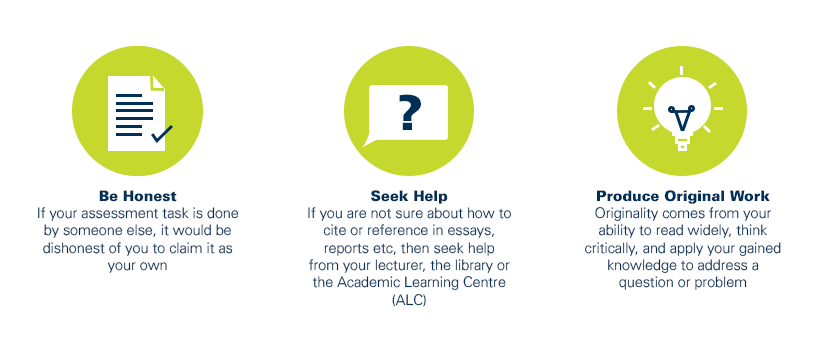
As a CQUniversity student you are expected to act honestly in all aspects of your academic work.
Any assessable work undertaken or submitted for review or assessment must be your own work. Assessable work is any type of work you do to meet the assessment requirements in the unit, including draft work submitted for review and feedback and final work to be assessed.
When you use the ideas, words or data of others in your assessment, you must thoroughly and clearly acknowledge the source of this information by using the correct referencing style for your unit. Using others’ work without proper acknowledgement may be considered a form of intellectual dishonesty.
Participating honestly, respectfully, responsibly, and fairly in your university study ensures the CQUniversity qualification you earn will be valued as a true indication of your individual academic achievement and will continue to receive the respect and recognition it deserves.
As a student, you are responsible for reading and following CQUniversity’s policies, including the Student Academic Integrity Policy and Procedure. This policy sets out CQUniversity’s expectations of you to act with integrity, examples of academic integrity breaches to avoid, the processes used to address alleged breaches of academic integrity, and potential penalties.
What is a breach of academic integrity?
A breach of academic integrity includes but is not limited to plagiarism, self-plagiarism, collusion, cheating, contract cheating, and academic misconduct. The Student Academic Integrity Policy and Procedure defines what these terms mean and gives examples.
Why is academic integrity important?
A breach of academic integrity may result in one or more penalties, including suspension or even expulsion from the University. It can also have negative implications for student visas and future enrolment at CQUniversity or elsewhere. Students who engage in contract cheating also risk being blackmailed by contract cheating services.
Where can I get assistance?
For academic advice and guidance, the Academic Learning Centre (ALC) can support you in becoming confident in completing assessments with integrity and of high standard.
What can you do to act with integrity?