Overview
Foundation Mathematics is designed to provide you with foundation concepts, rules and methods of elementary mathematics. The main aim of this unit is to provide the foundations of mathematics, which are necessary to develop a unified body of knowledge. You will apply number and algebra concepts to solve problems. You will select appropriate mathematical methods to investigate and solve problems, and interpret the results. Mathematics will be used as a language to communicate results, concepts and ideas in context. You will document solutions to problems in a way that demonstrates a clear, logical and precise approach.
Details
Pre-requisites or Co-requisites
There are no requisites for this unit.
Important note: Students enrolled in a subsequent unit who failed their pre-requisite unit, should drop the subsequent unit before the census date or within 10 working days of Fail grade notification. Students who do not drop the unit in this timeframe cannot later drop the unit without academic and financial liability. See details in the Assessment Policy and Procedure (Higher Education Coursework).
Offerings For Term 1 - 2026
Attendance Requirements
All on-campus students are expected to attend scheduled classes - in some units, these classes are identified as a mandatory (pass/fail) component and attendance is compulsory. International students, on a student visa, must maintain a full time study load and meet both attendance and academic progress requirements in each study period (satisfactory attendance for International students is defined as maintaining at least an 80% attendance record).
Recommended Student Time Commitment
Each 6-credit Undergraduate unit at CQUniversity requires an overall time commitment of an average of 12.5 hours of study per week, making a total of 150 hours for the unit.
Class Timetable
Assessment Overview
Assessment Grading
This is a pass/fail (non-graded) unit. To pass the unit, you must pass all of the individual assessment tasks shown in the table above.
All University policies are available on the CQUniversity Policy site.
You may wish to view these policies:
- Grades and Results Policy
- Assessment Policy and Procedure (Higher Education Coursework)
- Review of Grade Procedure
- Student Academic Integrity Policy and Procedure
- Academic Progression Policy and Procedure
- Student Refund and Credit Balance Policy and Procedure
- Complaints Policy and Procedure
- Information and Communications Technology Acceptable Use Policy and Procedure
This list is not an exhaustive list of all University policies. The full list of University policies are available on the CQUniversity Policy site.
Feedback, Recommendations and Responses
Every unit is reviewed for enhancement each year. At the most recent review, the following staff and student feedback items were identified and recommendations were made.
Feedback from Unit coordinator reflection
The portfolio assessment task requires clearer definition.
Revise the portfolio assessment requirements to provide additional clarity.
Feedback from Student unit evaluation data
Students reported a high level of satisfaction with the unit.
Maintain current teaching and learning practices.
- Apply number and algebra concepts to solve problems
- Use appropriate mathematical methods to investigate and solve problems including interpreting the results
- Use mathematics as a language to communicate results, concepts and ideas in context
- Document the solutions to problems in a way that demonstrates a clear, logical and precise approach.
The Learning Outcomes for this unit are linked with the Engineers Australia Stage 1 Competency Standards for Professional Engineers in the areas of 1. Knowledge and Skill Base, 2. Engineering Application Ability and 3. Professional and Personal Attributes at the following levels:
Introductory
1.2 Conceptual understanding of the mathematics, numerical analysis, statistics, and computer and information sciences which underpin the engineering discipline. (LO: 1N 2N 3N 4N)
2.1 Application of established engineering methods to complex engineering problem solving. (LO: 1N 2N)
2.2 Fluent application of engineering techniques, tools and resources. (LO: 1N 2N)
3.2 Effective oral and written communication in professional and lay domains. (LO: 3N 4N)
3.3 Creative, innovative and pro-active demeanour. (LO: 1N 2N)
3.4 Professional use and management of information. (LO: 3N 4N)
Note: LO refers to the Learning Outcome number(s) which link to the competency and the levels: N – Introductory, I – Intermediate and A - Advanced.
Refer to the Engineering Undergraduate Course Moodle site for further information on the Engineers Australia's Stage 1 Competency Standard for Professional Engineers and course level mapping information https://moodle.cqu.edu.au/course/view.php?id=1511
Alignment of Assessment Tasks to Learning Outcomes
| Assessment Tasks | Learning Outcomes | |||
|---|---|---|---|---|
| 1 | 2 | 3 | 4 | |
| 1 - Written Assessment - 0% | ||||
| 2 - Portfolio - 0% | ||||
| 3 - Examination - 0% | ||||
Alignment of Graduate Attributes to Learning Outcomes
| Graduate Attributes | Learning Outcomes | |||
|---|---|---|---|---|
| 1 | 2 | 3 | 4 | |
| 1 - Communication | ||||
| 2 - Problem Solving | ||||
| 3 - Critical Thinking | ||||
| 4 - Information Literacy | ||||
| 5 - Team Work | ||||
| 6 - Information Technology Competence | ||||
| 7 - Cross Cultural Competence | ||||
| 8 - Ethical practice | ||||
| 9 - Social Innovation | ||||
| 10 - First Nations Knowledges | ||||
| 11 - Aboriginal and Torres Strait Islander Cultures | ||||
Textbooks
Engineering Mathematics
- Ninth Edition (2021)
- Authors: John Bird
- Routledge
- New York New York , New York , USA
- ISBN: 978-0-367-64378-2
IT Resources
- CQUniversity Student Email
- Internet
- Unit Website (Moodle)
- Access to a document scanner and/or pdf converter (all assessment submitted electronically as pdf file)
- Access to a printer (for printing assessment and tutorial materials)
- Access to a webcam, speakers and microphone or a headset (for participating in Zoom lectures and tutorials)
All submissions for this unit must use the referencing style: Harvard (author-date)
For further information, see the Assessment Tasks.
j.wang@cqu.edu.au
Week 1
Begin Date: 09 Mar 2026Module/Topic
Textbook Sections 1.1 to 1.4
Chapter
Chapter 1: Revision of fractions, decimals and percentages
Events and Submissions/Topic
Textbook Practice Exercises 1 to 5 and Week 1 Tutorial Exercises
Week 2
Begin Date: 16 Mar 2026Module/Topic
Textbook Sections 2.1 to 2.3
Chapter
Chapter 2: Indices, engineering notation and metric conversions
Events and Submissions/Topic
Textbook Practice Exercises 6 to 9 and Week 2 Tutorial Exercises
Week 3
Begin Date: 23 Mar 2026Module/Topic
Textbook Sections 5.1 to 5.5
Chapter
Chapter 5: Algebra
Events and Submissions/Topic
Textbook Practice Exercises 27 to 32 and Week 3 Tutorial Exercises
Week 4
Begin Date: 30 Mar 2026Module/Topic
Textbook Sections 6.1 to 6.3
Chapter
Chapter 6: Further algebra
Events and Submissions/Topic
Textbook Practice Exercises 33 to 36 and Week 4 Tutorial Exercises
Week 5
Begin Date: 06 Apr 2026Module/Topic
Textbook Sections 7.1 to 7.4
Chapter
Chapter 7: Partial fractions
Events and Submissions/Topic
Textbook Practice Exercises 37 to 39 and Week 5 Tutorial Exercises
Week 6
Begin Date: 13 Apr 2026Module/Topic
Textbook Sections 8.1 to 8.5
Chapter
Chapter 8: Solving simple equations
Events and Submissions/Topic
Textbook Practice Exercises 40 to 44 and Week 6 Tutorial Exercises
Vacation Week
Begin Date: 20 Apr 2026Module/Topic
Chapter
Events and Submissions/Topic
Week 7
Begin Date: 27 Apr 2026Module/Topic
Textbook Sections 9.1 to 9.4
Chapter
Chapter 9: Transposition of formulae
Events and Submissions/Topic
Textbook Practice Exercises 45 to 48 and Week 7 Tutorial Exercises
Week 8
Begin Date: 04 May 2026Module/Topic
Textbook Sections 10.1 to 10.5
Chapter
Chapter 10: Solving simultaneous equations
Events and Submissions/Topic
Textbook Practice Exercises 49 to 53 and Week 8 Tutorial Exercises
Week 9
Begin Date: 11 May 2026Module/Topic
Textbook Sections 11.1 to 11.6
Chapter
Chapter 11: Solving quadratic equations
Events and Submissions/Topic
Textbook Practice Exercises 54 to 59 and Week 9 Tutorial Exercises
Week 10
Begin Date: 18 May 2026Module/Topic
Textbook Sections 12.1 to 12.6
Chapter
Chapter 12: Inequalities
Events and Submissions/Topic
Textbook Practice Exercises 60 to 65 and Week 10 Tutorial Exercises
Week 11
Begin Date: 25 May 2026Module/Topic
Textbook Sections 13.1 to 13.4
Chapter
Chapter 13: Logarithms
Events and Submissions/Topic
Textbook Practice Exercises 66 to 69 and Week 11 Tutorial Exercises
Week 12
Begin Date: 01 Jun 2026Module/Topic
Textbook Sections 14.1 to 14.5
Chapter
Chapter 14: Exponential functions
Events and Submissions/Topic
Textbook Practice Exercises 70 to 75 and Week 12 Tutorial Exercises
Exam Week
Begin Date: 08 Jun 2026Module/Topic
Chapter
Events and Submissions/Topic
Vacation/Exam Week
Begin Date: 15 Jun 2026Module/Topic
Chapter
Events and Submissions/Topic
1 Written Assessment
Students will progress through a series of Competency Tests linked to the textbook, Engineering Mathematics.
Upon completion of the prescribed weekly coursework, students are required to complete the corresponding Competency Test.
The test is then submitted for marking and feedback. Each competency test requires a result of 80% or more.
If a submission results in less than 80%, students must review the coursework and then complete and pass an additional Competency Test.
Below is the guideline for AI usage (Artificial Intelligence)
AI ASSESSMENT SCALE - AI COLLABORATION.
You are encouraged to use computer software, or similar, or online AI tools to verify and validate any aspects of your solutions to the posed assignment problems. You may use AI tools to rewrite/edit to clarify or refine your ideas. If AI is used to edit/refine your final submission, you must acknowledge the use of AI tools, and the original work must be provided for comparison.
While you can use AI to improve the clarity or quality of the work, no new content can be created using AI unless specifically allowed in the assessment.
The Competency Test will be due by Tuesday 5:00PM AEST in the week following the associated prescribed course work. Due dates will be as advised on the MATH11247 Moodle site.
It is envisaged that feedback will be available within two weeks, or as soon as the marking process is completed.
Questions are from course content covered in the week associated with the competency test. Solutions are awarded full marks if they are error-free, partial marks if there are some errors, and no marks if not attempted or contain so many errors as to render the attempt to be without value.
- Apply number and algebra concepts to solve problems
- Use appropriate mathematical methods to investigate and solve problems including interpreting the results
- Use mathematics as a language to communicate results, concepts and ideas in context
- Document the solutions to problems in a way that demonstrates a clear, logical and precise approach.
2 Portfolio
Students will develop and submit a portfolio. This task aims to reward all students in the unit for their continuing efforts in the unit and their focus on progressing the prescribed weekly coursework.
The portfolio submission is the workbook of solutions the student develops for the prescribed weekly coursework. This task is divided into three parts: Workbook (Part 1), Workbook (Part 2), and Workbook (Part 3).
Students submit their personally developed solutions to questions from the practice exercises related to the unit textbook. Completing these exercises is prescribed as the minimal weekly level of effort required to grasp the essentials of MATH11247 Foundation Mathematics.
The workbooks will capture and formalise the portfolio of work that students engage with as they progress through the unit. Students will develop and submit workbooks progressively during the term. They are permitted to take these workbooks into the examination at the end of the term.
Each workbook, contributing to the portfolio, will be graded as either Pass or Fail. If a Fail is awarded, students are allowed to review their feedback and then submit a revised workbook submission that addresses the feedback.
Below is the guideline for AI usage (Artificial Intelligence)
AI ASSESSMENT SCALE - AI COLLABORATION.
You are encouraged to use computer software, or similar, or online AI tools to verify and validate any aspects of your solutions to the posed assignment problems. You may use AI tools to rewrite/edit to clarify or refine your ideas. If AI is used to edit/refine your final submission, you must acknowledge the use of AI tools, and the original work must be provided for comparison.
While you can use AI to improve the clarity or quality of the work, no new content can be created using AI unless specifically allowed in the assessment.
Due dates will be as advised on the MATH11247 Moodle site.
It is envisaged that feedback will be available within two weeks, or as soon as the marking process is completed.
The portfolio consists of a series of workbooks. Each workbook is to contain:
1) numbered pages;
2) student signature on each page of the workbook of solutions;
3) solutions, personally developed by the student, to each problem in the prescribed weekly coursework;
4) Each solution is identified by its associated practice exercise and question number;
5) a workbook index linking the developed solutions with the prescribed weekly coursework; and
6) a university standard of presentation.
- Apply number and algebra concepts to solve problems
- Use appropriate mathematical methods to investigate and solve problems including interpreting the results
- Use mathematics as a language to communicate results, concepts and ideas in context
- Document the solutions to problems in a way that demonstrates a clear, logical and precise approach.
Examination
Calculator - all non-communicable calculators, including scientific, programmable and graphics calculators are authorised
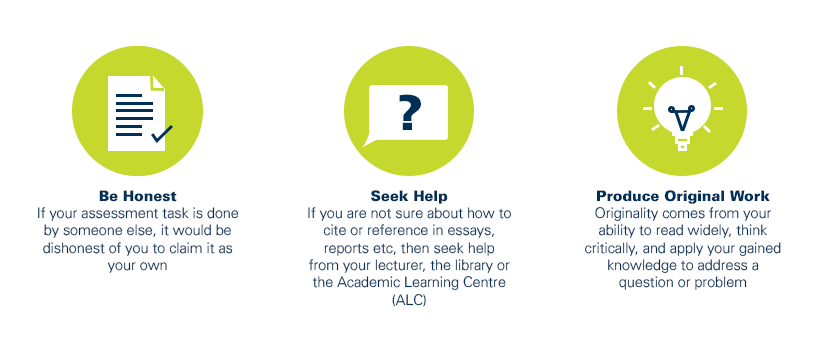
As a CQUniversity student you are expected to act honestly in all aspects of your academic work.
Any assessable work undertaken or submitted for review or assessment must be your own work. Assessable work is any type of work you do to meet the assessment requirements in the unit, including draft work submitted for review and feedback and final work to be assessed.
When you use the ideas, words or data of others in your assessment, you must thoroughly and clearly acknowledge the source of this information by using the correct referencing style for your unit. Using others’ work without proper acknowledgement may be considered a form of intellectual dishonesty.
Participating honestly, respectfully, responsibly, and fairly in your university study ensures the CQUniversity qualification you earn will be valued as a true indication of your individual academic achievement and will continue to receive the respect and recognition it deserves.
As a student, you are responsible for reading and following CQUniversity’s policies, including the Student Academic Integrity Policy and Procedure. This policy sets out CQUniversity’s expectations of you to act with integrity, examples of academic integrity breaches to avoid, the processes used to address alleged breaches of academic integrity, and potential penalties.
What is a breach of academic integrity?
A breach of academic integrity includes but is not limited to plagiarism, self-plagiarism, collusion, cheating, contract cheating, and academic misconduct. The Student Academic Integrity Policy and Procedure defines what these terms mean and gives examples.
Why is academic integrity important?
A breach of academic integrity may result in one or more penalties, including suspension or even expulsion from the University. It can also have negative implications for student visas and future enrolment at CQUniversity or elsewhere. Students who engage in contract cheating also risk being blackmailed by contract cheating services.
Where can I get assistance?
For academic advice and guidance, the Academic Learning Centre (ALC) can support you in becoming confident in completing assessments with integrity and of high standard.
What can you do to act with integrity?