Overview
LAWS13009 Corporations Law examines the various business structures available under Australian law, with a particular focus on companies. Topics include partnerships, corporate personality; the incorporation process; the corporate constitution; company contracts; administration of companies and management of the business of companies; duties and liabilities of directors and officers; share capital and membership; members’ remedies; company credit and security arrangements; and winding up of companies. This unit meets the LPAB requirements for company law.
Details
Pre-requisites or Co-requisites
Prerequisite: 48 credit points of law including LAWS11057.
Important note: Students enrolled in a subsequent unit who failed their pre-requisite unit, should drop the subsequent unit before the census date or within 10 working days of Fail grade notification. Students who do not drop the unit in this timeframe cannot later drop the unit without academic and financial liability. See details in the Assessment Policy and Procedure (Higher Education Coursework).
Offerings For Term 1 - 2026
Attendance Requirements
All on-campus students are expected to attend scheduled classes - in some units, these classes are identified as a mandatory (pass/fail) component and attendance is compulsory. International students, on a student visa, must maintain a full time study load and meet both attendance and academic progress requirements in each study period (satisfactory attendance for International students is defined as maintaining at least an 80% attendance record).
Recommended Student Time Commitment
Each 6-credit Undergraduate unit at CQUniversity requires an overall time commitment of an average of 12.5 hours of study per week, making a total of 150 hours for the unit.
Class Timetable
Assessment Overview
Assessment Grading
This is a graded unit: your overall grade will be calculated from the marks or grades for each assessment task, based on the relative weightings shown in the table above. You must obtain an overall mark for the unit of at least 50%, or an overall grade of 'pass' in order to pass the unit. If any 'pass/fail' tasks are shown in the table above they must also be completed successfully ('pass' grade). You must also meet any minimum mark requirements specified for a particular assessment task, as detailed in the 'assessment task' section (note that in some instances, the minimum mark for a task may be greater than 50%). Consult the University's Grades and Results Policy for more details of interim results and final grades.
All University policies are available on the CQUniversity Policy site.
You may wish to view these policies:
- Grades and Results Policy
- Assessment Policy and Procedure (Higher Education Coursework)
- Review of Grade Procedure
- Student Academic Integrity Policy and Procedure
- Academic Progression Policy and Procedure
- Student Refund and Credit Balance Policy and Procedure
- Complaints Policy and Procedure
- Information and Communications Technology Acceptable Use Policy and Procedure
This list is not an exhaustive list of all University policies. The full list of University policies are available on the CQUniversity Policy site.
Feedback, Recommendations and Responses
Every unit is reviewed for enhancement each year. At the most recent review, the following staff and student feedback items were identified and recommendations were made.
Feedback from Based on student feedback during tutorials during semester.
Use tutorials to learn note taking and exam technique.
Continue to develop and use problem questions to develop students' capacity to prepare notes for and to sit examinations.
Feedback from SUTE data and email feedback from students.
No other specific feedback - the SUTE data/feedback reflected students' satisfaction with the current format and approach taken in the subject.
Will continue to engage with students to ensure they are happy with the approach during next iteration of the subject in 2026.
Feedback from SUTE data.
Feedback regarding difficulty of providing a legal opinion on content not already covered.
Ensure more announcements (more than three next time) on the fact that the assignment is a research assignment, intended to test students' ability to research a topic in the subject area as part of external accreditation body's requirements. As such, the assignment will necessarily have to cover matters not covered in classes before the due date for the assessment.
- Explain and advise on the structure and set-up of different business organisations and their internal governance, rights, duties and termination procedures.
- Explain and advise on the legal relationship between business organisations, third parties, external administrators (if any), and regulatory authorities.
- Explain and advise on company finance and the regulation of markets for the issue, sale and purchase of company securities.
Alignment of Assessment Tasks to Learning Outcomes
| Assessment Tasks | Learning Outcomes | ||
|---|---|---|---|
| 1 | 2 | 3 | |
| 1 - Practical Assessment - 50% | |||
| 2 - Examination - 50% | |||
Alignment of Graduate Attributes to Learning Outcomes
| Graduate Attributes | Learning Outcomes | ||
|---|---|---|---|
| 1 | 2 | 3 | |
| 1 - Communication | |||
| 2 - Problem Solving | |||
| 3 - Critical Thinking | |||
| 4 - Information Literacy | |||
| 5 - Team Work | |||
| 6 - Information Technology Competence | |||
| 7 - Cross Cultural Competence | |||
| 8 - Ethical practice | |||
| 9 - Social Innovation | |||
| 10 - First Nations Knowledges | |||
| 11 - Aboriginal and Torres Strait Islander Cultures | |||
Textbooks
Australian Corporate Law
- 8th edition (2023)
- Authors: Hargovan, A, Adams, M, & Brown, C
- LexisNexis Butterworths
- Sydney Sydney , NSW , Australia
- ISBN: 9780409356441
IT Resources
- CQUniversity Student Email
- Internet
- Unit Website (Moodle)
- Camera and microphone for attending Zoom tutorials
All submissions for this unit must use the referencing style: Australian Guide to Legal Citation, 4th ed
For further information, see the Assessment Tasks.
j.french@cqu.edu.au
Week 1 Business Structures, Corporate Personality and Regulation
Begin Date: 09 Mar 2026Module/Topic
Business Structures, Corporate Personality and Regulation
Chapter
Anil Hargovan, Michael Adams and Catherine Brown, Australian Corporate Law (LexisNexis, 8th ed, 2023 ), Ch 3 (pp 54-68, 76-93), Ch 4 (pp 105-146).
Events and Submissions/Topic
Week 2 Nature of a Company and its Promoters
Begin Date: 16 Mar 2026Module/Topic
The Nature of the Company and its Promoters
Chapter
Anil Hargovan, Michael Adams and Catherine Brown, Australian Corporate Law (LexisNexis, 8th ed, 2023 ), Ch 5 (all), Ch 2 (pp 26-37), Ch 8.
Events and Submissions/Topic
Week 3 Internal Governance and Management Structures
Begin Date: 23 Mar 2026Module/Topic
Internal Governance and Management Structures
Chapter
Anil Hargovan, Michael Adams and Catherine Brown, Australian Corporate Law (LexisNexis, 8th ed,
2023 ). Ch 6, Ch 13, Ch 19 (pp 617-620).
Events and Submissions/Topic
Week 4 Company Liabilities
Begin Date: 30 Mar 2026Module/Topic
Company Liabilities
Chapter
Anil Hargovan, Michael Adams and Catherine Brown, Australian Corporate Law (LexisNexis, 8th ed, 2023 ), Ch 7.
Events and Submissions/Topic
Week 5 Directors' Role and Fiduciary Duties
Begin Date: 06 Apr 2026Module/Topic
Directors' Role and Fiduciary Duties
Chapter
Anil Hargovan, Michael Adams and Catherine Brown, Australian Corporate Law (LexisNexis, 8th ed, 2023 ), Chs 14, 15 and 16.
Events and Submissions/Topic
Week 6 Directors' Duty of Care and Insolvent Trading
Begin Date: 13 Apr 2026Module/Topic
Directors' Duty of Care and Insolvent Trading
Chapter
Anil Hargovan, Michael Adams and Catherine Brown, Australian Corporate Law (LexisNexis, 8th ed, 2023), Chs 17 and 18.
Events and Submissions/Topic
Major Assignment due.
Assignment Task (50 %) Due: Week 6 Friday (17 Apr 2026) 11:59 pm AEST
Mid-Term Break
Begin Date: 20 Apr 2026Module/Topic
Mid-Term Break
Chapter
Events and Submissions/Topic
Week 7 Members and their Remedies
Begin Date: 27 Apr 2026Module/Topic
Members and their Remedies
Chapter
Anil Hargovan, Michael Adams and Catherine Brown, Australian Corporate Law (LexisNexis, 8th ed, 2023 ), Chs 12 and 19.
Events and Submissions/Topic
Week 8 Corporate Reporting, Record Keeping and Auditing
Begin Date: 04 May 2026Module/Topic
Corporate Reporting, Record Keeping and Auditing
Chapter
Anil Hargovan, Michael Adams and Catherine Brown, Australian Corporate Law (LexisNexis, 8th ed, 2023 ), Ch 20.
Events and Submissions/Topic
Week 9 Corporate Financing
Begin Date: 11 May 2026Module/Topic
Corporate Financing
Chapter
Anil Hargovan, Michael Adams and Catherine Brown, Australian Corporate Law (LexisNexis, 8th ed, 2020), Chs 9, 10 and 11.
Events and Submissions/Topic
Week 10 External Administration: Schemes, Receivership, Restructure and Administration
Begin Date: 18 May 2026Module/Topic
External Administration: Schemes, Receivership, Restructure and Administration
Chapter
Anil Hargovan, Michael Adams and Catherine Brown, Australian Corporate Law (LexisNexis, 8th ed, 2023 ), Ch 21 (pp 688-694, 706-730).
Events and Submissions/Topic
Week 11 External Administration: Liquidation
Begin Date: 25 May 2026Module/Topic
External Administration: Liquidation
Chapter
Anil Hargovan, Michael Adams and Catherine Brown, Australian Corporate Law (LexisNexis, 8th ed, 2023, Ch 21 (pp 694-705).
Events and Submissions/Topic
Week 12 Securities Trading and Takeovers
Begin Date: 01 Jun 2026Module/Topic
Securities Trading and Takeovers and Revision
Chapter
The textbook does not include material on this week’s topics.
For this week, listen to the podcast, read the Week 12 Study Guide and access the relevant sections of the Corporations Act 2001 (Cth) referred to in the Study Guide.
Events and Submissions/Topic
University Exam Period
Begin Date: 08 Jun 2026Module/Topic
Chapter
Events and Submissions/Topic
Vacation/Exam Week
Begin Date: 15 Jun 2026Module/Topic
Chapter
Events and Submissions/Topic
Extensions on assessments of more than 14 days will need to be approved by the Deputy Dean of Learning and Teaching. Since the subject forms part of the formal accreditation requirements for admission as a legal practitioner, students must sit the mandatory invigilated formal examination as part of the inherent subject requirements to qualify for admission.
1 Practical Assessment
This is a research-based assignment based on solving a problem and providing a legal opinion to, and advocacy for, a client on an issue in Corporations Law.
Details of the Unit Learning Outcomes assessed by this assignment are set out via the Moodle subject page. The assessment is a task that will test students' advocacy skills. More specific details of the assessment, including detailed instructions for the assessment task and the applicable marking criteria/rubric are available via the Moodle subject page.
The submission for this assignment is also online via the Moodle subject page (Assignment Inbox will be available via Moodle).
Extensions of more than 14 days are not available for this assessment. Due to the need to provide prompt feedback to students and the content of feedback provided, submissions received after the assessment has been returned to students cannot be accepted for academic integrity reasons. Students seeking extensions beyond this timeframe will be required to undertake a different version of the assessment task.
This assessment must be submitted by the specified due date and time. Due to the nature of this task, the standard 72-hour grace period does not apply. We recognise that unexpected circumstances may arise, and encourage students to reach out as early as possible if they are experiencing difficulties, so that appropriate support or adjustments can be considered in line with university policy.
Students requesting any extension must submit their request together with supporting documentation via the University's assignment extension system. Any application for an extension must be made before the due date. Applications made via email will not be considered.
Details of the Unit Learning Outcomes assessed by this assignment are set out via the Moodle subject page. The assessment is a task that will test students' skills in legal methodology. More specific details of the assessment, including detailed instructions for the assessment task and the marking criteria/rubric are available via the Moodle subject page.
Late penalties are applied where students do not submit by the due date (or where you have been granted an extension and submit beyond the extended due date). Late penalties are 5% of the total available marks per day or part day.
This assessment requires students to adhere to the guidelines on the use of artificial intelligence tools as specified in the Artificial Intelligence Assessment Scale (AIAS). Any misuse or lack of disclosure regarding the use of AI tools will be
considered a breach of academic integrity. The Level of GenAI use allowed for this assessment will be disclosed at the same time as the assignment question is released (details provided via Moodle).
Week 6 Friday (17 Apr 2026) 11:59 pm AEST
Full details are provided via Moodle.
Week 8 Friday (8 May 2026)
Returned via online feedback centre for individual feedback (including via the marking rubric), with further feedback via Moodle from the Unit Co-Ordinator.
The assignment tests the following Unit Learning Outcomes:
- Identification of legal and ethical issues involved and use of relevant authorities (ULOs 2, 3, 4 and 8)
- Apply relevant facts to interpretation of the law; reflection and critical thinking - use of legal principles and deductive reasoning to solve problems (ULOs 2, 3 and 4)
- Quality of communication, including ability to advocate for a client (ULO 1)
- Research skills and use of appropriate legal authority (ULO 4)
The assessment is marked across each ULO and using a marking rubric (supplied via Moodle) which itself adopts the the University's grading scale for assessment of subjects by coursework.
- Explain and advise on the structure and set-up of different business organisations and their internal governance, rights, duties and termination procedures.
- Explain and advise on the legal relationship between business organisations, third parties, external administrators (if any), and regulatory authorities.
- Explain and advise on company finance and the regulation of markets for the issue, sale and purchase of company securities.
Examination
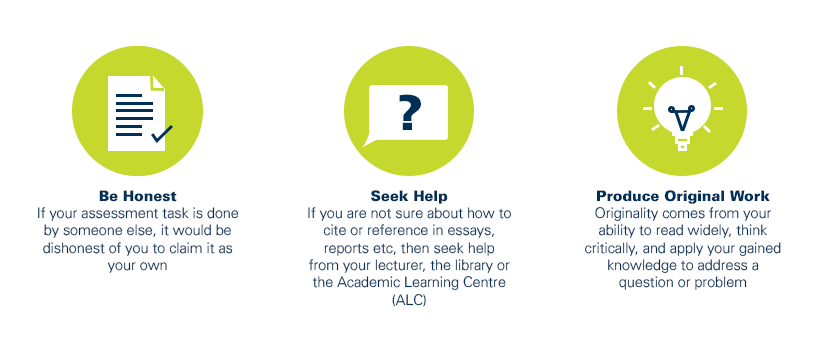
As a CQUniversity student you are expected to act honestly in all aspects of your academic work.
Any assessable work undertaken or submitted for review or assessment must be your own work. Assessable work is any type of work you do to meet the assessment requirements in the unit, including draft work submitted for review and feedback and final work to be assessed.
When you use the ideas, words or data of others in your assessment, you must thoroughly and clearly acknowledge the source of this information by using the correct referencing style for your unit. Using others’ work without proper acknowledgement may be considered a form of intellectual dishonesty.
Participating honestly, respectfully, responsibly, and fairly in your university study ensures the CQUniversity qualification you earn will be valued as a true indication of your individual academic achievement and will continue to receive the respect and recognition it deserves.
As a student, you are responsible for reading and following CQUniversity’s policies, including the Student Academic Integrity Policy and Procedure. This policy sets out CQUniversity’s expectations of you to act with integrity, examples of academic integrity breaches to avoid, the processes used to address alleged breaches of academic integrity, and potential penalties.
What is a breach of academic integrity?
A breach of academic integrity includes but is not limited to plagiarism, self-plagiarism, collusion, cheating, contract cheating, and academic misconduct. The Student Academic Integrity Policy and Procedure defines what these terms mean and gives examples.
Why is academic integrity important?
A breach of academic integrity may result in one or more penalties, including suspension or even expulsion from the University. It can also have negative implications for student visas and future enrolment at CQUniversity or elsewhere. Students who engage in contract cheating also risk being blackmailed by contract cheating services.
Where can I get assistance?
For academic advice and guidance, the Academic Learning Centre (ALC) can support you in becoming confident in completing assessments with integrity and of high standard.
What can you do to act with integrity?