Overview
In Modern Environmental Issues you will learn how scientific methods and knowledge inform issues of environmental concern. You will learn about different environments and their interaction with human populations, resources and pollution, disturbance, atmospheric composition and air pollution, fossil fuels and renewable sources of energy, conservation and environmental management. You will begin to apply basic scientific knowledge and quantitative data to researching and discussing environmental issues and 'wicked' problems.
Details
Pre-requisites or Co-requisites
There are no requisites for this unit.
Important note: Students enrolled in a subsequent unit who failed their pre-requisite unit, should drop the subsequent unit before the census date or within 10 working days of Fail grade notification. Students who do not drop the unit in this timeframe cannot later drop the unit without academic and financial liability. See details in the Assessment Policy and Procedure (Higher Education Coursework).
Offerings For Term 2 - 2026
Attendance Requirements
All on-campus students are expected to attend scheduled classes - in some units, these classes are identified as a mandatory (pass/fail) component and attendance is compulsory. International students, on a student visa, must maintain a full time study load and meet both attendance and academic progress requirements in each study period (satisfactory attendance for International students is defined as maintaining at least an 80% attendance record).
Recommended Student Time Commitment
Each 6-credit Undergraduate unit at CQUniversity requires an overall time commitment of an average of 12.5 hours of study per week, making a total of 150 hours for the unit.
Class Timetable
Assessment Overview
Assessment Grading
This is a graded unit: your overall grade will be calculated from the marks or grades for each assessment task, based on the relative weightings shown in the table above. You must obtain an overall mark for the unit of at least 50%, or an overall grade of 'pass' in order to pass the unit. If any 'pass/fail' tasks are shown in the table above they must also be completed successfully ('pass' grade). You must also meet any minimum mark requirements specified for a particular assessment task, as detailed in the 'assessment task' section (note that in some instances, the minimum mark for a task may be greater than 50%). Consult the University's Grades and Results Policy for more details of interim results and final grades.
All University policies are available on the CQUniversity Policy site.
You may wish to view these policies:
- Grades and Results Policy
- Assessment Policy and Procedure (Higher Education Coursework)
- Review of Grade Procedure
- Student Academic Integrity Policy and Procedure
- Academic Progression Policy and Procedure
- Student Refund and Credit Balance Policy and Procedure
- Complaints Policy and Procedure
- Information and Communications Technology Acceptable Use Policy and Procedure
This list is not an exhaustive list of all University policies. The full list of University policies are available on the CQUniversity Policy site.
Feedback, Recommendations and Responses
Every unit is reviewed for enhancement each year. At the most recent review, the following staff and student feedback items were identified and recommendations were made.
Feedback from Unit Coordinator
Invented citations in fortnightly assessable questions and the end of term on line quiz are a growing issue
All scientific literature citations need to be accompanied by a clickable DOI link to ensure invented citations are minimized. Students will need to indicate the page and paragraph the cited item originates from.
Feedback from Student
Content and assessments felt excessive for a first year unit and required significantly more time commitments than second and third year units.
The content of the unit does not exceed the standards for first year units (12.5 hours/wk). Lectures are 3 hours, fortnightly assessment is 3-4 hours, and readings are ~3 hours.
Feedback from Student
Each assessment criteria was clear and precise, the lecturer was easy to get a hold of and quick to respond to all questions and provide further clarification when needed, and the assessment results were returned in a timely manner.
The assessment criteria will continue to updated and modified to help students improve their research and communication skills, to help them incorporate GenAI into their workflow, and to deepen their knowledge of environmental issues and their impact on society and nature.
Feedback from Student
Proof check moodle before term commencement, particularly assessment items, due dates and ability to post to ECHO360.
Remove ECHO360 links from individual weekly tiles so that all video lecture material is available through the Virtual Classes tile. Tick the "allow text" box on the Assessment 2 to allow students to submit assessment to ECHO360 through Moodle. Check and recheck dates against the Unit Profile. Reduce due dates to three places on each Moodle page (UP, Assessment Tile summary, and each assessment item).
- Describe the underpinning science of environmental issues
- Discuss possible solutions to environmental issues
- Communicate the scientific basis of environmental issues to general audiences
- Discuss the ecological and scientific principles relevant to understanding natural and human impacts on the environment
- Synthesise information from scientific literature relating to modern environmental issues.
Alignment of Assessment Tasks to Learning Outcomes
| Assessment Tasks | Learning Outcomes | ||||
|---|---|---|---|---|---|
| 1 | 2 | 3 | 4 | 5 | |
| 1 - Online discussion forum - 20% | |||||
| 2 - Presentation - 30% | |||||
| 3 - Online Test - 50% | |||||
Alignment of Graduate Attributes to Learning Outcomes
| Graduate Attributes | Learning Outcomes | ||||
|---|---|---|---|---|---|
| 1 | 2 | 3 | 4 | 5 | |
| 1 - Communication | |||||
| 2 - Problem Solving | |||||
| 3 - Critical Thinking | |||||
| 4 - Information Literacy | |||||
| 5 - Team Work | |||||
| 6 - Information Technology Competence | |||||
| 7 - Cross Cultural Competence | |||||
| 8 - Ethical practice | |||||
| 9 - Social Innovation | |||||
| 10 - First Nations Knowledges | |||||
| 11 - Aboriginal and Torres Strait Islander Cultures | |||||
Textbooks
Environment: the science behind the stories.
- latest edition (latest edition)
- Authors: Withgott JH & Laposata M
- Benjamin Cummings (imprint of Pearson)
- San Francisco San Francisco , CA , USA
- ISBN: 978-0135269145
6th Edition is also acceptable.
- Binding: Paperback
IT Resources
- CQUniversity Student Email
- Internet
- Unit Website (Moodle)
- Recent (but not necessarily latest) versions of installed software including Microsoft Word, Excel, and PowerPoint; Adobe reader, etc.
- Modern computer/laptop with sufficient hard drive & memory size, plus adequate Internet access and connection reliability to facilitate significant uploads/downloads/video streaming and sustained lengthy connections (e.g., for lecture downloads, Zoom tutorial sessions), with microphone and speakers (built-in or external) OR microphone+speaker headset (cheap '$20' set is suitable).
- Camera or mobile phone capable of capturing video.
- Access to video editing software (eg Blender (no cost version), iMovie, etc.)
All submissions for this unit must use the referencing style: Harvard (author-date)
For further information, see the Assessment Tasks.
n.english@cqu.edu.au
Week 1
Begin Date: 13 Jul 2026Module/Topic
Unit welcome and introduction.
Introduction to concepts underpinning the discipline of Environmental Science and its application.
Chapter
Textbook Chaps 1, 2 & 5 'Science and sustainability: an introduction to environmental science' 'Earth's physical systems: matter, energy, and geology', and 'Environmental systems and ecosystem ecology' (parts - see lecture).
Events and Submissions/Topic
ALL students to make at least one constructive post to the Week 1 'fortnightly assessable questions' online forum, and to post each fortnight thereafter to that week's topic after reviewing the preceding forum and group feedback.
Week 1 discussion (fortnightly assessable questions) forum:
Open Monday 9AM AEST, Week 1;
Close Monday 11:59PM AEST, Week 2.
Week 2
Begin Date: 20 Jul 2026Module/Topic
Demography, and the environmental problem of people.
Chapter
Textbook Chap 8 'Human population'.
Events and Submissions/Topic
Week 3
Begin Date: 27 Jul 2026Module/Topic
Impacts of disturbance.
Chapter
Textbook Chaps 4 & 6 'Species interactions and community ecology' and 'Environmental ethics and economics: values and choices' (part - see lecture).
Events and Submissions/Topic
Week 3 discussion (fortnightly assessable questions) forum:
Open Monday 9AM AEST, Week 3;
Close Monday 11:59PM AEST, Week 4.
Week 4
Begin Date: 03 Aug 2026Module/Topic
Fuels and energy consumption
Chapter
Textbook Chaps 19, 20 and 21 'Fossil fuels, their impacts and energy conservation', 'Conventional energy alternatives', and 'New renewable energy alternatives'.
Events and Submissions/Topic
Week 5
Begin Date: 10 Aug 2026Module/Topic
Mining and resource extraction.
Chapter
Textbook Chap 23 'Minerals and mining'.
Events and Submissions/Topic
Week 5 discussion (fortnightly assessable questions) forum:
Open Monday 9AM AEST, Week 5;
Close Monday 11:59PM AEST, Week 6.
Week 6
Begin Date: 17 Aug 2026Module/Topic
Air pollution.
Chapter
Textbook Chap 17 'Atmospheric science and air pollution'.
Events and Submissions/Topic
Vacation Week
Begin Date: 24 Aug 2026Module/Topic
Chapter
Events and Submissions/Topic
Week 7
Begin Date: 31 Aug 2026Module/Topic
Accelerated climate change.
Chapter
Textbook Chap 18 'Global climate change'.
Events and Submissions/Topic
Week 7 discussion (fortnightly assessable questions) forum:
Open Monday 9AM AEST, Week 7;
Close Monday 11:59PM AEST, Week 8.
Week 8
Begin Date: 07 Sep 2026Module/Topic
Modern agriculture.
Chapter
Textbook Chaps 'Soil and agriculture' and 'Agriculture, biotechnology, and the future of food' (parts - see lecture).
Events and Submissions/Topic
Week 9
Begin Date: 14 Sep 2026Module/Topic
Waste generation and management.
Chapter
Textbook Chap 22 'Managing our waste'.
Events and Submissions/Topic
Week 9 discussion (fortnightly assessable questions) forum:
Open Monday 9AM AEST, Week 9;
Close Monday 11:59PM AEST, Week 10.
Week 10
Begin Date: 21 Sep 2026Module/Topic
Aquatic and marine systems management.
Chapter
Textbook Chaps 15 & 16 'Freshwater systems and resources' and 'Marine and coastal systems and resources'.
Events and Submissions/Topic
Week 11
Begin Date: 28 Sep 2026Module/Topic
Native vegetation and forest management.
Chapter
Textbook Chap 12 'Forests, forest management, and protected areas'.
Events and Submissions/Topic
Week 11 discussion (fortnightly assessable questions) forum:
Open Monday 9AM AEST, Week 11;
Close Monday 11:59PM AEST, Week 12.
Week 12
Begin Date: 05 Oct 2026Module/Topic
Indigenous land management.
Chapter
Textbook Chap 6 'Environmental ethics and economics: values and choices' or 'Environmental ethics and economics: values and choices' (part - see lecture).
Events and Submissions/Topic
Quiz Opens Thursday at 5AM AEST of Week 12 (unless you have an approved extension request) and closes at 5AM AEST the next day. You have 3 hours to complete the quiz once you begin it. You must begin the quiz 3 hours before it closes to get the full time to complete the quiz.
Exam Week
Begin Date: 12 Oct 2026Module/Topic
Chapter
Events and Submissions/Topic
Vacation/Exam Week
Begin Date: 19 Oct 2026Module/Topic
Chapter
Events and Submissions/Topic
1 Online discussion forum
Fortnightly assessable questions (20%)
Every other week of the term, beginning in Week 1, you need to participate in the Fortnightly Assessable Questions (FAQ's) forum that will relate to the previous two weeks' unit content. The FAQ's assessment is designed to enhance learning, encourage peer-learning and help you develop new ways of thinking about modern issues in environmental science. Every other Monday (and the week following) you can access the FAQ's assessment via the link published in that week's tasks on the unit Moodle site, and follow the specific instructions for that particular forum task. A 'model' answer and other feedback will be posted once the period for student posts has closed and within one week. Posts after the closure date of a forum will not receive any marks. Forum responses in Weeks 3, 5, 7, 9, and 11 will attract a maximum of 4 marks each (20 marks total). The Week 1 forum will not be marked but allows students to introduce themselves to other ENVR11011 students and to get used to the FAQ's forum and format.
There is a word limit on each post of 400 words (just <1 page), citations (including the parenthetical citation in the text) are excluded from word count. I anticipate answers to the FAQ's will take up to 1.5 hours to research and up to 1.5 hours to craft. Dot points are acceptable when appropriate.
All discussion (fortnightly assessable questions) forums open at 9 am AEST on Mondays and close a week later. The 72 hour grace period does not apply to this assessment.
Level of GenAI use allowed:
Level 2: You may use Al for planning, idea development, and research. Your final submission should show how you have developed and refined these ideas. Place the GenAI prompt and text below your references.
Note: Unacknowledged cutting and pasting of LLM/AI (e.g. ChatGPT) material into assessments is plagiarism. If you have questions about LLM material and plagiarism, please speak with your lecturer and/or contact an ALC advisor.
Forums will open at 9:00AM AEST on Monday of Weeks 1, 3, 5, 7, 9 and 11 and each forum will close one week (7 calendar days) later at 11:59PM AEST.
Forum posts will be read in detail and feedback provided on a fortnightly basis. Marks will be returned to students two weeks after the close of the respective FAQ..
You will be graded in this assessment on your constructive participation rather than solely on the accuracy of your answer (because there will be no single correct or complete answer possible).
Note that 'constructive participation' is defined here as providing a reasoned rationale based on environmental science principles and supported by evidence (not just stating agreement or disagreement with the topic question), and means a post must include relevant information from cited, peer-reviewed articles or government websites. Quantitative information and citation of relevant scientific journal articles in your answer is a requirement for full marks (engage with the data and use them to support your answer).
Note that the Week 1 forum is not graded but please contribute just the same. You should participate constructively and within the relevant time frames in the remaining 5 forums to score full marks (i.e., at 4 marks per forum for a maximum 20% of total unit marks).
- 1 mark - Response(s) marred by multiple simple spelling or grammatical mistakes and/or is disorganised without clear points made or obvious reasoning; and/or is a brief and superficial treatment of the issue or shows little relevance and no citation of sources; lack specificity, integration of evidence, or critical reasoning (characteristics often found in generic AI-generated answers); and/or word count is over 400 will not earn full marks;
- 2 marks - Response(s) marred by several spelling or grammatical errors and/or by no citation of sources, and only a few relevant points or arguments made (or more made but insubstantially, i.e. not linked to quantitative data) arguments often not integrated well;
- 3 marks - Response(s) displaying only a few spelling or grammatical errors, otherwise well-organised and considered/reasoned, exploring the issue adequately but no quantitative data or data sources are limited to only textbooks and generalist websites and the like; and
- 4 marks - Response(s) display no spelling or grammatical errors, have concise and excellent organisation of clear, salient and reasoned points and arguments supported by quantitative data and citing numerous scientific sources with linked DOI's and correctly using parenthetical referencing.
Please note there is a minimum achievement level set for this assessment task, i.e., you must equal or exceed the set minimum achievement level for this assessment in order to be considered for a passing grade for the course overall (irrespective of your achievement level in other assessment activities).
- Communicate the scientific basis of environmental issues to general audiences
- Discuss the ecological and scientific principles relevant to understanding natural and human impacts on the environment
- Synthesise information from scientific literature relating to modern environmental issues.
2 Presentation
This assessment task requires you to identify an important environmental issue in your local area that fits within one of our weekly topics in the unit, and to submit a video presentation of its cause (or causes), effects, and the most likely possible solution.
Your video presentation should be five (5) minutes long (±10% or 30 seconds).
There will be three broad components you will have to consider for this assessment:
- Choice of suitable topic - fits within one of our weekly unit topics, a small enough topic to be adequately covered in 5 minutes (cause/effect/solution) and big enough to fill the 5 minute presentation without padding etc.;
- Being entirely scientific and dispassionate in your approach to content (no value-laden language), including the use of relevant scientific concepts and terms (this will require considerable planning and research, e.g., construction of a script); and
- Production of a reasonable video presentation (that will involve practice and shot planning so quality of the video production does not detract from the content).
Note that you are not expected to become a professional videographer or video editor, but there must be an adequate level of continuity to your submission. Further criteria will be posted on Moodle.
Level of GenAI use allowed:
Level 2: You may use Al for planning, idea development, and research. Your final submission should show how you have developed and refined these ideas. Include in all GenAI prompts and outputs below the link to your video file in the submitted document. You may not use AI to generate imagery or scripts.
Week 8 Monday (7 Sept 2026) 11:59 pm AEST
Week 10 Monday (21 Sept 2026)
Submissions will be assessed on the criteria in the table below (roughly content 56%, presentation 44%):
| Criterion | Maximum marks |
|---|---|
| Presentation topic fits within one of our weekly unit topics | 5 |
| Adequate detail of cause(s) | 10 |
| Adequate detail of effects | 10 |
| Adequate detail of solution(s) | 10 |
| Video duration is 5 mins ± 10% | 5 |
| Quality of oral expression (sentence construction, grammar, pronunciation, etc.) | 10 |
| How engaging is the presentation: High Medium or Low | 5 |
| Adequate video coverage of cause and effect components | 10 |
| General production quality of presentation (alignment of video and audio, video and audio are clear, etc.) | 5 |
| In-text source citation (5 marks max.) and reference list (5 marks max.) | 10 |
Please note a minimum achievement level is set for this assessment activity (i.e., you must equal or exceed this set minimum achievement level for you to be considered for a passing grade for this unit overall, irrespective of your achievement in other assessment components in this unit).
- Describe the underpinning science of environmental issues
- Discuss possible solutions to environmental issues
- Communicate the scientific basis of environmental issues to general audiences
- Synthesise information from scientific literature relating to modern environmental issues.
3 Online Test
The Online End of Term Quiz is a total of 40 marks. The marks are divided among three (3) questions total: two (2) Short Answer questions at 5 marks each; and one (1) Long Answer question for 30 marks. You must complete both (2) Short Answer questions for 10 marks total (5 marks each).
You must complete only one (1) of the Long Answer Questions (30 marks total). You will be provided three (3) Long Answer Questions to pick from (select the Long Answer question you are most comfortable answering). You must only attempt to answer one Long Answer Question (1). The short and long answer questions are each pulled randomly from a question bank of equally difficult questions of the same type. You have 3 hours to complete the quiz once you begin it.
The quiz opens at 5AM AEST on Monday of Review/Exam Week (unless you have an approved extension request) and closes at 5AM AEST the next day. I have allowed 20 minutes to complete the Short Answer questions, another 30 minutes to read all three (3) Long Answer questions and then just over 2 hours to complete one (1) of the long answer questions that you select. You must begin the quiz 3 hours before it closes to get the full time to complete the quiz. The 72 hour grace period does not apply to this assessment.
This is a TIMED, OPEN BOOK/INTERNET quiz. You may use any resources at your disposal, but the answers must be your own and in your own words (please see the CQU policy on Academic Misconduct). You may not work in groups or with others. I recommend you refer to the previous Fortnightly Assessable Question pages for ideas or sources, but do not copy or paraphrase those answers.
I strongly recommend you write your answers in a word processing program and then cut and paste the answers into the quiz when they are complete. You may also wish to have a calculator handy. Remember to answer the questions asked, and to clearly annotate what question you are answering, (e.g. "Part (a)"). Use properly cited sources to clearly support your position if they are required.
Level of GenAI use allowed:
Level 2: You may use Al for planning, idea development, and research. Your final submission should show how you have developed and refined these ideas. As in the FAQ's, you must include all of your GenAI prompt and outputs below the references list.
Quiz Opens Thursday at 5AM AEST of Week 12 (unless you have an approved extension request) and closes at 5AM AEST the next day. You have 3 hours to complete the quiz once you begin it. You must begin the quiz 3 hours before it closes to get the full time to complete the quiz.
For the Short Answer questions, I am only looking for correctness of the answer (you do NOT need to provide sources, proofread, etc).
The criteria for the Long Answer questions are similar to those for the Fortnightly Assessable Questions, especially with respect to the GenAI criteria, except that the marks structure differs and there is NO WORD LIMIT and there is less emphasis on spelling/grammar (except as it impedes understanding).
- 1 to 8 marks: typically response(s) with spelling or grammatical mistakes that impede understanding and/or is disorganised without clear points made or obvious reasoning and/or is a brief and superficial treatment of the issue or shows little relevance with no citation of sources;
- 9 to 17 marks: typically response(s) with spelling or grammatical mistakes that impede understanding and/or by no citation of sources, and only a few relevant points or arguments made (or more made but insubstantially) often not integrated well;
- 18 to 24 marks: typically response(s) with spelling or grammatical mistakes that do not impede understanding, otherwise well-organised and considered/reasoned, exploring the issue adequately but no quantitative data or sources are limited and only textbooks and generalist websites and the like; and
- 24 to 30 marks: typically response(s) with spelling or grammatical mistakes that do not impede understanding, concise and excellent organisation of clear, salient and reasoned points and arguments exploring the issue in depth, and supported by quantitative data and citing numerous scientific sources and in the proper manner.
- Describe the underpinning science of environmental issues
- Discuss possible solutions to environmental issues
- Discuss the ecological and scientific principles relevant to understanding natural and human impacts on the environment
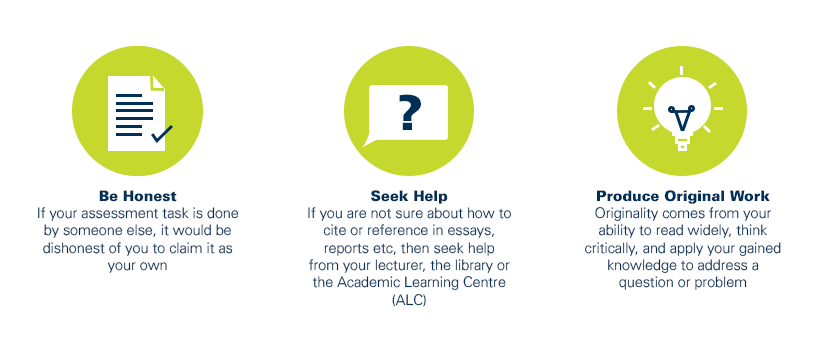
As a CQUniversity student you are expected to act honestly in all aspects of your academic work.
Any assessable work undertaken or submitted for review or assessment must be your own work. Assessable work is any type of work you do to meet the assessment requirements in the unit, including draft work submitted for review and feedback and final work to be assessed.
When you use the ideas, words or data of others in your assessment, you must thoroughly and clearly acknowledge the source of this information by using the correct referencing style for your unit. Using others’ work without proper acknowledgement may be considered a form of intellectual dishonesty.
Participating honestly, respectfully, responsibly, and fairly in your university study ensures the CQUniversity qualification you earn will be valued as a true indication of your individual academic achievement and will continue to receive the respect and recognition it deserves.
As a student, you are responsible for reading and following CQUniversity’s policies, including the Student Academic Integrity Policy and Procedure. This policy sets out CQUniversity’s expectations of you to act with integrity, examples of academic integrity breaches to avoid, the processes used to address alleged breaches of academic integrity, and potential penalties.
What is a breach of academic integrity?
A breach of academic integrity includes but is not limited to plagiarism, self-plagiarism, collusion, cheating, contract cheating, and academic misconduct. The Student Academic Integrity Policy and Procedure defines what these terms mean and gives examples.
Why is academic integrity important?
A breach of academic integrity may result in one or more penalties, including suspension or even expulsion from the University. It can also have negative implications for student visas and future enrolment at CQUniversity or elsewhere. Students who engage in contract cheating also risk being blackmailed by contract cheating services.
Where can I get assistance?
For academic advice and guidance, the Academic Learning Centre (ALC) can support you in becoming confident in completing assessments with integrity and of high standard.
What can you do to act with integrity?