Overview
Computer-Aided Design (CAD) skills are essential for a variety of engineering professionals. In this unit, you will learn the fundamentals of engineering design and drawings using orthographic projection conventions and sectioning conventions complying with relevant engineering standards with the aid of appropriate software tools. You will develop skills in 3D solid modelling and rendering as well as producing detailed assembly drawings. As part of a team, you will design and construct 3D printed objects gaining an insight into all aspects of the design and rapid prototyping process.
Details
Pre-requisites or Co-requisites
Prerequisite: Aircraft Structural Maintenance Practices.
Important note: Students enrolled in a subsequent unit who failed their pre-requisite unit, should drop the subsequent unit before the census date or within 10 working days of Fail grade notification. Students who do not drop the unit in this timeframe cannot later drop the unit without academic and financial liability. See details in the Assessment Policy and Procedure (Higher Education Coursework).
Offerings For Term 1 - 2026
Attendance Requirements
All on-campus students are expected to attend scheduled classes - in some units, these classes are identified as a mandatory (pass/fail) component and attendance is compulsory. International students, on a student visa, must maintain a full time study load and meet both attendance and academic progress requirements in each study period (satisfactory attendance for International students is defined as maintaining at least an 80% attendance record).
Recommended Student Time Commitment
Each 6-credit Undergraduate unit at CQUniversity requires an overall time commitment of an average of 12.5 hours of study per week, making a total of 150 hours for the unit.
Class Timetable
Assessment Overview
Assessment Grading
This is a graded unit: your overall grade will be calculated from the marks or grades for each assessment task, based on the relative weightings shown in the table above. You must obtain an overall mark for the unit of at least 50%, or an overall grade of 'pass' in order to pass the unit. If any 'pass/fail' tasks are shown in the table above they must also be completed successfully ('pass' grade). You must also meet any minimum mark requirements specified for a particular assessment task, as detailed in the 'assessment task' section (note that in some instances, the minimum mark for a task may be greater than 50%). Consult the University's Grades and Results Policy for more details of interim results and final grades.
All University policies are available on the CQUniversity Policy site.
You may wish to view these policies:
- Grades and Results Policy
- Assessment Policy and Procedure (Higher Education Coursework)
- Review of Grade Procedure
- Student Academic Integrity Policy and Procedure
- Academic Progression Policy and Procedure
- Student Refund and Credit Balance Policy and Procedure
- Complaints Policy and Procedure
- Information and Communications Technology Acceptable Use Policy and Procedure
This list is not an exhaustive list of all University policies. The full list of University policies are available on the CQUniversity Policy site.
Feedback, Recommendations and Responses
Every unit is reviewed for enhancement each year. At the most recent review, the following staff and student feedback items were identified and recommendations were made.
Feedback from Students
More help on CAD.
Improvements in instruction materials are recommended. The students should use the latest version of the AutoCAD Instructor book along with the tutor's instruction sheet.
Feedback from Students
Schedule classes after hours.
As students are working, classes should be scheduled in the evening.
Feedback from UC
The two-hour class for lectures and tutorials is short.
It is suggested that a contact period of three hours ( 1 hr Lec and 2 hr Tute) should be scheduled.
- Develop and interpret CAD drawings that use orthographic projection and sectioning conventions complying with relevant standards
- Scale, layout and dimension 2-dimensional and 3-dimensional CAD drawings to provide sufficient information to manufacture artefacts using a range of software tools
- Produce component detail and assembly CAD drawings including parts lists of artefacts to relevant standards
- Create a digital twin and a 3D printed prototype of an artefact
- Create professional documentation of the designs that conform to relevant standards individually and in teams.
Alignment of Assessment Tasks to Learning Outcomes
| Assessment Tasks | Learning Outcomes | ||||
|---|---|---|---|---|---|
| 1 | 2 | 3 | 4 | 5 | |
| 1 - Portfolio - 30% | |||||
| 2 - Project (applied) - 30% | |||||
| 3 - Project (applied) - 40% | |||||
Alignment of Graduate Attributes to Learning Outcomes
| Graduate Attributes | Learning Outcomes | ||||
|---|---|---|---|---|---|
| 1 | 2 | 3 | 4 | 5 | |
| 1 - Communication | |||||
| 2 - Problem Solving | |||||
| 3 - Critical Thinking | |||||
| 4 - Information Literacy | |||||
| 5 - Team Work | |||||
| 6 - Information Technology Competence | |||||
| 7 - Cross Cultural Competence | |||||
| 8 - Ethical practice | |||||
| 9 - Social Innovation | |||||
| 10 - First Nations Knowledges | |||||
| 11 - Aboriginal and Torres Strait Islander Cultures | |||||
Textbooks
AutoCAD Instructor
- Authors: James A. Leach & Thomas D. Bledsaw
- ISBN: 9781630576493
Engineering Drawing
- Authors: A W Boundy
- ISBN: 9781121491021
IT Resources
- CQUniversity Student Email
- Internet
- Unit Website (Moodle)
- AutoCAD (free student download available from Autodesk http://www.autodesk.com/education/free-software/autocad)
All submissions for this unit must use the referencing style: Harvard (author-date)
For further information, see the Assessment Tasks.
a.mazid@cqu.edu.au
Week 1. Visualisation
Begin Date: 09 Mar 2026Module/Topic
Methods of projection: Orthogonal and Oblique projections
Chapter
Ch 5 (SAI Global)
Events and Submissions/Topic
Lecture & Tutorial
Week 2. Drawing layout
Begin Date: 16 Mar 2026Module/Topic
Drawing layout and General Practices; Freehand sketching
Chapter
Ch 1 (Section 1.8) Boundy
Events and Submissions/Topic
Lecture & Tutorial
Week 3. Orthographic projection
Begin Date: 23 Mar 2026Module/Topic
Orthogonal projections: Third angle and First angle Projections
Chapter
Ch 3 Boundy
Events and Submissions/Topic
Lecture & Tutorial
Week 4. Section Views
Begin Date: 30 Mar 2026Module/Topic
Sectioning and Section Views
Chapter
Ch 5.9 SAI Global
Events and Submissions/Topic
Lecture & Tutorial
Week 5. Dimensioning
Begin Date: 06 Apr 2026Module/Topic
Methods of dimensioning: Linear and Angular; Overall dimension; Tolerancing
Chapter
Ch 1.9 Boundy Ch; 11 SAI Global
Events and Submissions/Topic
Lecture & Tutorial
Assessment 1: Freehand Sketching Due: Week 5 Friday (10 Apr 2026) 12:00 am AEST
Week 6. Auxiliary Views
Begin Date: 13 Apr 2026Module/Topic
Primary and Secondary Auxiliary Views
Chapter
Ch 4.3 & 4.4 Boundy
Events and Submissions/Topic
Lecture & Tutorial
Vacation Week
Begin Date: 20 Apr 2026Module/Topic
Chapter
Events and Submissions/Topic
NO CLASSES
Week 7. AutoCAD preliminaries
Begin Date: 27 Apr 2026Module/Topic
Working with lines; Drawing Commands
Chapter
AutoCAD software & AutoCAD Instructor Ch 15 & 16
Events and Submissions/Topic
Lecture & Tutorial
Week 8. AutoCAD Preliminaries
Begin Date: 04 May 2026Module/Topic
Draw section views of objects using AutoCAD
Chapter
AutoCAD software & AutoCAD Instructor Ch 17 & 18
Events and Submissions/Topic
Lecture & Tutorial
Week 9. Getting productive with AutoCAD
Begin Date: 11 May 2026Module/Topic
Draw detail drawing of given object/s
Chapter
Ch 10 SAI Global;
AutoCAD software & AutoCAD Instructor
Events and Submissions/Topic
Lecture & Tutorial
Assessment 2. Freehand Sketching and CAD drawing Due: Week 9 Friday (15 May 2026) 12:00 am AEST
Week 10. Multiview drawing using AutoCAD
Begin Date: 18 May 2026Module/Topic
Pictorial and Multiview drawing using AutoCAD
Chapter
AutoCAD software & AutoCAD Instructor;
Ch 4 Boundy
Events and Submissions/Topic
Lecture & Tutorial
Week 11. AutoCAD: Sectioning and Dimensioning
Begin Date: 25 May 2026Module/Topic
Sectioning and Dimensioning using AutoCAD
Chapter
AutoCAD software & AutoCAD Instructor;
Ch 1.9 Boundy
Events and Submissions/Topic
Lecture & Tutorial
Week 12. AutoCAD: Sectioning and Dimensioning (contd.)
Begin Date: 01 Jun 2026Module/Topic
Sectioning and Dimensioning using AutoCAD
Chapter
AutoCAD software & AutoCAD Instructor;
Ch 1.9 Boundy
Events and Submissions/Topic
Lecture & Tutorial
Assessment 3. CAD drawing of machine parts Due: Week 12 Friday (5 June 2026) 12:00 am AEST
Exam Week
Begin Date: 08 Jun 2026Module/Topic
Chapter
Events and Submissions/Topic
Vacation/Exam Week
Begin Date: 15 Jun 2026Module/Topic
Chapter
Events and Submissions/Topic
1 Portfolio
You will create freehand sketches of several engineering objects, producing the required orthographic views (top view and relevant side view/s). You will complete these sketches without adding dimensions.
Assessment detail document is available in Unit Moodle site.
AI ASSESSMENT SCALE: No AI
You must not use AI at any point during the assessment. You must demonstrate your core skills and knowledge.
Week 5 Friday (10 Apr 2026) 12:00 am AEST
This assessment includes a 72‑hour submission grace period. If you submit within 72 hours after the stated deadline, no late penalty will be applied. Submissions after the grace period may attract penalties as per university policy.
Week 7 Friday (1 May 2026)
Assessment 1 marking criteria:
- Produce neat and accurate sketches complying with AS1100.
- Demonstrate an clear understanding of several required views of parts applicable for engineering drawings.
NOTE: More particular instruction will be provided in assessment document uploaded in Unit Moodle site.
You must achieve at least 50% on this assessment to pass it.
- Develop and interpret CAD drawings that use orthographic projection and sectioning conventions complying with relevant standards
- Scale, layout and dimension 2-dimensional and 3-dimensional CAD drawings to provide sufficient information to manufacture artefacts using a range of software tools
- Produce component detail and assembly CAD drawings including parts lists of artefacts to relevant standards
- Create a digital twin and a 3D printed prototype of an artefact
2 Project (applied)
You will complete a combined freehand and CAD drawing task. You will read and interpret a provided engineering assembly drawing, then extract the required part/s and produce accurate freehand and CAD drawings. You may be required to add dimensions, tolerances, and other annotation elements in line with engineering drawing standards.
You must demonstrate your understanding of assembly drawings, dimensioning practices, and tolerance application, using the appropriate CAD tools to create clear and accurate drawings.
Assessment detail document is available in Unit Moodle site.
AI ASSESSMENT SCALE: No AI
You must not use AI at any point during the assessment. You must demonstrate your core skills and knowledge.
Week 9 Friday (15 May 2026) 12:00 am AEST
This assessment includes a 72‑hour submission grace period. If you submit within 72 hours after the stated deadline, no late penalty will be applied. Submissions after the grace period may attract penalties as per university policy.
Week 11 Friday (29 May 2026)
Assessment 2 marking criteria:
- Neat and accurate manual and CAD drawing complying with AS1100.
- Demonstrate standard knowledge of reading assembly drawing and understanding dimensions and tolerances of parts in the assembly.
- Demonstrate preliminary knowledge of applications of CAD tools, dimensioning part drawing and overall dimension of assembly drawings.
NOTE: More particular instruction will be provided in assessment document uploaded in Unit Moodle site.
You must achieve at least 50% on this assessment to pass it.
- Develop and interpret CAD drawings that use orthographic projection and sectioning conventions complying with relevant standards
- Scale, layout and dimension 2-dimensional and 3-dimensional CAD drawings to provide sufficient information to manufacture artefacts using a range of software tools
- Create professional documentation of the designs that conform to relevant standards individually and in teams.
3 Project (applied)
You will demonstrate your capability to interpret simple assembly drawings and extract the individual components needed to produce manufacturing‑ready part/detail drawings. You will identify required fits, tolerances, surface finish, and any other specifications relevant to accurate and cost‑effective manufacturing.
You will produce a complete and accurate CAD drawing of the assigned part(s), ensuring that all required views and dimensions are included. You will then transfer your CAD model to a 3D printing machine to produce a prototype and verify the dimensions you assigned in your drawing.
NOTE: More detail instruction will be provided in assessment document available in Unit Moodle site.
AI ASSESSMENT SCALE: No AI
You must not use AI at any point during the assessment. You must demonstrate your core skills and knowledge.
Week 12 Friday (5 June 2026) 12:00 am AEST
This assessment includes a 72‑hour submission grace period. If you submit within 72 hours after the stated deadline, no late penalty will be applied. Submissions after the grace period may attract penalties as per university policy.
Exam Week Friday (12 June 2026)
Assessment 3 marking criteria:
- Neat and accurate CAD drawing complying with AS1100.
- Draw the part drawing with necessary views in a A4 drawing page, unwanted view/s may disadvantage the quality.
- Show all necessary dimensions (linear, angular) on the part drawing, repeat dimensions may serve as disadvantage.
- Determine suitable fits and tolerances and assign them, also surface roughness values as required. Unnecessary higher ranges of surface roughness, tolerances and fits increase production cost and these may undermine the quality of your work.
- Transfer your part drawing to a 3D printing machine as available and produce sample part. Investigate the dimensions you assigned.
NOTE: More specific instructions are available in the assessment item document.
You must achieve at least 50% on this assessment to pass it.
- Produce component detail and assembly CAD drawings including parts lists of artefacts to relevant standards
- Create a digital twin and a 3D printed prototype of an artefact
- Create professional documentation of the designs that conform to relevant standards individually and in teams.
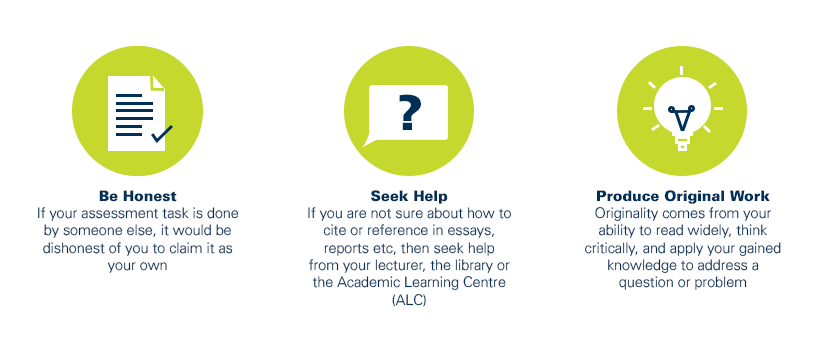
As a CQUniversity student you are expected to act honestly in all aspects of your academic work.
Any assessable work undertaken or submitted for review or assessment must be your own work. Assessable work is any type of work you do to meet the assessment requirements in the unit, including draft work submitted for review and feedback and final work to be assessed.
When you use the ideas, words or data of others in your assessment, you must thoroughly and clearly acknowledge the source of this information by using the correct referencing style for your unit. Using others’ work without proper acknowledgement may be considered a form of intellectual dishonesty.
Participating honestly, respectfully, responsibly, and fairly in your university study ensures the CQUniversity qualification you earn will be valued as a true indication of your individual academic achievement and will continue to receive the respect and recognition it deserves.
As a student, you are responsible for reading and following CQUniversity’s policies, including the Student Academic Integrity Policy and Procedure. This policy sets out CQUniversity’s expectations of you to act with integrity, examples of academic integrity breaches to avoid, the processes used to address alleged breaches of academic integrity, and potential penalties.
What is a breach of academic integrity?
A breach of academic integrity includes but is not limited to plagiarism, self-plagiarism, collusion, cheating, contract cheating, and academic misconduct. The Student Academic Integrity Policy and Procedure defines what these terms mean and gives examples.
Why is academic integrity important?
A breach of academic integrity may result in one or more penalties, including suspension or even expulsion from the University. It can also have negative implications for student visas and future enrolment at CQUniversity or elsewhere. Students who engage in contract cheating also risk being blackmailed by contract cheating services.
Where can I get assistance?
For academic advice and guidance, the Academic Learning Centre (ALC) can support you in becoming confident in completing assessments with integrity and of high standard.
What can you do to act with integrity?