Overview
In this unit, you will develop the knowledge and skills required to program, interface, and control microcontroller-based embedded systems using structured programming techniques. The unit introduces the architecture and core principles of embedded systems, covering key programming elements such as data types, loops, branching statements, and functions. You will also explore advanced topics, including interrupt handling, timers, and interfacing with peripherals, analogue and digital sensors, and external devices through various communication protocols. Through hands-on laboratory exercises, you will design, prototype, and test embedded systems using commercially available microcontrollers. The unit culminates in a final project where you will design and implement a real-world embedded application. To complete the compulsory practical activities and project, you will need to purchase specific hardware components. Details of the required components and associated costs are available on the unit Moodle site. This unit supports UN Sustainable Development Goal 9: Industry, Innovation and Infrastructure by highlighting how microcontroller-based systems enable low-cost automation and innovation in small-scale industrial applications.
Details
Pre-requisites or Co-requisites
ENEE14006 Embedded Microcontrollers is an Anti-Requisite for this unit.
Important note: Students enrolled in a subsequent unit who failed their pre-requisite unit, should drop the subsequent unit before the census date or within 10 working days of Fail grade notification. Students who do not drop the unit in this timeframe cannot later drop the unit without academic and financial liability. See details in the Assessment Policy and Procedure (Higher Education Coursework).
Offerings For Term 2 - 2026
Attendance Requirements
All on-campus students are expected to attend scheduled classes - in some units, these classes are identified as a mandatory (pass/fail) component and attendance is compulsory. International students, on a student visa, must maintain a full time study load and meet both attendance and academic progress requirements in each study period (satisfactory attendance for International students is defined as maintaining at least an 80% attendance record).
Recommended Student Time Commitment
Each 12-credit Postgraduate unit at CQUniversity requires an overall time commitment of an average of 25 hours of study per week, making a total of 300 hours for the unit.
Class Timetable
Assessment Overview
Assessment Grading
This is a graded unit: your overall grade will be calculated from the marks or grades for each assessment task, based on the relative weightings shown in the table above. You must obtain an overall mark for the unit of at least 50%, or an overall grade of 'pass' in order to pass the unit. If any 'pass/fail' tasks are shown in the table above they must also be completed successfully ('pass' grade). You must also meet any minimum mark requirements specified for a particular assessment task, as detailed in the 'assessment task' section (note that in some instances, the minimum mark for a task may be greater than 50%). Consult the University's Grades and Results Policy for more details of interim results and final grades.
All University policies are available on the CQUniversity Policy site.
You may wish to view these policies:
- Grades and Results Policy
- Assessment Policy and Procedure (Higher Education Coursework)
- Review of Grade Procedure
- Student Academic Integrity Policy and Procedure
- Academic Progression Policy and Procedure
- Student Refund and Credit Balance Policy and Procedure
- Complaints Policy and Procedure
- Information and Communications Technology Acceptable Use Policy and Procedure
This list is not an exhaustive list of all University policies. The full list of University policies are available on the CQUniversity Policy site.
Feedback, Recommendations and Responses
Every unit is reviewed for enhancement each year. At the most recent review, the following staff and student feedback items were identified and recommendations were made.
Feedback from Self-reflection
Students have found some assessments in this unit challenging.
The Unit Coordinator should review the curriculum and assessment design to ensure an appropriate workload, clear expectations, and effective sequencing of assessment tasks to support student learning.
- Apply structured programming principles to develop software code
- Program a microcontroller to interface with external devices, including analog and digital sensors, actuators, and computers
- Analyse and design microcontroller-based real-time applications using industry-standard development systems and software tools
- Prototype an embedded microcontroller system for a real-world application
- Communicate professionally using relevant technical terminology, symbols, and diagrams, and effectively document design and prototyped solutions
- Work independently and collaboratively to analyse problems and present solutions.
Alignment of Assessment Tasks to Learning Outcomes
| Assessment Tasks | Learning Outcomes | |||||
|---|---|---|---|---|---|---|
| 1 | 2 | 3 | 4 | 5 | 6 | |
| 1 - Online Quiz(zes) - 20% | ||||||
| 2 - Practical Assessment - 40% | ||||||
| 3 - Project (applied) - 40% | ||||||
Alignment of Graduate Attributes to Learning Outcomes
| Graduate Attributes | Learning Outcomes | |||||
|---|---|---|---|---|---|---|
| 1 | 2 | 3 | 4 | 5 | 6 | |
| 1 - Knowledge | ||||||
| 2 - Communication | ||||||
| 3 - Cognitive, technical and creative skills | ||||||
| 4 - Research | ||||||
| 5 - Self-management | ||||||
| 6 - Ethical and Professional Responsibility | ||||||
| 7 - Leadership | ||||||
| 8 - First Nations Knowledges | ||||||
| 9 - Aboriginal and Torres Strait Islander Cultures | ||||||
Textbooks
There are no required textbooks.
Additional Textbook Information
Students must follow the instructions on the Unit Moodle to install the required software by the end of Week 1. In addition, students are expected to purchase an Arduino UNO kit by the end of Week 2 to complete the weekly workshop exercises.
IT Resources
- CQUniversity Student Email
- Internet
- Unit Website (Moodle)
- Access to a document scanner and a software that can create pdf documents
- Access to a computer with Windows 10 with authoity to install software required for the unit
- Download and Install Visual Studio Code
- Online TinkerCAD
- Purchase Arduino UNO R3 and related hardware
All submissions for this unit must use the referencing style: Harvard (author-date)
For further information, see the Assessment Tasks.
l.bui@cqu.edu.au
Week 1
Begin Date: 13 Jul 2026Module/Topic
- Introduction to C Language Programming Environment
- Introduction to Embedded Systems and Microcontrollers
Chapter
N/A
Events and Submissions/Topic
- Week 1 workshop exercise submission
Week 2
Begin Date: 20 Jul 2026Module/Topic
- AVR Programming Basics
- Digital Inputs and Outputs
Chapter
N/A
Events and Submissions/Topic
- Week 2 workshop exercise submission
- Forming groups for Laboratory Exercises
Week 3
Begin Date: 27 Jul 2026Module/Topic
- Programming in C Language - Motor Control
Chapter
N/A
Events and Submissions/Topic
- Week 3 workshop exercise submission
- Online Quiz 1 Due: Week 3, Thursday at 23:59 AEST (covering materials for Weeks 1 and 2
Week 4
Begin Date: 03 Aug 2026Module/Topic
- ATMEGA328P Serial Communication
Chapter
N/A
Events and Submissions/Topic
- Week 4 workshop exercise submission
- Forming groups for the Robotic Project
Week 5
Begin Date: 10 Aug 2026Module/Topic
- Analog to Digital Conversion (ADC)
- Project Preparation and Planning
Chapter
N/A
Events and Submissions/Topic
- Week 5 workshop exercise submission
- Online Quiz 2 Due: Week 5, Thursday at 23:59 AEST (covering materials for Weeks 3 and 4)
- Project Preparation and Planning Submission
Week 6
Begin Date: 17 Aug 2026Module/Topic
- Timers, Interrupts, and PWM
Chapter
N/A
Events and Submissions/Topic
- Week 6 workshop exercise submission
Vacation Week
Begin Date: 24 Aug 2026Module/Topic
- Project Progress Update 1
Chapter
Events and Submissions/Topic
- Project Progress Update 1 submission
Week 7
Begin Date: 31 Aug 2026Module/Topic
- Servo Motor Control
Chapter
N/A
Events and Submissions/Topic
- Week 7 workshop exercise submission
- Online Quiz 3 Due: Week 7, Thursday at 23:59 AEST (covering materials for Weeks 5 and 6)
Week 8
Begin Date: 07 Sep 2026Module/Topic
- Ultrasonic Sensor Interfacing
- Project Progress Update 2
Chapter
N/A
Events and Submissions/Topic
- Week 8 workshop exercise submission
- Project Progress Update 2 Submission
Week 9
Begin Date: 14 Sep 2026Module/Topic
Chapter
N/A
Events and Submissions/Topic
- Online Quiz 4 Due: Week 9, Thursday at 23:59 AEST (covering materials for Weeks 7 and 8)
Laboratory Exercises Due: Week 9 Thursday (17 Sept 2026) 11:59 pm AEST
Week 10
Begin Date: 21 Sep 2026Module/Topic
• Project Progress Update 3
Chapter
N/A
Events and Submissions/Topic
• Project Progress Update 3 submission
Week 11
Begin Date: 28 Sep 2026Module/Topic
- Project Demonstration Readiness Review
Chapter
N/A
Events and Submissions/Topic
- In-person Project Demonstration Readiness Review and individual viva
Week 12
Begin Date: 05 Oct 2026Module/Topic
- Final Project Demonstration
Chapter
N/A
Events and Submissions/Topic
- In-person Project Demonstration and individual viva
Exam Week
Begin Date: 12 Oct 2026Module/Topic
Chapter
Events and Submissions/Topic
Vacation/Exam Week
Begin Date: 19 Oct 2026Module/Topic
Chapter
Events and Submissions/Topic
- Attendance at weekly workshops is compulsory and essential for developing the knowledge and practical skills required in this unit.
- Students are required to bring their laptop and microcontroller kit to every workshop, as hands-on hardware activities will be conducted.
- At the end of each workshop, an individual viva will be conducted. Performance in these vivas will contribute to the laboratory assessment component of the unit.
1 Online Quiz(zes)
AI ASSESSMENT SCALE: NO AI
You must not use AI at any point during the assessment. You must demonstrate your core skills and knowledge.
You will complete a series of four online quizzes assessing your understanding of fundamental hardware programming concepts. You must complete each quiz individually. There is no time limit, and multiple attempts are allowed. For each attempt, the system randomly selects questions from a question bank. The final quiz mark is calculated as the average of all attempts, enabling you to improve your performance through subsequent attempts. This assessment contributes 20% to the final unit mark, and students must achieve a minimum of 30% in this assessment.
IMPORTANT NOTE: This assessment is exempt from the 72-hour grace period.
You must complete the quiz via the Unit Moodle and follow the instructions given.
Quiz result and feedback will be available to students after the quiz is closed.
Correct numerical answer or selection of the best answer among the available multiple-choice options.
- Apply structured programming principles to develop software code
2 Practical Assessment
AI ASSESSMENT SCALE: AI PLANNING
You may use AI for planning, idea development, and research. Your final submission should show how you have developed and refined these ideas.
You will complete weekly workshop activities involving programming, interfacing, and prototyping. At the end of each workshop, you will participate in a viva to demonstrate your understanding of the weekly tasks.
You will work in a group of up to five students to produce a single laboratory report. The report is a group submission and includes peer assessment. Each student will receive an individual report mark calculated as:
Individual Report Mark = Group Report Mark × Peer-Assessed Contribution Score
To achieve a high overall mark for this assessment, you must:
- Prepare consistently for each weekly workshop
- Actively participate in workshops and vivas
- Contribute meaningfully and reliably to your group’s work
Week 9 Thursday (17 Sept 2026) 11:59 pm AEST
You must submit only one laboratory report (in PDF) per group via the Unit Moodle and attend scheduled viva sessions weekly.
Marked laboratory report with feedback will be returned to you within 2 weeks after submission deadline.
Assessment Components
- Viva: 40%
- Report: 60%
Laboratory Report Requirements
1. Program Flowchart
Include a clear flowchart showing overall program logic, including control flow, key functions, decisions, and system interactions.
2. Programming Requirements
Use AVR C with register-level programming only. Arduino libraries are not permitted and will result in zero marks.
3. Functionality and Demonstration
The program must operate correctly and produce expected results. Assessment includes:
- In-person demonstration during workshops
- Clear verbal explanation during the demonstration and viva
4. Code Explanation
Clearly explain:
- Function purposes
- Initialisation and configuration settings
- Key program logic
- In-code comments for major sections
Explanations must show understanding of how and why the code works.
5. Code Evidence
Include relevant code screenshots with clear references and brief explanations.
6. Testing and Results
Provide:
- Test plan
- Test conditions and expected outcomes
- Actual results
- Brief performance evaluation
All content must be clear, logically organised, and technically accurate.
- Apply structured programming principles to develop software code
- Program a microcontroller to interface with external devices, including analog and digital sensors, actuators, and computers
- Analyse and design microcontroller-based real-time applications using industry-standard development systems and software tools
- Prototype an embedded microcontroller system for a real-world application
3 Project (applied)
AI ASSESSMENT SCALE: AI PLANNING
You may use AI for planning, idea development, and research. Your final submission should show how you have developed and refined these ideas.
This project is a core component of the unit, combining structured guidance with open-ended tasks to enable students to demonstrate their engineering capabilities. You will work in a team of up to five students to design, develop, and present an applied engineering project. The required deliverables include:
- A working prototype
- A project demonstration
- A final written portfolio
Each student’s final project mark is composed of four components:
- Project Demo Readiness Mark (Group)
- Group Demonstration Mark (Group)
- Group Portfolio Mark (Group)
- Individual Viva Mark (Individual)
The readiness, demonstration, and portfolio marks are awarded at the group level. All group members receive the same base mark, which is then adjusted using an individual peer assessment weighting. The Individual Viva Mark is assessed independently and is not subject to peer adjustment.
Achieving a high overall mark in this assessment requires:
- Strong group collaboration and performance
- Meaningful individual contribution
- A comprehensive understanding of the entire project system
You are expected to actively contribute to your team while developing both depth and breadth of knowledge across the project.
You must achieve a minimum of 50% in this assessment to pass.
IMPORTANT NOTE: This assessment is exempt from the 72-hour grace period.
Exam Week Thursday (15 Oct 2026) 11:59 pm AEST
You must submit one portfolio report (in PDF) per group via the Unit Moodle and attend scheduled demonstration and viva sessions.
Marked portfolio report will be returned with feedback after the certification of grades.
The project is assessed based on both overall system performance and your individual contribution. The assessment components are:
- Project Demonstration Readiness Review (10%)
A single group mark (out of 100) is awarded during the in-person review in Week 11, using the rubric available on Moodle. You will receive the same raw group mark as your teammates before any peer adjustment. If you are absent, you will receive zero for this component. - Project Demonstration (40%)
A single group mark (out of 100) is awarded during live testing in Week 12, using the rubric available on Moodle. You will receive the same raw group mark as your teammates before any peer adjustment. If you are absent, you will receive zero for this component. - Project Portfolio (35%)
A single group mark (out of 100) is awarded after submission, using the rubric available on Moodle. You will receive the same raw group mark as your teammates before any peer adjustment. - Individual Viva Voce (15%)
You will answer 2–3 questions after the project demonstration. This is an individual assessment and is not peer-adjusted. It evaluates your understanding of the project, including hardware design, software implementation, testing, and troubleshooting.
A high-quality project demonstrates strong technical competence, effective teamwork, clear individual contribution, sound engineering design, and professional documentation. To achieve a high mark, you need both strong group performance and strong individual understanding.
- Program a microcontroller to interface with external devices, including analog and digital sensors, actuators, and computers
- Analyse and design microcontroller-based real-time applications using industry-standard development systems and software tools
- Prototype an embedded microcontroller system for a real-world application
- Communicate professionally using relevant technical terminology, symbols, and diagrams, and effectively document design and prototyped solutions
- Work independently and collaboratively to analyse problems and present solutions.
As a CQUniversity student you are expected to act honestly in all aspects of your academic work.
Any assessable work undertaken or submitted for review or assessment must be your own work. Assessable work is any type of work you do to meet the assessment requirements in the unit, including draft work submitted for review and feedback and final work to be assessed.
When you use the ideas, words or data of others in your assessment, you must thoroughly and clearly acknowledge the source of this information by using the correct referencing style for your unit. Using others’ work without proper acknowledgement may be considered a form of intellectual dishonesty.
Participating honestly, respectfully, responsibly, and fairly in your university study ensures the CQUniversity qualification you earn will be valued as a true indication of your individual academic achievement and will continue to receive the respect and recognition it deserves.
As a student, you are responsible for reading and following CQUniversity’s policies, including the Student Academic Integrity Policy and Procedure. This policy sets out CQUniversity’s expectations of you to act with integrity, examples of academic integrity breaches to avoid, the processes used to address alleged breaches of academic integrity, and potential penalties.
What is a breach of academic integrity?
A breach of academic integrity includes but is not limited to plagiarism, self-plagiarism, collusion, cheating, contract cheating, and academic misconduct. The Student Academic Integrity Policy and Procedure defines what these terms mean and gives examples.
Why is academic integrity important?
A breach of academic integrity may result in one or more penalties, including suspension or even expulsion from the University. It can also have negative implications for student visas and future enrolment at CQUniversity or elsewhere. Students who engage in contract cheating also risk being blackmailed by contract cheating services.
Where can I get assistance?
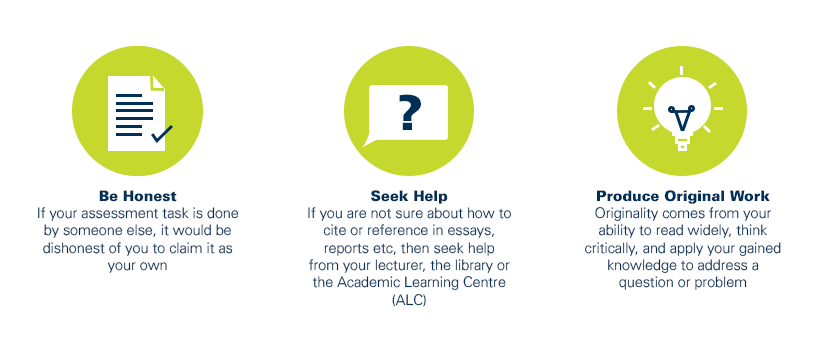
For academic advice and guidance, the Academic Learning Centre (ALC) can support you in becoming confident in completing assessments with integrity and of high standard.
What can you do to act with integrity?