Overview
This unit examines the technological skills and knowledge necessary in a 21st-century digitally connected world. In this unit, you will investigate the theoretical foundations of e-learning and how technology offers a platform for inclusivity, creativity, and innovation with a particular emphasis on Web 2.0 interconnectivity and Web 4.0 intelligence. It is both theoretical and practical, providing opportunities to develop, refine, and reflect on skills and literacies related to e-learning in a secondary context. The unit also encourages ongoing reflection on the cultural and critical aspects of technological literacy while helping pre-service teachers to expand and enhance their existing technological skills.
Details
Pre-requisites or Co-requisites
Prerequisite EDFE11038 Professional Practice 1 - Introduction to Teaching
Important note: Students enrolled in a subsequent unit who failed their pre-requisite unit, should drop the subsequent unit before the census date or within 10 working days of Fail grade notification. Students who do not drop the unit in this timeframe cannot later drop the unit without academic and financial liability. See details in the Assessment Policy and Procedure (Higher Education Coursework).
Offerings For Term 1 - 2026
Attendance Requirements
All on-campus students are expected to attend scheduled classes - in some units, these classes are identified as a mandatory (pass/fail) component and attendance is compulsory. International students, on a student visa, must maintain a full time study load and meet both attendance and academic progress requirements in each study period (satisfactory attendance for International students is defined as maintaining at least an 80% attendance record).
Recommended Student Time Commitment
Each 6-credit Undergraduate unit at CQUniversity requires an overall time commitment of an average of 12.5 hours of study per week, making a total of 150 hours for the unit.
Class Timetable
Assessment Overview
Assessment Grading
This is a graded unit: your overall grade will be calculated from the marks or grades for each assessment task, based on the relative weightings shown in the table above. You must obtain an overall mark for the unit of at least 50%, or an overall grade of 'pass' in order to pass the unit. If any 'pass/fail' tasks are shown in the table above they must also be completed successfully ('pass' grade). You must also meet any minimum mark requirements specified for a particular assessment task, as detailed in the 'assessment task' section (note that in some instances, the minimum mark for a task may be greater than 50%). Consult the University's Grades and Results Policy for more details of interim results and final grades.
All University policies are available on the CQUniversity Policy site.
You may wish to view these policies:
- Grades and Results Policy
- Assessment Policy and Procedure (Higher Education Coursework)
- Review of Grade Procedure
- Student Academic Integrity Policy and Procedure
- Academic Progression Policy and Procedure
- Student Refund and Credit Balance Policy and Procedure
- Complaints Policy and Procedure
- Information and Communications Technology Acceptable Use Policy and Procedure
This list is not an exhaustive list of all University policies. The full list of University policies are available on the CQUniversity Policy site.
Feedback, Recommendations and Responses
Every unit is reviewed for enhancement each year. At the most recent review, the following staff and student feedback items were identified and recommendations were made.
Feedback from Student feedback; staff reflection
Multiple platforms required for completion of assessment tasks were excessive.
Consolidate platforms required for assessment completion to reduce confusion.
Feedback from Student feedback; staff reflection
Excessive workload resulting from too many features in Assessment Task 2.
Refine Assessment Task 2 with clear expectations, ensuring weekly workshops address these.
Feedback from Staff feedback
Only online tutorials are offered, but these were poorly attended, possibly due to the timing of the sessions during school hours.
Consider tutorial timing to optimise attendance.
- Develop and evaluate strategies to differentiate learning in ICT-rich learning environments to meet individual learning needs
- Design and create learning plans in which learner engagement is transformed by the use of ICT
- Propose learning strategies that are inclusive and learner-centred
- Model and support legal, safe and ethical practice in learners
- Participate in and contribute to the development of a professional online learning community.
Successful completion of this unit provides opportunities for students to engage with the Australian Professional Standards for Teachers (Graduate Career Stage) focus areas of:
1.2 Understand how students learn
1.5 Differentiate teaching to meet the learning needs of students across the full range of abilities
2.6 Information and Communication Technology
3.4 Select and use resources
4.1 Support student participation
4.5 Use ICT safely, responsibly and ethically
6.2 Engage in professional learning and improve practice
Alignment of Assessment Tasks to Learning Outcomes
| Assessment Tasks | Learning Outcomes | ||||
|---|---|---|---|---|---|
| 1 | 2 | 3 | 4 | 5 | |
| 1 - Written Assessment - 50% | |||||
| 2 - Portfolio - 50% | |||||
Alignment of Graduate Attributes to Learning Outcomes
| Graduate Attributes | Learning Outcomes | ||||
|---|---|---|---|---|---|
| 1 | 2 | 3 | 4 | 5 | |
| 1 - Communication | |||||
| 2 - Problem Solving | |||||
| 3 - Critical Thinking | |||||
| 4 - Information Literacy | |||||
| 5 - Team Work | |||||
| 6 - Information Technology Competence | |||||
| 7 - Cross Cultural Competence | |||||
| 8 - Ethical practice | |||||
| 9 - Social Innovation | |||||
| 10 - First Nations Knowledges | |||||
| 11 - Aboriginal and Torres Strait Islander Cultures | |||||
Textbooks
There are no required textbooks.
IT Resources
- CQUniversity Student Email
- Internet
- Unit Website (Moodle)
- Padlet
All submissions for this unit must use the referencing style: American Psychological Association 7th Edition (APA 7th edition)
For further information, see the Assessment Tasks.
g.hobdell@cqu.edu.au
Week 1: The contemporary classroom
Begin Date: 09 Mar 2026Module/Topic
THE CONTEMPORARY TEACHER
THE CONTEMPORARY LEARNER
- evolving teacher identity
- digital readiness
- Web 4.0 capability building
Chapter
Links and readings in Moodle, including:
- OECD (2025). Preparing teachers for digital education: Continuing professional learning on digital skills and pedagogies
- Digital learning in the 21st Century: trends, challenges, and innovations in technology integration (Frontiers, 2025)
- UNESCO — Digital Learning and Transformation of Education (2025–2026)
Refer to Week 1 Reading List
Events and Submissions/Topic
- Topic 1 Moodle – readings and activities (expected)
- ZOOM Session – Wednesday 4:00 pm – 6:00 pm (unless otherwise advised)
Toward assessments:
AT1 setup: create Padlet (Stream); Introductory post.
Week 2: The nature of digital pedagogy
Begin Date: 16 Mar 2026Module/Topic
THE NATURE OF DIGITAL PEDAGOGY
- Conceptual frameworks + influences of AI/Web 4.0 on pedagogical models
- TPAC
- SAMR
- Taxonomies
Chapter
Links and readings in Moodle, including:
-
Mapping of digital pedagogies in higher education (Springer, 2024)
-
Education 4.0: Transforming Learning for the Fourth Industrial Revolution (SAGE, 2025)
-
Critical digital pedagogy for contemporary transformative practices in the Global South (Cogent Education, 2025)
-
Irvine, J. (2017). A Comparison of Revised Bloom and Marzano's New Taxonomy of Learning.
-
Smartcopying website.
- Baker, R. (nd). Pedagogies and digital content in the Australian school sector.
Refer to Week 2 Reading List
Events and Submissions/Topic
- Topic 2 Moodle – readings and activities (expected)
- ZOOM Session – Wednesday 4:00 pm – 6:00 pm (unless otherwise advised)
Toward assessments:
AT1: Padlet Post 1 (SAMR in your discipline) — share link.
Week 3: Digital technologies 1: Collaborative learning paces
Begin Date: 23 Mar 2026Module/Topic
DIGITAL TECHNOLOGIES 1: Collaborative learning spaces
- digital collaboration
- connected learning
- intelligent or smart environments
Chapter
Links and readings in Moodle
-
A Systematic Review and Research Trends of Smart Learning Environments (Springer, 2024)
-
E-learning technologies at the secondary education level: literature review (Frontiers, 2025)
Refer to Week 3 Reading List
Events and Submissions/Topic
- Topic 3 Moodle – readings and activities (expected)
- ZOOM Session – Wednesday 4:00 pm – 6:00 pm (unless otherwise advised)
Toward assessment task 1:
AT1: Padlet Post 2 due (Digital Tools 1; peer feedback opens).
Week 4: Digital tools 2 - Digital media
Begin Date: 30 Mar 2026Module/Topic
DIGITAL TECHNOLOGIES 2: Redefining learning
- transformational digital learning
- redefinition level SAMR
- Web 4.0 intelligence
Chapter
Links and readings in Moodle, including:
- Jones, B. & Flannigan, S. (nd). Connecting the digital dots: Literacies of the 21st Century.
- Education 4.0 and eLearning: Revolutionizing Digital Learning Environments (IntechOpen, 2025)
- E-learning using Web 4.0 (IJRASET, 2024)
- The Australian Curriculum: General Capabilities, Digital Literacy
Refer to Week 4 Reading List
Events and Submissions/Topic
- Topic 4 Moodle – readings and activities (expected)
- ZOOM Session – Wednesday 4:00 pm – 6:00 pm (unless otherwise advised)
Toward assessment task 1:
AT1: Padlet Post 3 due (Digital Tool 2).
Week 5: Digital tools 3 - Presenting learning
Begin Date: 06 Apr 2026Module/Topic
STUDENTS AS CONTENT CREATORS
- Multimodal creation
- digital agency
- Industry 4.0 tools for creativity
- authentic, problem-based learning
- the Australian Curriculum General Capabilities
Chapter
Links and readings in Moodle, including:
- Digital learning in the 21st century (Frontiers, 2025)
- Inclusive learning using Industry 4.0 technologies: addressing student diversity in modern education (Cogent Education, 2024)
- Williams, M. (2021). The pedagogy of innovation: collaborative challenge-based learning
- Australian Curriculum: General Capabilities
Refer to Week 5 Reading List
Events and Submissions/Topic
- Topic 5 Moodle – readings and activities (expected)
- ZOOM Session – Wednesday 4:00 pm – 6:00 pm (unless otherwise advised)
Toward assessment task 1:
AT1: Padlet Post 4 due (Ethical Practice).
Week 6: Planning Learning: General capabilities and digital pedagogy
Begin Date: 13 Apr 2026Module/Topic
PLANNING LEARNING: General capabilities and digital pedagogy
- planning for capability development
- aligning digital tools with curriculum
Chapter
Links and readings in Moodle, including:
- OECD. Preparing teachers for digital education (2025)
- UNESCO. AI competency frameworks for students & teachers (2024–2025)
- Australian Curriculum
- Digital Literacy
- Technologies
Refer to Week 6 Reading List
Events and Submissions/Topic
- Topic 6 Moodle – readings and activities (expected)
- ZOOM Session – Wednesday 4:00 pm – 6:00 pm (unless otherwise advised)
Toward assessment task 2:
AT1: Padlet Post 5 (Culminating reflection).
Vacation Week
Begin Date: 20 Apr 2026Module/Topic
Chapter
Events and Submissions/Topic
Toward assessment task 1: Review all posts and formatting for submission, including transcript with peer feedback.
Analysis of Digital Technologies (Online Written) Due: Vacation Week Friday (24 Apr 2026) 11:45 pm AEST
Week 7: Online collaboration and professional learning 1
Begin Date: 27 Apr 2026Module/Topic
ONLINE COLLABORATION AND PROFESSIONAL LEARNING PART 1
- professional networks
- distributed learning communities
- curated resource ecosystems
Chapter
Links and readings in Moodle, including:
- Educational Technology in Teacher Training: Systematic Review of Competencies, Skills, Models and Methods (MDPI, 2025)
- NEA (ND). Preparing 21st Century students for a global society: An educator's guide to the "Four Cs"
Refer to Week 6 Reading List
Events and Submissions/Topic
- Topic 7 Moodle – readings and activities (expected)
- ZOOM Session – Wednesday 4:00 pm – 6:00 pm (unless otherwise advised)
Toward assessment task 2:
AT2 setup: create Padlet (Wall); start curated collection; share link
Week 8: Online collaboration and professional learning 2
Begin Date: 04 May 2026Module/Topic
ONLINE COLLABORATION AND PROFESSIONAL LEARNING PART 2
- professional networks
- distributed learning communities
- curated resource ecosystems
Chapter
Links and readings in Moodle, including:
Links and readings in Moodle, including:
- Digital Education Fronts 2025 (Springer, 2025)
- Lunevich, L. (2021). Critical Digital Pedagogy and Innovative Model, Revisiting Plato and Kant: An Environmental Approach to Teaching in the Digital Era.
Refer to Week 8 Reading List
Events and Submissions/Topic
- Topic 8 Moodle – readings and activities (expected)
- ZOOM Session – Wednesday 4:00 pm – 6:00 pm (unless otherwise advised)
Toward assessment task 2:
- Add to curated collection with acknowledgement of sources and curator's insights
- Upload mini‑unit outline to Padlet (Stream Blog or alternative); add ICT alignment plan
Week 9: Transforming learning with ICT: Learning design
Begin Date: 11 May 2026Module/Topic
TRANSFORMING LEARNING WITH ICT: Learning design
- designing adaptive, Web‑4.0 informed learning sequences
Chapter
Links and readings in Moodle, including:
- Towards Sustainable Education 4.0: Opportunities and Challenges of Decentralized Learning with Web3 Technologies (MDPI, 2025)
- Education 4.0 and eLearning (IntechOpen, 2025)
Refer to Week 9 Reading List
Events and Submissions/Topic
- Topic 9 Moodle – readings and activities (expected)
- ZOOM Session – Wednesday 4:00 pm – 6:00 pm (unless otherwise advised)
Toward Assessment Task 2:
AT2: Upload student profile + ICT plan refinements.
Week 10: ICT learning design and learning narratives
Begin Date: 18 May 2026Module/Topic
PROFESSIONAL LEARNING: Managing change
- APST's
- leading digital transformation
- policy literacy
- AI futures
Chapter
Links and readings in Moodle
-
AITSL standards - ICT elaborations
-
UNESCO — AI and the Future of Education: Disruptions, Dilemmas and Directions (2025)
-
World Economic Forum — Education 4.0 Framework (2025/26)
Refer to Week 9 Reading List
Events and Submissions/Topic
- Topic 10 Moodle – readings and activities (expected)
- ZOOM Session – Wednesday 4:00 pm – 6:00 pm (unless otherwise advised)
Toward Assessment Task 2
AT2: Upload student learning narrative and start reflection on learning
Week 11: Professional learning expectations and standards
Begin Date: 25 May 2026Module/Topic
PORTFOLIO, FEEDBACK and REFLECTION
- reflective digital professionalism
- lifelong learning
- online identity
Chapter
Links and readings in Moodle, including:
- AITSL standards - ICT elaborations
Refer to Week 11 Reading List
Events and Submissions/Topic
- Topic 11 Moodle – readings and activities (expected)
- ZOOM Session – Wednesday 4:00 pm – 6:00 pm (unless otherwise advised)
Toward assessment task 2:
AT2: Complete reflection on AITSL standards 6.2 and 7.4 and online collaboration experience.
Week 12: Assessment submission
Begin Date: 01 Jun 2026Module/Topic
Don't forget to complete your unit evaluation – we value your constructive feedback!
Chapter
Events and Submissions/Topic
1 Written Assessment
DOCUMENTING AND REFLECTING ON YOUR RESEARCH
This task develops your capacity as a digital pedagogue by engaging with contemporary digital tools, including emerging Web 4.0 capabilities, through a reflective and practice‑based Padlet (Stream) blog. You will document and evaluate a series of digital learning investigations, drawing on key digital pedagogy frameworks and contemporary ICT research.
Across six blog posts, you will:
- articulate your developing identity as a digital pedagogue;
- apply the SAMR model to analyse transformation in your discipline, including how Web 4.0 technologies may enable redefinition;
- explore, experiment with, and technically evaluate two digital tools, noting where relevant their adaptive, intelligent, or multimodal Web 4.0 features;
- evaluate safe, legal and ethical considerations related to classroom use; and
- reflect on your professional learning, participation in online communities, and evolving beliefs about digital pedagogy.
Peer feedback is an essential aspect of this task. You are required to use an approved peer‑feedback model when commenting on your peers’ posts, which contributes to the development of your professional online learning community.
Submission:
Completed via Padlet (Stream), with your blog link and uploaded transcript submitted through Moodle.
References to key literature are required in each of your blog posts 2-5. Peer feedback is required for the task.
DETAILS
Introductory Post (non-assessable)
Write an introductory post that discusses your position as a digital pedagogue, your beliefs about digital learning and teaching, and your mindset as you navigate this unit.
Blog Post 1 SAMR in your discipline (due Week 2)
Research the SAMR model and its possible application in your classroom. Use your developing knowledge of this framework to identify examples of how technology might be used in your classroom at each level of the model. You must acknowledge and critically evaluate sources to ensure your ideas' validity, ensuring that your suggestions support lower-order and higher-order thinking in your students. When applying the SAMR framework, ensure that your examples consider how intelligent and adaptive Web 4.0 technologies may enable transformation or redefinition in your discipline context.
Blog Post 2 DIGITAL TOOL 1 (due Week 3) and 3 DIGITAL TOOL 2 (due Week 4)
You are to select, experiment with, and evaluate the potential use of TWO (2) different digital tools that could be used innovatively in your classroom. Apply your findings to synthesise what you have learned about each tool, writing a focused reflection that outlines your exploration of its functionality and potential for transformational digital pedagogy. In doing so, you are to provide an overview of each tool's technical aspects.
- What can the tool offer for education in terms of technical aspects?
- What do the tools that you have explored allow you and your students to do?
- Can you multi-author? Do you have privacy settings?
- Can you customise outcomes?
- What other technical considerations are important? Is it easy to use?
- What experience is needed to operate it? What are the implications for your own professional learning?
- Can it be shared? How?
Where relevant, discuss any Web 4.0 characteristics of the tools (e.g., personalisation, intelligent feedback, multimodal or adaptive functionality) and evaluate their pedagogical implications.
Include significant evidence of your exploration using methods related to the classroom. It is expected that sufficient evidence is provided to support your claim of technical skill (such as a range of uploaded images, video or other files, links to external content, etc.).
Suggest how this tool could be used to transform learning through the redesign of a traditional task using the SAMR framework.
Blog Post 4 ETHICAL PRACTICE (due Week 5)
Research and identify the legal, safe, and ethical protocols to consider when your students work with these technologies. What key aspects should you consider for each tool? Referring to literature, identify the pedagogical benefits of working with tools such as these. Focus not only on your use but, importantly, your students’ use of ICT for learning. Consider your students creating with this technology as producers rather than mere consumers. You should address how emerging Web 4.0 technologies may shape your future professional identity and your students’ agency as creators in digital learning environments.
Blog Post 5 REFLECTION (due Week 6)
Provide a culminating reflection on your professional learning about digital learning and teaching by:
- addressing the impact and intent of engagement with the resources and activities of this unit on your beliefs, knowledge and skills about digital pedagogy and eLearning, and how you can use ICTs to engage students in their learning (APST 3.4), as well as implement teaching strategies for using ICT to expand curriculum learning opportunities for students (APST 2.6).
- identifying how your learning in this unit has supported your understanding of the relevant issues and the strategies available to support the safe, responsible and ethical use of ICT in learning and teaching (APST 4.5):
- how your learning will support future learning;
- evaluating your professional learning, with justified examples of how online interaction with others (providing and responding to feedback through blog comments), has enhanced/could enhance your professional growth and understanding of online professional learning as a teacher.
PEER FEEDBACK (timely alignment with progressive due dates – Posts 3, 4 and 5)
You are required to comment on the posts of at least 2 peers. The purpose of commenting is to make a timely contribution to the learning of others and to learn from the diverse exploration and reflection that has occurred. Late commenting or posting of your own reflections beyond the time frame of each activity will limit your capacity to demonstrate the professional networking requirement of this task. Improvements can be made to your posts following formative peer feedback and discussion up until the final AT1 due date.
You must use one of the provided Models of Effective Peer Feedback to guide your comments.
Evidence can be provided through links to other blog posts and comments or by inserting screen captures. Late submission of these tasks will not be permitted except by arrangement with the Unit Coordinator. Systematic and regular blog postings and participation in course activities are essential.
Use of Generative Artificial Intelligence agents (Gen AI)
Within this assessment, the use of Gen AI is as follows:
LEVEL 2

Source: Perkins, Furze, Roe & MacVaugh (2024). The Al Assessment Scale
Vacation Week Friday (24 Apr 2026) 11:45 pm AEST
Padlet (select best options for display of your work). Include a link or links in Moodle submission.
This assignment will be returned to students with sufficient time to allow for academic support and advice where necessary, prior to the submission of the next assessment task.
- Propose learning strategies that are inclusive and learner-centred.
- Participate in and contribute to the development of a professional online learning community.
- Develop and evaluate strategies to differentiate learning in ICT-rich learning environments to meet individual learning needs.
- Design and create learning plans in which learner engagement is transformed by the use of ICT.
- Model and support safe, legal and ethical practice.
- Develop and evaluate strategies to differentiate learning in ICT-rich learning environments to meet individual learning needs
- Design and create learning plans in which learner engagement is transformed by the use of ICT
- Propose learning strategies that are inclusive and learner-centred
- Model and support legal, safe and ethical practice in learners
- Participate in and contribute to the development of a professional online learning community.
2 Portfolio
Task Overview
This task requires you to design a transformative digital learning sequence that draws on contemporary digital pedagogies and integrates relevant Web 4.0 capabilities. Using Padlet (Wall), you will collaboratively curate a collection of digital resources and select one key artefact to underpin your mini‑unit design.
Your portfolio will demonstrate how you plan for high‑quality digital learning by drawing together your pedagogical reasoning, design decisions, and engagement with professional digital networks.
Your portfolio will include:
- A curated collection of digital artefacts developed collaboratively using Padlet (Wall).
- A curator’s insight explaining how your selected artefact supports transformational pedagogy, including any relevant Web 4.0 features (e.g., adaptive, intelligent, multimodal or decentralised capabilities).
- A learning sequence (mini‑unit) demonstrating modification or redefinition‑level design through the SAMR framework, showing how digital tools—including Web 4.0‑enabled approaches—can enhance personalisation, intelligent feedback, or learner autonomy.
- An ICT alignment plan outlining how specific digital technologies (and any relevant Web 4.0 affordances) support curriculum learning opportunities, ethical practice, and student capability development.
- A representative student profile that identifies learning needs relevant to your design.
- A learner narrative (first person) illustrating how a student might experience and respond to the designed learning sequence.
- A professional reflection aligned with AITSL Graduate Standards 6.2 and 7.4, drawing on your collaborative engagement, curated interactions, and participation in online professional learning communities.
SUPPORT AND PEDAGOGICAL FRAMING
- Designing a sequence of learning experiences should be grounded in curriculum intent, learning outcomes, and your values and beliefs about effective pedagogy. This task makes the processes behind your pedagogical decision‑making visible to the reader.
- The learning sequence should demonstrate high‑end digital pedagogy, incorporating complex, authentic and learner‑centred experiences. It must meet the modification and/or redefinition levels of the SAMR framework as introduced in Assessment Task 1. You will also show how you use ICT to expand curriculum learning opportunities (APST 2.6), engage students in their learning (APST 3.4), and support the safe, responsible and ethical use of ICT (APST 4.5).
- Your curated collection on Padlet functions as a collaborative digital curation process, enabling you to locate, share and refine resources. Ongoing engagement with your peers’ collections is essential, as these interactions support your development as a digital professional and inform your final reflection aligned with APST 6.2 and 7.4.
- Your work will be scaffolded through weekly tasks on Moodle (Weeks 7–11). Each task produces a portfolio artefact stored in your Padlet. These artefacts collectively justify your learning sequence design and demonstrate your insight as a developing digital pedagogue.
- Your portfolio concludes with a first‑person learning narrative, capturing how a learner might experience the designed learning sequence and providing evidence of how your plan translates into action.
Submission Notes
- Your portfolio must be presented in Padlet (Stream blog – Padlet Wall for Part 1, and Stream Blog for Parts 2-7, are recommended). A full transcript of Parts 2-7 must be provided for Turnitin upload.
- Artefacts may include links to externally hosted items; ensure public access settings are enabled for marking and moderation.
Total word count equivalent: approx. 3000 words.
Use of Generative Artificial Intelligence agents (Gen AI)
Within this assessment, the use of Gen AI is as follows:
LEVEL 2

Week 12 Monday (1 June 2026) 11:59 pm AEST
Padlet (select best options for display of your work). Include a link or links in Moodle submission.
Feedback on this final assessment response will be provided following University Assesment policy and before Certification of Grades.
- Propose learning strategies that are inclusive and learner-centred.
- Participate in and contribute to the development of a professional online learning community.
- Develop and evaluate strategies to differentiate learning in ICT-rich learning environments to meet individual learning needs.
- Design and create learning plans in which learner engagement is transformed by the use of ICT.
- Model and support safe, legal and ethical practice
- Develop and evaluate strategies to differentiate learning in ICT-rich learning environments to meet individual learning needs
- Design and create learning plans in which learner engagement is transformed by the use of ICT
- Propose learning strategies that are inclusive and learner-centred
- Model and support legal, safe and ethical practice in learners
- Participate in and contribute to the development of a professional online learning community.
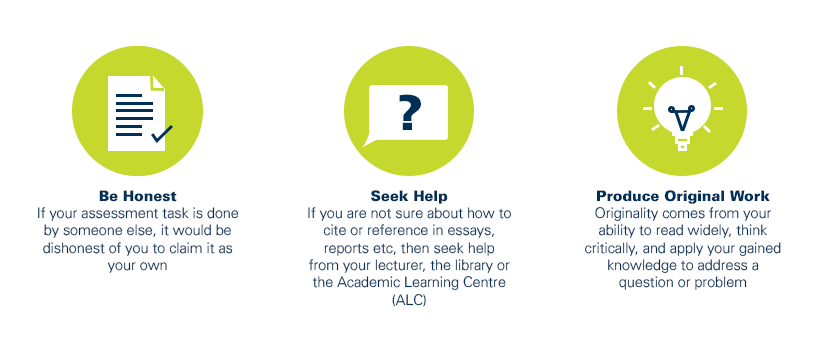
As a CQUniversity student you are expected to act honestly in all aspects of your academic work.
Any assessable work undertaken or submitted for review or assessment must be your own work. Assessable work is any type of work you do to meet the assessment requirements in the unit, including draft work submitted for review and feedback and final work to be assessed.
When you use the ideas, words or data of others in your assessment, you must thoroughly and clearly acknowledge the source of this information by using the correct referencing style for your unit. Using others’ work without proper acknowledgement may be considered a form of intellectual dishonesty.
Participating honestly, respectfully, responsibly, and fairly in your university study ensures the CQUniversity qualification you earn will be valued as a true indication of your individual academic achievement and will continue to receive the respect and recognition it deserves.
As a student, you are responsible for reading and following CQUniversity’s policies, including the Student Academic Integrity Policy and Procedure. This policy sets out CQUniversity’s expectations of you to act with integrity, examples of academic integrity breaches to avoid, the processes used to address alleged breaches of academic integrity, and potential penalties.
What is a breach of academic integrity?
A breach of academic integrity includes but is not limited to plagiarism, self-plagiarism, collusion, cheating, contract cheating, and academic misconduct. The Student Academic Integrity Policy and Procedure defines what these terms mean and gives examples.
Why is academic integrity important?
A breach of academic integrity may result in one or more penalties, including suspension or even expulsion from the University. It can also have negative implications for student visas and future enrolment at CQUniversity or elsewhere. Students who engage in contract cheating also risk being blackmailed by contract cheating services.
Where can I get assistance?
For academic advice and guidance, the Academic Learning Centre (ALC) can support you in becoming confident in completing assessments with integrity and of high standard.
What can you do to act with integrity?