Overview
In this unit you will develop an understanding of both the content and pedagogy required to teach science in early childhood education and care settings and in primary school classrooms. You are introduced to concepts on how children learn science, the importance of science education in an Australian and international context and current views regarding effective pedagogical practice. You will examine research that has informed the selection of pedagogy with children in early childhood education and care settings and in primary school classrooms. Practical application of skills related to the Australian Curriculum: Science will focus on learning and teaching across the four Understanding Substrands of Biological Sciences, Earth and Space Sciences, Chemical Sciences and Physical Sciences. There is an emphasis on science inquiry skills, in particular, identifying and posing questions; planning, conducting and reflecting on investigations; processing, analysing and interpreting evidence; and communicating findings. The unit includes an emphasis on effective student engagement within science education through the appropriate selection, application and assessment of science content knowledge.
Details
Pre-requisites or Co-requisites
There are no requisites for this unit.
Important note: Students enrolled in a subsequent unit who failed their pre-requisite unit, should drop the subsequent unit before the census date or within 10 working days of Fail grade notification. Students who do not drop the unit in this timeframe cannot later drop the unit without academic and financial liability. See details in the Assessment Policy and Procedure (Higher Education Coursework).
Offerings For Term 1 - 2026
Attendance Requirements
All on-campus students are expected to attend scheduled classes - in some units, these classes are identified as a mandatory (pass/fail) component and attendance is compulsory. International students, on a student visa, must maintain a full time study load and meet both attendance and academic progress requirements in each study period (satisfactory attendance for International students is defined as maintaining at least an 80% attendance record).
Recommended Student Time Commitment
Each 6-credit Postgraduate unit at CQUniversity requires an overall time commitment of an average of 12.5 hours of study per week, making a total of 150 hours for the unit.
Class Timetable
Assessment Overview
Assessment Grading
This is a graded unit: your overall grade will be calculated from the marks or grades for each assessment task, based on the relative weightings shown in the table above. You must obtain an overall mark for the unit of at least 50%, or an overall grade of 'pass' in order to pass the unit. If any 'pass/fail' tasks are shown in the table above they must also be completed successfully ('pass' grade). You must also meet any minimum mark requirements specified for a particular assessment task, as detailed in the 'assessment task' section (note that in some instances, the minimum mark for a task may be greater than 50%). Consult the University's Grades and Results Policy for more details of interim results and final grades.
All University policies are available on the CQUniversity Policy site.
You may wish to view these policies:
- Grades and Results Policy
- Assessment Policy and Procedure (Higher Education Coursework)
- Review of Grade Procedure
- Student Academic Integrity Policy and Procedure
- Academic Progression Policy and Procedure
- Student Refund and Credit Balance Policy and Procedure
- Complaints Policy and Procedure
- Information and Communications Technology Acceptable Use Policy and Procedure
This list is not an exhaustive list of all University policies. The full list of University policies are available on the CQUniversity Policy site.
Feedback, Recommendations and Responses
Every unit is reviewed for enhancement each year. At the most recent review, the following staff and student feedback items were identified and recommendations were made.
Feedback from Moodle
Assessments
Assessments will be updated and refined with further scaffolding to assist with student clarity.
Feedback from Moodle
Moodle
Continual improvements are being made to keep unit content relevant, interesting and engaging.
- Evaluate examples of teaching and assessment practice in science education to identify how connections are made to students’ prior knowledge or experience to promote learning
- Access and apply professional literature on contemporary science education to critically evaluate or justify planning and assessment practices
- Plan learning experiences that use appropriate research-based pedagogy and ICTs to structure content and address students’ possible misconceptions in science education
- Develop diagnostic, formative and summative assessment tools that identify students’ understanding of scientific phenomena
- Select teaching and learning and assessment strategies that draw on understandings from research of how students learn in order to support active learning, promote higher order thinking and scaffold students’ understanding of core concepts in science
- Identify strategies to support inclusive student participation and engagement in classroom activities.
Successful completion of this course provides opportunities for students to demonstrate the Australian Professional Standards for Teachers focus areas of:
1.1 Physical, social and intellectual development and characteristics of students.
1.2 Understand how learners learn
2.1 Content and teaching strategies of the teaching area
2.3 Curriculum, assessment and reporting
2.6 Information and Communication Technology (ICT)
3.2 Plan, structure and sequence learning programs
3.3 Use teaching strategies
3.4 Select and use resources
3.6 Evaluate and improve teaching programs
4.1 Support student participation
5.1 Assess student learning
5.5 Report on student achievement
Alignment of Assessment Tasks to Learning Outcomes
| Assessment Tasks | Learning Outcomes | |||||
|---|---|---|---|---|---|---|
| 1 | 2 | 3 | 4 | 5 | 6 | |
| 1 - Written Assessment - 50% | ||||||
| 2 - Written Assessment - 50% | ||||||
Alignment of Graduate Attributes to Learning Outcomes
| Graduate Attributes | Learning Outcomes | |||||
|---|---|---|---|---|---|---|
| 1 | 2 | 3 | 4 | 5 | 6 | |
| 1 - Knowledge | ||||||
| 2 - Communication | ||||||
| 3 - Cognitive, technical and creative skills | ||||||
| 4 - Research | ||||||
| 5 - Self-management | ||||||
| 6 - Ethical and Professional Responsibility | ||||||
| 7 - Leadership | ||||||
| 8 - First Nations Knowledges | ||||||
| 9 - Aboriginal and Torres Strait Islander Cultures | ||||||
Textbooks
Science in Early Childhood
- 5th Edition (2024)
- Authors: Campbell, C. & Howitt, C.
- Cambridge University Press
- Melbourne Melbourne , Victoria , Australia
- ISBN: 9781009339742
Teaching Primary Science Constructively
- 8th Edition (2024)
- Authors: Skamp, K. & Preston. C.
- Cengage
- Melbourne Melbourne , Victoria , Australia
- ISBN: 9780170472814
IT Resources
- CQUniversity Student Email
- Internet
- Unit Website (Moodle)
All submissions for this unit must use the referencing style: American Psychological Association 7th Edition (APA 7th edition)
For further information, see the Assessment Tasks.
d.mallett@cqu.edu.au
Week 1
Begin Date: 09 Mar 2026Module/Topic
Theoretical Frameworks
Chapter
Addey, C., & Gorur, R. (2020). Translating PISA, translating the world. Comparative Education, 56(4), 547–564. https://doi.org/10.1080/03050068.2020.1771873
Campbell, C., Jobling, W., & Howitt, C. (2015). Science in early childhood (2nd ed.). Cambridge University Press.
Fragkiadaki, G., Fleer, M., & Rai, P. (2021). Early childhood science education from 0 to 6: A literature review. Education Sciences, 11(4), Article 178. https://doi.org/10.3390/educsci11040178
Events and Submissions/Topic
Week 2
Begin Date: 16 Mar 2026Module/Topic
Science Inquiry, the curriculum, and play-based learning
Chapter
Bodrova, E., & Leong, D. J. (2003). The importance of being playful. Educational Leadership, 60(7), 50–53.
Cremin, T., Glauert, E., Craft, A., Compton, A., & Styliandou, F. (2015). Creative little scientists: Exploring pedagogical synergies between inquiry-based and creative approaches in early years science. Education, 43(4), 404–419.
Fleer, M. (2018). Digital animation: New conditions for children's development in play-based setting. British Journal of Educational Technology, 49(5), 943–958.
Nagro, S. A., Fraser, D. W., & Hooks, S. D. (2019). Lesson planning with engagement in mind: Proactive classroom management strategies for curriculum instruction. Intervention in School and Clinic, 54(3), 131–140. https://doi.org/10.1177/1053451218767905
Events and Submissions/Topic
Choose a unit or work or series of lessons in Science Education that you are keen to consider analysing for your assignment.
From this week, students are encouraged to try out their inquiries or teaching activities and present the results to the class online for peer feedback.
Week 3
Begin Date: 23 Mar 2026Module/Topic
Scientific literacy and language
Chapter
Arneson, J. B., Offerdahl, E. G., & Sevian, H. (2018). Visual literacy in bloom: Using Bloom’s taxonomy to support visual learning skills. CBE—Life Sciences Education, 17(1), ar7. https://doi.org/10.1187/cbe.17-08-0178
Australian Children’s Education and Care Quality Authority. (2022). Belonging, being & becoming: The Early Years Learning Framework for Australia (Version 2.0). https://www.acecqa.gov.au/sites/default/files/2023-01/EYLF-2022-V2.0.pdf
Australian Curriculum, Assessment and Reporting Authority. (n.d.). Understanding this learning area: Science. https://www.australiancurriculum.edu.au/curriculum-information/understand-this-learning-area/science
Hintz, A., Smith, A., Glen, K., Gannon, E., & Wishart, A. (2020). Story time STEM: Nurturing children's joy and wonder through shared reading experiences. NAEYC. See also https://www.jstor.org/stable/26979138 p. 30.
Tomas, L. (2012). Writing narratives about a socioscientific issue: Engaging students and learning science. Teaching Science, 58(4), 24–28.
Vardell, S., & Wong, J. (2017). Learning about trees with the 5Es: The poetry of science building literacy in playful, meaningful ways. Science and Children, 55(4), 20–25.
Events and Submissions/Topic
Week 4
Begin Date: 30 Mar 2026Module/Topic
Science as a human Endeavour
Chapter
Australian Education Research Organisation. (2024). Teach explicitly: Practice guide. https://www.edresearch.edu.au/sites/default/files/2024-02/teach-explicitly-aa.pdf
Gomes, J., & Fleer, M. (2020). Is science really everywhere? Teachers’ perspectives on science learning possibilities in the preschool environment. Research in Science Education, 50, 1961–1989.
Ireland, J. (2018). Creating science: Hands-on science activities & experiments for everyone! Creating Science. ISBN 978-0-9923294-1-9. https://www.creatingscience.org/creating-science.html
Sjöström, J. (2025). Vision III of scientific literacy and science education: an alternative vision for science education emphasising the ethico-socio-political and relational-existential. Studies in Science Education, 61(2), 239–274. https://doi.org/10.1080/03057267.2024.2405229
Tanner, K. D. (2013). Structure matters: Twenty-one teaching strategies to promote student engagement and cultivate classroom equity. CBE—Life Sciences Education, 12(3), 322–331. https://doi.org/10.1187/cbe.13-06-0115
Events and Submissions/Topic
Week 5
Begin Date: 06 Apr 2026Module/Topic
STEM and STEAM
Chapter
Bucher, E., & Pindra, S. (2020). Infant and toddler STEAM: Supporting interdisciplinary experiences with our youngest learners. Young Children, 75(2).
Bybee, R. W. (2009). The BSCS 5E instructional model and 21st century skills. NSTA Press. https://sites.nationalacademies.org/cs/groups/dbassesite/documents/webpage/dbasse_073327.pdf
DeadlyScience. (n.d.). DeadlyScience. https://deadlyscience.org.au/
Erduran, S. (2020). Nature of “STEM”? Epistemic underpinnings of integrated science, technology, engineering, and mathematics in education. Science & Education, 29(4), 781–784. https://research.ebsco.com/c/uiheld/viewer/pdf/qu3vdjkavn
Simoncini, K., & Lasen, M. (2021). Pop-up loose parts playgrounds: Learning opportunities for early childhood preservice teachers. International Journal of Play, 10(1), 93–108. https://doi.org/10.1080/21594937.2021.1878775
Events and Submissions/Topic
Week 6
Begin Date: 13 Apr 2026Module/Topic
Digital literacy, diversity, and First Nations perspectives
Chapter
Mantilla, A., & Edwards, S. (2019). Digital technology use by and with young children: A systematic review for the statement on young children and digital technologies. Australasian Journal of Early Childhood, 44(2), 182–195. https://doi.org/10.1177/1836939119832744
Ng, W. (2011). Why digital literacy is important for science teaching and learning? Teaching Science, 57(4), 26–32.
Pigott, C. (2013). Embedding Indigenous perspectives in science. Educating Young Children: Learning and Teaching in the Early Childhood Years, 19(1), 8–9.
Events and Submissions/Topic
AT1 due next week
Vacation Week
Begin Date: 20 Apr 2026Module/Topic
Chapter
Events and Submissions/Topic
Week 7
Begin Date: 27 Apr 2026Module/Topic
Scientific Misconceptions
Chapter
Bonus, J. A., & Mares, M.-L. (2018). When the sun sings science, are children left in the dark? Representations of science in children’s television and their effects on children’s learning. Human Communication Research, 44(4), 449–472. https://doi.org/10.1093/hcr/hqy009
Dekker, Sanne & Lee, Nikki & Howard-Jones, Paul & Jolles, Jelle. (2012). Neuromyths in Education: Prevalence and Predictors of Misconceptions among Teachers. Frontiers in Psychology. 3. 429. https://doi.org/10.3389/fpsyg.2012.00429
Delaney, Elizabeth (2018) The Scientist in Fiction How Do Primary School Children Engage with Fictional Representations of Science and Scientists? Doctoral thesis, University of Huddersfield. This version is available at http://eprints.hud.ac.uk/id/eprint/34668/
Elliott, K., & Pillman, A. (2016). Making science misconceptions work for us. Teaching Science, 62(1), 38–41.
Howard-Jones, P. Neuroscience and education: myths and messages. Nat Rev Neurosci 15, 817–824 (2014). https://doi.org/10.1038/nrn3817 , https://www.researchgate.net/publication/266945518_Neuroscience_and_education_Myths_and_messages
Kambouri, M. (2016). Investigating early years teachers' understanding and response to children's preconceptions. European Early Childhood Education Research Journal, 24(6), 907–927.
Events and Submissions/Topic
Week 8
Begin Date: 04 May 2026Module/Topic
Assessing Learning in Science Education
Chapter
Agboola, O., & Awogbindin, O. (2017). Assessment of science process skills inherent in the play activities of primary school pupils in Osun State, Nigeria. International Journal of Arts & Sciences, 10(2), 125–135.
Forbes, A. (2023). Primary science education: A teacher’s toolkit (Chap. 3, pp. 69–95). Cambridge University Press. https://www.cambridge.org
Gregson, R. (2012). Connecting with science education. Oxford University Press.
Lopez-Lozano, L., Solis, E., & Azcarate, P. (2017). Evolution of ideas about assessment in science: Incidence of a formative process. Research in Science Education, 48(5), 915–937.
Queensland Curriculum and Assessment Authority. (n.d.). P–10 Science assessment resources (Australian Curriculum v9.0). https://www.qcaa.qld.edu.au/p-10/aciq/version-9/learning-areas/p-10-science/p-10-science-assessment-resources
Teachers Pay Teachers. (n.d.). Diagnostic assessment science (free resources). https://www.teacherspayteachers.com
Events and Submissions/Topic
Week 9
Begin Date: 11 May 2026Module/Topic
Chemical Sciences
Chapter
Ashbrook, P. (2008). Exploring the properties of a mixture: The early years—Resources and conversations on PreK to 2 science. Science and Children, 45(5), 18.
Slaviero, J. (2011). Chemistry in the Australian Curriculum: Science K–6. Science Education News, 60(2), 70–73.
Taylor, N., Taylor, S., Rizk, N., & Cooper, G. (2017). Suggestions for teaching floating, sinking and density. Teaching Science, 63(4), 10–15.
Events and Submissions/Topic
Week 10
Begin Date: 18 May 2026Module/Topic
Physical Sciences
Chapter
Carruthers, R., & de Berg, K. (2010). The use of magnets for introducing primary school students to some properties of forces through small-group pedagogy. Teaching Science, 56(2), 13–17.
Fridberg, M., Jonsson, A., Redfors, A., & Thulin, S. (2020). The role of intermediary objects of learning in early years chemistry and physics. Early Childhood Education Journal, 48(5), 585–595.
Johnson, C. C., Walton, J. B., & Peters-Burton, E. (2019). Physics in motion, kindergarten: STEM road map for elementary school. National Science Teachers Association Press.
Events and Submissions/Topic
Week 11
Begin Date: 25 May 2026Module/Topic
Biological Sciences
Chapter
Connor, C. R., Watkins, M., Walte, B., & Harper, J. D. I. (2020). Food for thought: Bringing primary school microbiology to life. Teaching Science, 66(1), 20–28.
Ernst, J., McAllister, K., Siklander, P., & Storli, R. (2021). Contributions to sustainability through young children’s nature play: A systematic review. Sustainability, 13(13), Article 7443. https://doi.org/10.3390/su13137443
Gurholt, K. P., & Sanderud, J. R. (2016). Curious play: Children’s exploration of nature. Journal of Adventure Education and Outdoor Learning, 16(4), 318–329.
Events and Submissions/Topic
AT2 due next week.
Week 12
Begin Date: 01 Jun 2026Module/Topic
First Nations Perspectives and Earth and Space Sciences
Chapter
Aboriginal Astronomy. (2023). Australian Indigenous astronomy. http://www.aboriginalastronomy.com.au/
Aktamis, H., Acar, E., & Unal Coban, G. (2015). A summer camp experience of primary students: Let’s learn astronomy, explore the space summer camp. Asia-Pacific Forum on Science Learning and Teaching, 16(1), 1–24. https://research.ebsco.com/c/uiheld/viewer/pdf/yqhqegvhkz
Commonwealth Scientific and Industrial Research Organisation. (n.d.). Indigenous science. https://www.csiro.au/en/research/indigenous-science
Isik-Ercan, Z., Inan, H. Z., Nowak, J. A., & Kim, B. (2014). “We put on the glasses and Moon comes closer!” Urban second graders exploring the Earth, the Sun and Moon through 3D technologies in a science and literacy unit. International Journal of Science Education, 36(1), 129–156.
Melis, C., Wold, P.-A., Billing, A. M., Bjørgen, K., & Moe, B. (2020). Kindergarten children’s perception about the ecological roles of living organisms. Sustainability, 12(22), Article 9565. https://doi.org/10.3390/su12229565
Spiteri, J. (2021). Can you hear me? Young children’s understanding of environmental issues. International Studies in Sociology of Education, 30(1–2), 191–213. https://doi.org/10.1080/09620214.2020.1859401
Events and Submissions/Topic
Exam Week
Begin Date: 08 Jun 2026Module/Topic
Chapter
Events and Submissions/Topic
Vacation/Exam Week
Begin Date: 15 Jun 2026Module/Topic
Chapter
Events and Submissions/Topic
1 Written Assessment
Word Count: 3000 words
Task Description
You will be reporting on an inquiry that you have done/hope to do with your students.
Context: Inquiry is foundational for children’s learning in science and begins with young children as they play and interact with others within their everyday environment. While children are naturally interested in phenomena in their world, adults support this inquiry as they pose questions and support children to make predictions (Australian Government, 2022).
The Early Years’ Learning Framework also addresses in outcome 4 that “children are confident and involved learners [as they] … develop a range of learning and thinking skills and processes such as problem solving, inquiry, experimentation, hypothesising, researching and investigating.”
In this assessment task, you will report on a unit of work for science education that focuses on Inquiry in science education. You can use published units or create your own. Note: You are not assessed on your unit, but on your analysis of that unit and the ways you intend to improve and implement it.
Part 1: Describe your inquiry, connecting it with curriculum goals for your students. Demonstrate how you can recognise it as a Scientific Inquiry, including using the five stages of the National Curriculum, and also demonstrate an awareness of the Science as a Human Endeavour aspects of your curriculum goals.
Part 2: Provide a critical summary of how your preferred learning theory/s inform the teaching practices in your unit of instruction. For example, you may draw from social constructivist learning theory, neuroscience or even Cognitive Load theory and how this influences or informs the way you teach.
Part 3: Provide a critical reflection on how will you guide and teach students to think scientifically with teacher guided, student-led questions. Draw from the literature to justify how this prompting will enable differentiated instruction within an inclusive learning environment. You might like to include a hypothetical dialogue, which might include several guiding questions/prompts, with a student to show a deeper understanding of the importance of using differentiated prompts in your teaching.
Part 4: Provide a justification and critical peer appraisal of your work. Developing professionalism involves creating supportive networks and engaging in peer support; seek constructive feedback from peers in this unit, practicing teachers, or trusted family and friends. Be sure to say how you implemented feedback. A high quality justification will include links to the literature and feedback on the positive, negative and otherwise aspects of the unit, with a careful note of how the person has addressed the intention and demands of the Australian Curriculum and good science teaching.
Vacation Week Thursday (23 Apr 2026) 1:00 pm AEST
Submit online via Moodle
Week 8 Monday (4 May 2026)
Your task will be returned once moderation has occurred and in time so that you can apply the feedback to your next assignment.
Scientific Inquiry: Demonstrated, clear and practical understanding of Science Inquiry and Science as a Human Endeavour strands of the Australian Curriculum (Science) and a current scientific understanding of the concepts of the curriculum. ULO: 1, 4, 5; APST 2.1; 2.3; 3.2 and 3.4
Student Engagement: Utilising highly effective pedagogical approaches to maximise student engagement through student-led questions and inclusive student participation. ULO: 4, 5 and 6; APST 1.1, 1.2, 1.3, 1.4, 3.3, 4.1,
Critical appraisal: As part of a critical appraisal, gain and implement peer feedback to help you justify how this approach to learning and teaching will make a positive impact on learners. ULO 1, 2; APST 3.6, 6.3
Scholarly Communication: Effective, scholarly and professional communication in accordance with accepted academic conventions APA 7th. ULO 5; APST 6.3
- Access and apply professional literature on contemporary science education to critically evaluate or justify planning and assessment practices
- Select teaching and learning and assessment strategies that draw on understandings from research of how students learn in order to support active learning, promote higher order thinking and scaffold students’ understanding of core concepts in science
- Identify strategies to support inclusive student participation and engagement in classroom activities.
2 Written Assessment
Weighting: 50%
Word Count: 3000 Words (+/- 10%)
Use of Generative Artificial Intelligence agents (Gen AI)
You may use Gen AI tools throughout your work, either as you wish or as specifically directed. Focus on directing AI to help achieve your goals while engaging in and demonstrating critical thinking in your assignment response. Any misuse or lack of disclosure regarding AI tools will be considered a breach of academic integrity. More information and guidance on appropriate Gen AI usage will be given in workshops and is contained on Moodle.
Task Description
As we experience the world, including the interactions we have with other children and adults, we build explanations of how the world works. Through this, we often develop alternate conceptions or ‘misconceptions’ about the world, that differ from the formally accepted scientific account of how the world works.
You are to prepare a report on a scientific concept in the curriculum, misconceptions around that concept, and ways to address and even harness those misconceptions.
Part 1: Choose a key scientific concept learning outcome from your unit of work, and demonstrate your fluent understanding of this concept, including its SHE aspects.
Part 2: Report on a lesson/series of lessons that involve the development and deployment of a diagnostic tool to help you diagnose student misconceptions around your chosen concept, including how some misconceptions can help us understanding student thinking.
Part 3: Explore how you intend to address those misconceptions though curriculum relevant, and engaging student experiences.
Part 4: Modern education plans, from the start, aim for communication with stakeholders. Outline how you would report your findings to children/students, parents/carers, the school community and leadership, and broader community.
Be sure to write academically and to justify all your pedagogical decisions with high quality, recent, peer reviewed research, keeping any lessons/unit plans in the appendix/online in order to keep your report within the word limit.
Further elaborations are provided in Moodle.
Week 12 Thursday (4 June 2026) 1:00 pm AEST
Submit online via Moodle
Your response will be returned once moderation has occurred.
The Concept: Evidence that the contemporary scientific concept is clearly understood and discussed, including its contributions to Science as a Human Endeavor. ULO 1, 5; APST 1.1, 1.2, 2.1
The Diagnostic Instrument: Report on a comprehensive diagnostic assessment tool to analyse the understandings that learners may have about the selected concept, including ways that misconceptions may be helpful. ULO: 1, 3, 4, 6; APST 1.2, 1.4, 2.1, 2.3, 5.1
Learning sequence: Report on the plans to address these misconceptions though engaging inquiry lessons, respecting contemporary research into the characteristics of students and related implications for learning and teaching, such as demonstrating explicit use of learning theories, curriculum links and ICT to guide pedagogy. ULO 1, 2, 3, 5, 6; APST 1.2, 2.6, 3.2, 3.3, 3.4, 4.1.
Stakeholder communication: Communicates findings using appropriate language for context (students, parents/carers and teachers). ULO 4; APST 3.2, 5.5
Scholarly communication: Effective, scholarly and professional communication in accordance with accepted academic conventions APA 7th. ULO 2; APST 6.3
- Evaluate examples of teaching and assessment practice in science education to identify how connections are made to students’ prior knowledge or experience to promote learning
- Access and apply professional literature on contemporary science education to critically evaluate or justify planning and assessment practices
- Plan learning experiences that use appropriate research-based pedagogy and ICTs to structure content and address students’ possible misconceptions in science education
- Develop diagnostic, formative and summative assessment tools that identify students’ understanding of scientific phenomena
- Select teaching and learning and assessment strategies that draw on understandings from research of how students learn in order to support active learning, promote higher order thinking and scaffold students’ understanding of core concepts in science
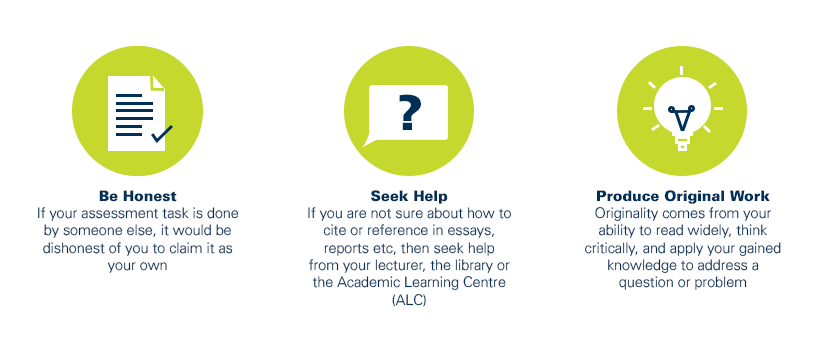
As a CQUniversity student you are expected to act honestly in all aspects of your academic work.
Any assessable work undertaken or submitted for review or assessment must be your own work. Assessable work is any type of work you do to meet the assessment requirements in the unit, including draft work submitted for review and feedback and final work to be assessed.
When you use the ideas, words or data of others in your assessment, you must thoroughly and clearly acknowledge the source of this information by using the correct referencing style for your unit. Using others’ work without proper acknowledgement may be considered a form of intellectual dishonesty.
Participating honestly, respectfully, responsibly, and fairly in your university study ensures the CQUniversity qualification you earn will be valued as a true indication of your individual academic achievement and will continue to receive the respect and recognition it deserves.
As a student, you are responsible for reading and following CQUniversity’s policies, including the Student Academic Integrity Policy and Procedure. This policy sets out CQUniversity’s expectations of you to act with integrity, examples of academic integrity breaches to avoid, the processes used to address alleged breaches of academic integrity, and potential penalties.
What is a breach of academic integrity?
A breach of academic integrity includes but is not limited to plagiarism, self-plagiarism, collusion, cheating, contract cheating, and academic misconduct. The Student Academic Integrity Policy and Procedure defines what these terms mean and gives examples.
Why is academic integrity important?
A breach of academic integrity may result in one or more penalties, including suspension or even expulsion from the University. It can also have negative implications for student visas and future enrolment at CQUniversity or elsewhere. Students who engage in contract cheating also risk being blackmailed by contract cheating services.
Where can I get assistance?
For academic advice and guidance, the Academic Learning Centre (ALC) can support you in becoming confident in completing assessments with integrity and of high standard.
What can you do to act with integrity?