Overview
In a pluralist society, criminal justice policy is heavily influenced by public perception of crime and in particular fear of crime. In this unit you will explore the media’s role in constructing an image of crime and critique the ways in which forms of power control this process. You will discuss different representations of crime from the early print news media through to the growth of social media and the rise of ‘fake news’. This unit discusses the forms of media regulation that seek to govern the way truth is presented particularly within news media. You will apply this knowledge by developing an organisational media response to a complex issue.
Details
Pre-requisites or Co-requisites
There are no requisites for this unit.
Important note: Students enrolled in a subsequent unit who failed their pre-requisite unit, should drop the subsequent unit before the census date or within 10 working days of Fail grade notification. Students who do not drop the unit in this timeframe cannot later drop the unit without academic and financial liability. See details in the Assessment Policy and Procedure (Higher Education Coursework).
Offerings For Term 2 - 2026
Attendance Requirements
All on-campus students are expected to attend scheduled classes - in some units, these classes are identified as a mandatory (pass/fail) component and attendance is compulsory. International students, on a student visa, must maintain a full time study load and meet both attendance and academic progress requirements in each study period (satisfactory attendance for International students is defined as maintaining at least an 80% attendance record).
Recommended Student Time Commitment
Each 6-credit Undergraduate unit at CQUniversity requires an overall time commitment of an average of 12.5 hours of study per week, making a total of 150 hours for the unit.
Class Timetable
Assessment Overview
Assessment Grading
This is a graded unit: your overall grade will be calculated from the marks or grades for each assessment task, based on the relative weightings shown in the table above. You must obtain an overall mark for the unit of at least 50%, or an overall grade of 'pass' in order to pass the unit. If any 'pass/fail' tasks are shown in the table above they must also be completed successfully ('pass' grade). You must also meet any minimum mark requirements specified for a particular assessment task, as detailed in the 'assessment task' section (note that in some instances, the minimum mark for a task may be greater than 50%). Consult the University's Grades and Results Policy for more details of interim results and final grades.
All University policies are available on the CQUniversity Policy site.
You may wish to view these policies:
- Grades and Results Policy
- Assessment Policy and Procedure (Higher Education Coursework)
- Review of Grade Procedure
- Student Academic Integrity Policy and Procedure
- Academic Progression Policy and Procedure
- Student Refund and Credit Balance Policy and Procedure
- Complaints Policy and Procedure
- Information and Communications Technology Acceptable Use Policy and Procedure
This list is not an exhaustive list of all University policies. The full list of University policies are available on the CQUniversity Policy site.
Feedback, Recommendations and Responses
Every unit is reviewed for enhancement each year. At the most recent review, the following staff and student feedback items were identified and recommendations were made.
Feedback from SUTE
Some of the assessment deadlines were clustered closely together, which added pressure to students workload.
Alter the assessment submission deadlines to ensure that they are more evenly spaced during the term.
Feedback from SUTE
Students suggested restructuring the workbook assessment, so it is submitted in one part rather than two parts.
Investigate the feasibility of collapsing the workbook part one and part two assessments into a single assessment submission.
Feedback from SUTE, student communication
Students found the Unit content interesting and engaging.
Maintain current and contemporary Unit content in order to remain interesting and engaging for students.
- Critique the different forms of power that shape media institutions and networks
- Develop strategies for managing organisational media presence in traditional and social media
- Discuss the regulatory structures that govern media institutions
- Explain the role of media in the construction of social attitudes to crime and the justice system
- Explain the ways in which social media has changed the way that we understand crime.
No external accreditation is relevant to this award.
Alignment of Assessment Tasks to Learning Outcomes
| Assessment Tasks | Learning Outcomes | ||||
|---|---|---|---|---|---|
| 1 | 2 | 3 | 4 | 5 | |
| 1 - Written Assessment - 40% | |||||
| 2 - Practical Assessment - 30% | |||||
| 3 - Learning logs / diaries / Journal / log books - 30% | |||||
Alignment of Graduate Attributes to Learning Outcomes
| Graduate Attributes | Learning Outcomes | ||||
|---|---|---|---|---|---|
| 1 | 2 | 3 | 4 | 5 | |
| 1 - Communication | |||||
| 2 - Problem Solving | |||||
| 3 - Critical Thinking | |||||
| 4 - Information Literacy | |||||
| 5 - Team Work | |||||
| 6 - Information Technology Competence | |||||
| 7 - Cross Cultural Competence | |||||
| 8 - Ethical practice | |||||
| 9 - Social Innovation | |||||
| 10 - First Nations Knowledges | |||||
| 11 - Aboriginal and Torres Strait Islander Cultures | |||||
Alignment of Assessment Tasks to Graduate Attributes
| Assessment Tasks | Graduate Attributes | ||||||||||
|---|---|---|---|---|---|---|---|---|---|---|---|
| 1 | 2 | 3 | 4 | 5 | 6 | 7 | 8 | 9 | 10 | 11 | |
| 1 - Written Assessment - 40% | |||||||||||
| 2 - Practical Assessment - 30% | |||||||||||
| 3 - Learning logs / diaries / Journal / log books - 30% | |||||||||||
Textbooks
There are no required textbooks.
IT Resources
- CQUniversity Student Email
- Internet
- Unit Website (Moodle)
- Zoom (both microphone and webcam capability)
All submissions for this unit must use the referencing style: American Psychological Association 7th Edition (APA 7th edition)
For further information, see the Assessment Tasks.
e.turley@cqu.edu.au
c.chatham@cqu.edu.au
Week 1
Begin Date: 13 Jul 2026Module/Topic
Introduction: The evolution of media criminology
Chapter
Leonard, L. J. (2022). Introduction: Cases on Crime and Media. In Cases on Crimes, Investigations, and Media Coverage (pp. 1–10). IGI Global.
Haney, C. (2009). Media criminology and the death penalty. The De Paul Law Review, 58(3),
Events and Submissions/Topic
Week 2
Begin Date: 20 Jul 2026Module/Topic
Theorising media representations of crime
Chapter
Marsh, I., & Melville, G. (2019). Applying theoretical perspectives on the media to crime. In Crime, Justice and the Media (3rd ed., pp. 21–49). Routledge.
Tabbert, U. (2015). Chapter 2: Crime theories and the media. In Crime and Corpus. John Benjamins Publishing Company.
Lipschultz, J. H., & Hilt, M. L. (2002). Theory and Research on Crime News. In Crime and Local Television News (pp. 33–49). Routledge.
Events and Submissions/Topic
Week 3
Begin Date: 27 Jul 2026Module/Topic
The power of the media: Fear of crime and moral panic
Chapter
Hunt, A (1997). “Moral Panic” and Moral Language in the Media. The British Journal of Sociology, 48(4), 629–648.
Kort-Butler, L. A., & Habecker, P. (2018). Framing and cultivating the story of crime : the effects of media use, victimization, and social networks on attitudes about crime. Criminal Justice Review 43(2), 127–146.
Events and Submissions/Topic
Week 4
Begin Date: 03 Aug 2026Module/Topic
Media, politics and the state
Chapter
Fake news as an informational moral panic: the symbolic deviancy of social media during the 2016 US presidential election. Information, Communication & Society, 23(3), 374–388.
Crump, J., (2011) What Are the Police Doing on Twitter? Social Media, the Police and the Public, Policy & Internet: Vol. 3:4, Article 7.
Events and Submissions/Topic
Week 5
Begin Date: 10 Aug 2026Module/Topic
The portrayal of violence in the media
Chapter
Rafter, N. (2007). Crime, film and criminology: Recent sex-crime movies. Theoretical Criminology, 11(3), 403–420.
Anderson, C. A., & Bushman, B. J. (2018). Media Violence and the General Aggression Model. Journal of Social Issues, 74(2), 386–413.
Wiest, J. B. (2016). Casting Cultural Monsters: Representations of Serial Killers in U.S. and U.K. News Media. The Howard Journal of Communications, 27(4), 327–346.
Events and Submissions/Topic
Week 6
Begin Date: 17 Aug 2026Module/Topic
Court reporting and trial by media
Chapter
Chagnon, N., & Chesney-Lind, M. (2015). Someones been in the house: A tale of burglary and trial by media. Crime Media Culture, 11(1), 41–60.
Keyzer, P., Johnston, J., & Pearson, M. (2012). The courts and the media : challenges in the era of digital and social media. Halstead Press.
Events and Submissions/Topic
Workbook 1 assessment due
Vacation Week
Begin Date: 24 Aug 2026Module/Topic
Break
Chapter
Events and Submissions/Topic
Week 7
Begin Date: 31 Aug 2026Module/Topic
Punitive media and penal populism
Chapter
Norris, A. N., & Lipsey, K. (2019). Public Attitudes Toward New Prisons in New Zealand and Deficit Narratives: A Quantitative Survey. International Criminal Justice Review, 29(4), 348–360.
Bonner, M. D. (2018). Media and Punitive Populism in Argentina and Chile. Bulletin of Latin American Research, 37(3), 275–290.
Intravia, J. (2019). Investigating the Influence of Social Media Consumption on Punitive Attitudes Among a Sample of U.S. University Students. International Journal of Offender Therapy and Comparative Criminology, 63(2), 309–333.
Events and Submissions/Topic
Week 8
Begin Date: 07 Sep 2026Module/Topic
Media and victims of crime
Chapter
Gronow, A. (2021). Identifying victims of sexual harassment in the age of (hashtag) MeToo: Time for the media to prioritise a victim’s right to privacy. Alternative Law Journal, 46(2), 120–127.
Neely, C. L. (2015). Chapter 2. The deserving vs. undeserving victim case studies of biased media reporting and law enforcement intervention. In C. L. Neely (2015). You’re dead - so what? : media, police, and the invisibility of black women as victims of homicide. Michigan State University Press.
Cripps, K. (2021). Media constructions of Indigenous women in sexual assault cases: reflections from Australia and Canada. Current Issues in Criminal Justice, 33(3), 300–321.
Events and Submissions/Topic
Week 9
Begin Date: 14 Sep 2026Module/Topic
Media and minorities
Chapter
Jacobs, L. (2017). Patterns of criminal threat in television news coverage of ethnic minorities in Flanders (2003-2013). Journal of Ethnic and Migration Studies, 43(5), 809–829.
Douai, A., & Perry, B. (2018). A Different Lens?: How Ethnic Minority Media Cover Crime. Canadian Journal of Criminology and Criminal Justice, 60(1), 96–121. https://doi.org/10.3138/cjccj.2016-0013.r2
Events and Submissions/Topic
Research essay assessment due
Research essay Due: Week 9 Thursday (17 Sept 2026) 9:00 am AEST
Week 10
Begin Date: 21 Sep 2026Module/Topic
Social media facilitated offending
Chapter
Müller, K., & Schwarz, C. (2021). Fanning the Flames of Hate: Social Media and Hate Crime. Journal of the European Economic Association, 19(4), 2131–2167.
Louie, D. W. (2017). Social Media and the Sexual Exploitation of Indigenous Girls. Girlhood Studies, 10(2), 97–113.
Sammons, J. (2015). The intersection between social media, crime, and digital forensics: #WhoDunIt? In Digital Forensics. Elsevier Science & Technology Books.
Events and Submissions/Topic
Week 11
Begin Date: 28 Sep 2026Module/Topic
Crime as entertainment: The 'true crime renaissance'
Chapter
Michele Byers, Val Marie Johnson (2009). The CSI Effect: Television, Crime, and Governance. Lexington Books.
Walters, E. (2021). Netflix Originals: The Evolution of True Crime Television. The Velvet Light Trap, 88(88), 25–37.
Events and Submissions/Topic
Case study assessment due
Case study critical analysis Due: Week 11 Thursday (1 Oct 2026) 9:00 am AEST
Week 12
Begin Date: 05 Oct 2026Module/Topic
Summary and reflection: Doing media criminology
Chapter
Events and Submissions/Topic
Exam Week
Begin Date: 12 Oct 2026Module/Topic
Chapter
Events and Submissions/Topic
Workbook 2 assessment due
Vacation/Exam Week
Begin Date: 19 Oct 2026Module/Topic
Chapter
Events and Submissions/Topic
Unit Coordinator:
Chantelle Chatham
c.chatham@cqu.edu.au
Please note, Chantelle is working for CQU in a part time capacity.
1 Written Assessment
Select any topic covered in the unit and develop your own research prompt or question to research.
As examples, this could relate to the way a particular minority group or crime type is represented in the media; the way that victims are reflected in news reporting; or the intersection between the media and the state. Other examples are provided on Moodle and will be discussed during the workshops/in the online discussion forums.
Once you have chosen a topic, conduct thorough research on it using the CQU Library database and Google Scholar. You research should cover:
- The history and nature of the chosen issue - what does it look like? what characterises the issue/problem? where do you set it play out?
- Explanations - why does it occur? what purpose does it serve? Include any theories that exist to explain it.
- Real or potential impacts - how does it affect perceptions of crime/fear of crime? who does it disadvantage and how? what studies have been conducted that prove these impacts?
The essay should contain a minimum of 10 scholarly sources.
The word limit is 1500 words (+/-10%).
Submit your essay prompt/question via email for checking and feedback by the end of week 7. This will ensure that your topic is appropriate for the unit.
Level of GenAI use allowed:
Level 2: You may use Al for planning, idea development, and research. Your final submission should show how you have developed and refined these ideas.
Grace period/Extensions:
The automatic 72-hour grace period applies to this assessment, meaning you can submit the assessment within 72 hours of the due time without any penalty without a need to apply for an extension. Submitting your assignment after the grace period without an extension in place will result in late penalties. Late penalties are 5% of the value of the task, per calendar day. If you require an extension, please submit a request via the Moodle 'support' tab before the assessment due date.
Week 9 Thursday (17 Sept 2026) 9:00 am AEST
Submit via Moodle
Within two weeks of timely submission
- Quality of written piece, including layout, grammar, spelling etc.
- Appropriateness of chosen issue and depth of understanding of the issue
- Ability to explain the issue and its impacted, supported by scholarly resources and evidence
- Ability to conduct independent research on the chosen topic and integrate this into a meaningful analysis of the prompt
- Discuss the regulatory structures that govern media institutions
- Explain the role of media in the construction of social attitudes to crime and the justice system
- Explain the ways in which social media has changed the way that we understand crime.
- Communication
- Problem Solving
- Critical Thinking
- Information Literacy
- Information Technology Competence
- Cross Cultural Competence
- Ethical practice
- Social Innovation
2 Practical Assessment
This assessment is a practical exercise in "Doing media criminology". It requires you to critically analyse the media portrayal of a chosen crime event by applying the theories and concepts from the unit.
Collect two different media portrayals of the same crime event (e.g., News articles - provide PDF of article; News reports - provide transcript). The pieces could represent contrasting views on the same crime event, or each may have a different focus/angle.
Part A - Analyse the way the media has presented the crime event, providing an appropriate explanation (or rationale) as to why they may have chosen this particular angle.
Questions to consider - What is the particular focus of the news article/report - why might this be the case? Is the information factual or potentially biased - how so? What information is missing - why has it not been included?
PART B - Then present an overview of the potential impact of this approach to crime reporting. This may include the impact on public perceptions of the crime event (and of crime more generally) or the impact on the victim, victims' family/friends, offender (or all of these groups).
Questions - What impression could this give the public about the prevalence of this crime type? Could it potentially mislead the public about the crime event? Could the representation have negative ramifications for the victim/their family/the offender?
This is an exercise in critical thinking and requires your research and original thoughts on the issues presented, supported by scholarly sources (APA 7 format).
This may be presented in an essay style format - see Moodle for more details on presentation and layout.
Suggested crime events will be outlined on Moodle and discussed in workshops.
Maximum 1600 words (+/- 10%)
Level of Gen AI use allowed:
Level 2: You may use Al for planning, idea development, and research. Your final submission should show how you have developed and refined these ideas.
Grace period/Extensions:
The automatic 72-hour grace period applies to this assessment, meaning you can submit the assessment within 72 hours of the due time without any penalty without a need to apply for an extension. Submitting your assignment after the grace period without an extension in place will result in late penalties. Late penalties are 5% of the value of the task, per calendar day. If you require an extension, please submit a request via the Moodle 'support' tab before the assessment due date.
Week 11 Thursday (1 Oct 2026) 9:00 am AEST
Submit via Moodle
Within two weeks of timely submission
- Concise and accurate breakdown of the case study and its relevance for analysis.
- Exploration and explanation of the media presentation of the issue including the potential rationale for the reporting angle and impact on audience perceptions.
- Ability to frame discussion with key themes, concepts and issues raised in the unit, the set readings and independent research (scholarly citations).
- Quality of written piece - format, layout, spelling, grammar, etc.
- Ability to integrate and appropriately cite scholarly sources to support arguments.
- Critique the different forms of power that shape media institutions and networks
- Develop strategies for managing organisational media presence in traditional and social media
- Explain the role of media in the construction of social attitudes to crime and the justice system
- Communication
- Problem Solving
- Critical Thinking
- Information Literacy
- Information Technology Competence
- Cross Cultural Competence
- Ethical practice
- Social Innovation
3 Learning logs / diaries / Journal / log books
Complete the workbook template that is provided to you on Moodle. Do not develop your own workbook document.
Each week there is different challenge, question or reflection task that you must respond to which relates to the weekly topic. Include citations using APA 7 format where requested underneath each response.
Each entry should be approximately 160 words = 1600 words total.
The assessment is submitted in two parts:
Part One (weeks 1-5): due Wednesday 19 August in week 6 9am AEST
The automatic 72-hour grace period applies to this assessment, meaning you can submit the assessment within 72 hours of the due time without any penalty without a need to apply for an extension. Submitting your assignment after the grace period without an extension in place will result in late penalties. Late penalties are 5% of the value of the task, per calendar day. If you require an extension, please submit a request via the Moodle 'support' tab before the assessment due date.
Part Two (weeks 6-11): due Friday 9th October in week 12 9am AEST
The automatic 72 hour grace period does not apply to part 2 of the workbook. If you require an extension, please submit a request via the Moodle 'support' tab before the assessment due date.
Level of Gen AI use allowed:
Level 2: You may use Al for planning, idea development, and research. Your final submission should show how you have developed and refined these ideas.
Divided into two assessment submissions, please see Moodle for more information.
Withheld until certification of grades
- Succinctly answer the question showing a sufficient understanding of each weekly topic.
- Quality of written responses, including presentation, spelling, grammar, language use etc.
- Ability to identify and integrate sources where required to support answer, including adherence to APA format.
- Reflect on the topic, where requested, in a meaningful way that shows depth of reflection expected for this level.
- Critique the different forms of power that shape media institutions and networks
- Develop strategies for managing organisational media presence in traditional and social media
- Discuss the regulatory structures that govern media institutions
- Explain the ways in which social media has changed the way that we understand crime.
- Communication
- Problem Solving
- Critical Thinking
- Information Literacy
- Information Technology Competence
- Cross Cultural Competence
- Ethical practice
- Social Innovation
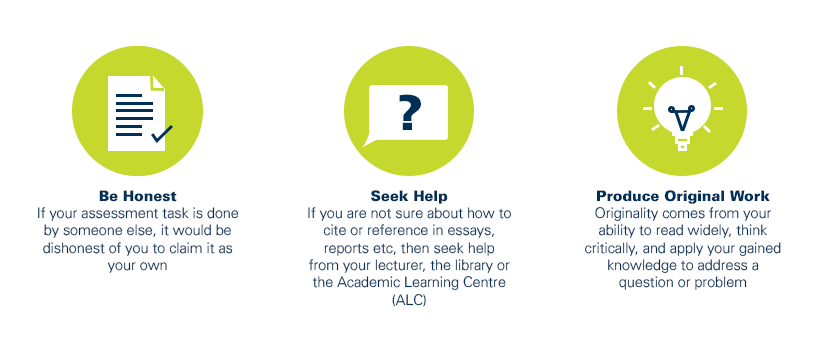
As a CQUniversity student you are expected to act honestly in all aspects of your academic work.
Any assessable work undertaken or submitted for review or assessment must be your own work. Assessable work is any type of work you do to meet the assessment requirements in the unit, including draft work submitted for review and feedback and final work to be assessed.
When you use the ideas, words or data of others in your assessment, you must thoroughly and clearly acknowledge the source of this information by using the correct referencing style for your unit. Using others’ work without proper acknowledgement may be considered a form of intellectual dishonesty.
Participating honestly, respectfully, responsibly, and fairly in your university study ensures the CQUniversity qualification you earn will be valued as a true indication of your individual academic achievement and will continue to receive the respect and recognition it deserves.
As a student, you are responsible for reading and following CQUniversity’s policies, including the Student Academic Integrity Policy and Procedure. This policy sets out CQUniversity’s expectations of you to act with integrity, examples of academic integrity breaches to avoid, the processes used to address alleged breaches of academic integrity, and potential penalties.
What is a breach of academic integrity?
A breach of academic integrity includes but is not limited to plagiarism, self-plagiarism, collusion, cheating, contract cheating, and academic misconduct. The Student Academic Integrity Policy and Procedure defines what these terms mean and gives examples.
Why is academic integrity important?
A breach of academic integrity may result in one or more penalties, including suspension or even expulsion from the University. It can also have negative implications for student visas and future enrolment at CQUniversity or elsewhere. Students who engage in contract cheating also risk being blackmailed by contract cheating services.
Where can I get assistance?
For academic advice and guidance, the Academic Learning Centre (ALC) can support you in becoming confident in completing assessments with integrity and of high standard.
What can you do to act with integrity?