Overview
This unit introduces you to the basic elements of criminology and criminal justice. The nature and trends associated with crime are examined, together with how it relates to dimensions such as social class, age, gender and ethnicity. You will examine crime in the context of contemporary criminology theory. This unit also introduces you to the institutional response to Criminal Justice in Australia, how society responds to offensive behaviour and the roles of key agencies and individuals within the justice system.
Details
Pre-requisites or Co-requisites
There are no requisites for this unit.
Important note: Students enrolled in a subsequent unit who failed their pre-requisite unit, should drop the subsequent unit before the census date or within 10 working days of Fail grade notification. Students who do not drop the unit in this timeframe cannot later drop the unit without academic and financial liability. See details in the Assessment Policy and Procedure (Higher Education Coursework).
Offerings For Term 1 - 2026
Attendance Requirements
All on-campus students are expected to attend scheduled classes - in some units, these classes are identified as a mandatory (pass/fail) component and attendance is compulsory. International students, on a student visa, must maintain a full time study load and meet both attendance and academic progress requirements in each study period (satisfactory attendance for International students is defined as maintaining at least an 80% attendance record).
Recommended Student Time Commitment
Each 6-credit Undergraduate unit at CQUniversity requires an overall time commitment of an average of 12.5 hours of study per week, making a total of 150 hours for the unit.
Class Timetable
Assessment Overview
Assessment Grading
This is a graded unit: your overall grade will be calculated from the marks or grades for each assessment task, based on the relative weightings shown in the table above. You must obtain an overall mark for the unit of at least 50%, or an overall grade of 'pass' in order to pass the unit. If any 'pass/fail' tasks are shown in the table above they must also be completed successfully ('pass' grade). You must also meet any minimum mark requirements specified for a particular assessment task, as detailed in the 'assessment task' section (note that in some instances, the minimum mark for a task may be greater than 50%). Consult the University's Grades and Results Policy for more details of interim results and final grades.
All University policies are available on the CQUniversity Policy site.
You may wish to view these policies:
- Grades and Results Policy
- Assessment Policy and Procedure (Higher Education Coursework)
- Review of Grade Procedure
- Student Academic Integrity Policy and Procedure
- Academic Progression Policy and Procedure
- Student Refund and Credit Balance Policy and Procedure
- Complaints Policy and Procedure
- Information and Communications Technology Acceptable Use Policy and Procedure
This list is not an exhaustive list of all University policies. The full list of University policies are available on the CQUniversity Policy site.
Feedback, Recommendations and Responses
Every unit is reviewed for enhancement each year. At the most recent review, the following staff and student feedback items were identified and recommendations were made.
Feedback from Student feedback Educator observation
Students benefited from the Academic Learning Centre (ALC) sessions that were embedded into the workshops
Continue to collaborate with the ALC to guide student learning and provide opportunities for ALC staff to present at workshops in advance of the assessment due dates to prepare students for assessments.
Feedback from Student feedback
Vary assessment due dates so they are not clustered around week 4, 10 and 12 when other unit assessments are due.
It is recommended that the teaching team review the assessment due dates for all assessment items to ensure that the current dates support student success.
Feedback from SUTE data
Some students did not feel that feedback was useful
Review the methods used to provide feedback to students, exploring different avenue for communication of feedback (e.g. voice recorded feedback in Turn It In feedback suite).
- Describe how crime is classified, measured and analysed
- Analyse basic criminology theories and how they relate to criminal activity
- Explain the roles of individuals and key agencies within the justice system
- Examine the societal and institutional responses to criminal justice in Australia.
Alignment of Assessment Tasks to Learning Outcomes
| Assessment Tasks | Learning Outcomes | |||
|---|---|---|---|---|
| 1 | 2 | 3 | 4 | |
| 1 - Online Quiz(zes) - 15% | ||||
| 2 - Written Assessment - 35% | ||||
| 3 - Written Assessment - 50% | ||||
Alignment of Graduate Attributes to Learning Outcomes
| Graduate Attributes | Learning Outcomes | |||
|---|---|---|---|---|
| 1 | 2 | 3 | 4 | |
| 1 - Communication | ||||
| 2 - Problem Solving | ||||
| 3 - Critical Thinking | ||||
| 4 - Information Literacy | ||||
| 5 - Team Work | ||||
| 6 - Information Technology Competence | ||||
| 7 - Cross Cultural Competence | ||||
| 8 - Ethical practice | ||||
| 9 - Social Innovation | ||||
| 10 - First Nations Knowledges | ||||
| 11 - Aboriginal and Torres Strait Islander Cultures | ||||
Alignment of Assessment Tasks to Graduate Attributes
| Assessment Tasks | Graduate Attributes | ||||||||||
|---|---|---|---|---|---|---|---|---|---|---|---|
| 1 | 2 | 3 | 4 | 5 | 6 | 7 | 8 | 9 | 10 | 11 | |
| 1 - Online Quiz(zes) - 15% | |||||||||||
| 2 - Written Assessment - 35% | |||||||||||
| 3 - Written Assessment - 50% | |||||||||||
Textbooks
There are no required textbooks.
IT Resources
- CQUniversity Student Email
- Internet
- Unit Website (Moodle)
All submissions for this unit must use the referencing style: American Psychological Association 7th Edition (APA 7th edition)
For further information, see the Assessment Tasks.
j.hotten@cqu.edu.au
Module 1 Introduction to criminology and criminal justice
Begin Date: 09 Mar 2026Module/Topic
Introduction to criminology and criminal justice
Chapter
Newburn, T. (2017). Criminology (3rd ed.). Routledge.
(pp. 3 - 13 only)
Events and Submissions/Topic
Module 2 Understanding and classifying crime
Begin Date: 16 Mar 2026Module/Topic
Understanding and classifying crime
Chapter
Atkinson, R. (2023). Introduction. In R. Atkinson (Ed.), Shades of deviance: A primer on crime, deviance and social harm (pp. 1-14).
Events and Submissions/Topic
Module 3 Measuring and analysing crime
Begin Date: 23 Mar 2026Module/Topic
Measuring and analysing crime
Chapter
Australian Bureau of Statistics. (2025). Crime & justice. https://www.abs.gov.au/statistics/people/crime-and-justice
Queensland Police Service. (2025). Maps & statistics. https://www.police.qld.gov.au/maps-and-statistics
Events and Submissions/Topic
Module 4 Theories of crime
Begin Date: 30 Mar 2026Module/Topic
Theories of crime
Chapter
Vito, G. F., & Maahs, J. R. (2021). Criminology: Theory, research, and policy (5th ed.). Jones & Bartlett Learning, LLC.
(pp. 38-48 only)
Events and Submissions/Topic
Module 5 The criminal justice system
Begin Date: 06 Apr 2026Module/Topic
The criminal justice system
Chapter
Willis, M., & Kapira, M. (2018). Justice reinvestment in Australia: A review of the literature. https://www.aic.gov.au/sites/default/files/2020-05/rr09_justice_reinvestment_in_australia_160518_0.pdf
Events and Submissions/Topic
Module 6 Policing and law enforcement
Begin Date: 13 Apr 2026Module/Topic
Policing and law enforcement
Chapter
Anthony, T., & Blagg, H. (2020, June 19). Enforcing assimilation, dismantling Aboriginal families: A history of police violence in Australia. The Conversation. https://theconversation.com/enforcing-assimilation-dismantling-aboriginal-families-a-history-of-police-violence-in-australia-140637
Events and Submissions/Topic
Assessment 1 due
Online quiz Due: Week 6 Monday (13 Apr 2026) 6:00 am AEST
Vacation week
Begin Date: 20 Apr 2026Module/Topic
Chapter
Events and Submissions/Topic
Module 7 Courts and sentencing
Begin Date: 27 Apr 2026Module/Topic
Courts and sentencing
Chapter
Heilpern, D. (2023, January 5). High, supreme, federal, family, county: What do all our different courts actually do? The Conversation. https://theconversation.com/high-supreme-federal-family-county-what-do-all-our-different-courts-actually-do-193228
Events and Submissions/Topic
Assessment 2 due
Analytical report Due: Week 7 Tuesday (28 Apr 2026) 9:00 am AEST
Module 8 Punishment and corrections
Begin Date: 04 May 2026Module/Topic
Punishment and corrections
Chapter
Australian Institute of Health & Welfare. (2025). Adults in prison - Summary. https://www.aihw.gov.au/reports/australias-welfare/adults-in-prison
Events and Submissions/Topic
Module 9 Victims and victimology
Begin Date: 11 May 2026Module/Topic
Victims and victimology
Chapter
Duggan, M. (2018). Introduction. In M. Duggan (Ed.). Revisiting the 'ideal victim': Developments in critical victimology (1st ed.). Bristol University Press.
(pp. 1-10 only)
Events and Submissions/Topic
Module 10 Youth crime and juvenile justice
Begin Date: 18 May 2026Module/Topic
Youth crime and juvenile justice
Chapter
Australian Institute of Health & Welfare. (2025). Youth justice. https://www.aihw.gov.au/reports/australias-welfare/youth-justice
Events and Submissions/Topic
Module 11 Crime prevention
Begin Date: 25 May 2026Module/Topic
Crime prevention
Chapter
Cozens, P. (2018, August 6). Designed features can make cities safer, but getting it wrong can be plain frightening. The Conversation. https://theconversation.com/designed-features-can-make-cities-safer-but-getting-it-wrong-can-be-plain-frightening-100239
Events and Submissions/Topic
Module 12 Contemporary issues and future of justice
Begin Date: 01 Jun 2026Module/Topic
Contemporary issues and future of justice
Chapter
McKay, C. (2022). The carceral automaton: Digital prisons & technologies of detention. International Journal of Crime, Justice & Social Democracy, 11(1), 100-119.
Events and Submissions/Topic
Assessment 3 due
Reflective portfolio Due: Week 12 Tuesday (2 June 2026) 9:00 am AEST
Exam Week
Begin Date: 08 Jun 2026Module/Topic
Chapter
Events and Submissions/Topic
Vacation/Exam Week
Begin Date: 15 Jun 2026Module/Topic
Chapter
Events and Submissions/Topic
1 Online Quiz(zes)
Weighting: 15%
Due: In week 6 (check the Assessment tab for dates/times).
**There is no Grace Period for the quiz**
AI level 1: NO AI – You must not use AI at any point during the assessment. You must demonstrate your core skills and knowledge.
There is one online quiz that will take place in week 6.
The quiz is designed to help you gauge your comprehension and to engage with course content. It will be based on set readings and content contained in the weekly modules (mods 1-6). No further research will be required, and you will not be tested on content from optional or additional readings.
The quiz has 15 questions drawn randomly from a larger pool. Questions will be worth 1% each for a total of 15%.
The quiz will contain questions about content and readings from modules 1 to 6.
Once you begin your quiz, you will have 1 hours to complete it.
*If you require any alterations to quiz timer or due dates, please get in touch with the unit coordinator.
Week 6 Monday (13 Apr 2026) 6:00 am AEST
The online quiz will open Monday 6am and close Sunday 19 April, 11:59pm
Results released when quiz closes on Sunday
Each question is worth 1 mark. Results are released when the quiz ends on Sunday night.
- Describe how crime is classified, measured and analysed
- Analyse basic criminology theories and how they relate to criminal activity
- Explain the roles of individuals and key agencies within the justice system
- Critical Thinking
- Information Literacy
2 Written Assessment
Assessment 2 (written assessment) — Analytical report
Length: 1,200 (+/‑10%)
Weight: 35%
Submission format: Submit as a Word Doc (not PDF), 12‑pt font of your choice (something legible and professional), 1.5-line spacing, and APA 7 referencing format
Academic Integrity - Original work; paraphrase with citations; no AI‑generated content submitted as your own unless explicitly permitted and acknowledged. AI may be used for pre-task activities such as brainstorming, outlining, and initial research. This level focuses on the effective use of AI for planning, synthesis, and ideation, but assessments should emphasise the ability to develop and refine these ideas independently.
Purpose - Demonstrate foundational knowledge of how a selected crime/issue is defined, classified, measured, explained with introductory criminological theory, and addressed by justice agencies in Australia. In doing so, you’ll be practicing research, academic writing, and ethical use of evidence.
Task - Choose one topic from the list below. With your chosen topic, write an analytical report that addresses all four sections:
- Define & classify the issue (legal and/or sociological definitions; deviance vs. crime)
- Measure & analyse (what data exists? ABS/AIC, dark figure, media framing, limitations)
- Apply theory (use 1 entry‑level theories: e.g., classical, strain, social learning, control, routine activity)
- Justice system responses (police/courts/corrections; aims, discretion, outcomes, inequalities; note victims where relevant)
Topic list (pick one):
- Shoplifting among young people
- Coercive control or intimate partner violence
- Online scams/cyber fraud
- Property damage/vandalism
- Cannabis cultivation in residential settings
- Hate crime
- Youth vehicle theft
Sources - Minimum 6 scholarly/reputable sources (e.g., peer‑reviewed articles, textbooks, ABS, AIC, government reports). Integrate at least one statistical source and one policy/legislation source where applicable.
The marking criteria will focus on the following areas. See the marking rubric for performance levels for grading.
- Crime classification & measurement
- Theory application
- Justice system responses
- Evaluation of societal/institutional dimensions
- Presentation & writing
- Use of sources
- Referencing
Week 7 Tuesday (28 Apr 2026) 9:00 am AEST
Submission via Moodle
Week 9 Tuesday (12 May)
|
Criterion (Weight) |
High Distinction (85–100) |
Distinction (75–84) |
Credit (65–74) |
Pass (50–64) |
Fail (0–49) |
|
1. Crime classification & measurement (15%) |
Precise legal/sociological definition; nuanced classification; insightful use of multiple data sources (incl. dark figure/media analysis); clear limits of measurement. (15-13) |
Accurate definition; appropriate classification; correct use of stats; acknowledges some limits. (12.5-11.5) |
Mostly accurate; some minor gaps; limited discussion of measurement limits. (11-10) |
Basic definition; minimal classification detail; uses data superficially. (9.5-7.5) |
Misdefined/misclassified; inaccurate or absent data; no limits discussed. (7.25-0) |
|
2. Application of criminological theory (20%) |
Selects highly relevant theory; explains clearly; applies to the issue with strong reasoning and evidence. (20-17) |
Relevant theory; good explanation; mostly sound application. (16.5-15) |
Appropriate but somewhat general application; limited depth. (14.5-13) |
Minimal or descriptive application; limited link to evidence. (12.5-10) |
Inaccurate theory use; no meaningful application. (9.75-0) |
|
3. Justice system responses (20%) |
Analyses police/courts/corrections with aims, discretion, outcomes; engages with inequality/ethics; uses evidence. (20-17) |
Sound analysis; some engagement with discretion/inequality. (16.5-15) |
Adequate descriptive coverage; limited analysis. (14.5-13) |
Mostly descriptive; little critical engagement. (12.5-10) |
Inaccurate or missing; no evidence. (9.75-0) |
|
4. Societal & institutional evaluation (15%) |
Critically evaluates broader societal responses, media, policy; offers balanced insights. (15-13) |
Clear evaluation with some critique. (12.5-11.5) |
Some evaluation; tends toward description. (11-10) |
Limited evaluation; generalisations. (9.5-7.5) |
Absent or erroneous. (7.25-0) |
|
5. Presentation & writing (10%) |
Exceptionally well-structured and written; ideas flow logically; language is clear, precise, and engaging. (10-8.5) |
Well-structured and clearly written; minor issues with flow or clarity. (8-7.5) |
Adequately structured; writing is generally clear but may lack polish. (7-6.5) |
Structure is weak or inconsistent; writing may be unclear or awkward. (6-5) |
Poorly structured and written; difficult to follow or understand. (4.75-0) |
|
6. Use of sources (10%) |
Uses a wide range of high‑quality, scholarly and reputable sources. (10-8.5) |
Uses a strong range of reputable sources (6–8), including required typologies. Sources are relevant and used effectively to support arguments. Some evidence of critical consideration. (8-7.5) |
Uses sufficient sources (6+), though some may be general or less suitable. Uses evidence mostly descriptively, with limited critical engagement. Required source types may be present but not well integrated. (7-6.5) |
Uses the minimum number of sources, with some low‑quality or inappropriate selections. Limited or inconsistent evidence use. Missing one required source type (statistics or legislation). (6-5) |
Uses fewer than required sources OR relies heavily on unreliable sources. Missing required source types. Points are unsupported or inaccurately sourced. Little or no engagement with evidence. (4.75-0) |
|
7. Referencing (10%) |
Flawless use of APA 7th referencing; all sources correctly cited. (10-8.5) |
Minor errors in APA referencing; citations mostly correct. (8-7.5) |
Some errors in APA style; citations generally present. (7-6.5) |
Frequent errors in referencing; inconsistent citation. (6-5) |
Referencing is incorrect or absent. (4.75-0) |
- Analyse basic criminology theories and how they relate to criminal activity
- Communication
- Problem Solving
- Critical Thinking
3 Written Assessment
Length: 1800 words (+/‑10%)
Weight: 50%
Submission format: Submit as a Word Doc (not PDF), Title page (not included in word count), 12 pt font of your choice (something legible and professional), 1.5-line spacing, and APA 7 referencing format (on a new page at the end; not included in word count)
Ethical Note - Do not disclose traumatic personal experiences. You may reflect on ideas, observations, and learning from study, media, or work. If this task raises personal concerns, contact university support services.
Academic Integrity - Original work; paraphrase with citations; no AI generated content submitted as your own unless explicitly permitted and acknowledged.
AI may be used for pre-task activities such as brainstorming, outlining, and initial research. This level focuses on the effective use of AI for planning, synthesis, and ideation, but assessments should emphasise the ability to develop and refine these ideas independently.
Purpose - Consolidate learning across the unit and demonstrate growth in understanding crime, criminological theory, the criminal justice system, and societal/institutional responses — while articulating your emerging professional identity, ethical stance, and commitment to social innovation.
Task & Structure - Write a reflective portfolio with the following sections:
Title page (separate page; not included in word count; add details including your word count & name)
Introduction (100-150 words): What you’ll reflect on and why
Reflection 1 – Understanding crime (500 words)
How have your definitions/assumptions about crime, deviance, and harm evolved?
What did you learn about measuring crime (dark figure, data limits, media)?
How did one theory change the way you interpret a specific issue?
Reflection 2 – The criminal justice system (500 words)
What challenged your ideas about policing, courts, sentencing, or corrections?
Where do discretion, inequality, or systemic constraints appear?
What did you learn about victims in the CJS?
Reflection 3 – Future directions & social innovation (500 words)
What does ethical practice look like for you now?
Which contemporary issue (e.g., AI in policing, restorative justice, Indigenous over‑representation) most shaped your thinking?
What realistic, evidence‑informed change could you champion?
Conclusion (100-150 words): Key takeaways, next steps for your learning
References list (new page; as needed — reflective writing can still cite readings, lectures, workshops, policy)
Sources - At least 6 quality sources recommended (unit readings count). Cite selectively to support your reflections (e.g., a theory, statistic, policy).
The marking criteria will focus on the following areas. See the marking rubric for performance levels for grading.
Depth of reflection & metacognition
Engagement with CJS & society
Ethical practice & information literacy
Use of sources
Presentation & writing
Referencing
Week 12 Tuesday (2 June 2026) 9:00 am AEST
Submission via Moodle
Withheld until certification of grades
|
Criterion (Weight) |
High Distinction (85–100) |
Distinction (75–84) |
Credit (65–74) |
Pass (50–64) |
Fail (0–49) |
|
1. Depth of reflection & metacognition (30%) |
Sophisticated self‑analysis; clearly evidences changed thinking; integrates experience with ideas; avoids mere narration. (30-25.5) |
Strong reflection; mostly analytical; shows growth. (25-23) |
Moderate reflection; mix of description and analysis. (22.5-19.5) |
Basic reflection; largely descriptive. (19-15) |
Minimal/absent reflection; anecdotal only. (14.75-0) |
|
2. Engagement with CJS & society (20%) |
Insightful critique of policing/courts/corrections and societal/institutional dynamics (discretion, inequality, ethics); well‑reasoned. (20-17) |
Clear critique with evidence. (16.5-15) |
Some critique; limited depth. (14.5-13) |
Mostly descriptive. (12.5-10) |
Incorrect or absent analysis. (9.75-0) |
|
3. Ethical practice & professional identity (20%) |
Articulates a mature ethical stance; identifies responsibilities and realistic boundaries; connects to future practice. (20-17) |
Clear ethical awareness and professional orientation. (16.5-15) |
Emerging ethical awareness. (14.5-13) |
Basic statements about ethics. (12.5-10) |
Ethical issues ignored or mishandled. (9.75-0) |
|
4. Use of sources (10%) |
Selective, high‑quality sources used to support reflection; citations accurate. (10-8.5) |
Good source use; minor citation issues. (8-7.5) |
Adequate; some integration issues. (7-6.5) |
Minimal sources; inconsistent citations. (6-5) |
Little/no evidence; referencing inaccurate. (4.75-0) |
|
5. Presentation & writing (10%) |
Engaging, clear reflective‑academic voice; logical structure; minimal errors; meets length. (10-8.5) |
Well written; minor issues. (8-7.5) |
Generally clear; some lapses. (7-6.5) |
Understandable but uneven. (6-5) |
Unclear and error‑prone. (4.75-0) |
|
6. Referencing (10%) |
Flawless use of APA 7th referencing; all sources correctly cited. (10-8.5) |
Minor errors in APA referencing; citations mostly correct. (8-7.5) |
Some errors in APA style; citations generally present. (7-6.5) |
Frequent errors in referencing; inconsistent citation. (6-5) |
Referencing is incorrect or absent. (4.75-0) |
- Explain the roles of individuals and key agencies within the justice system
- Examine the societal and institutional responses to criminal justice in Australia.
- Communication
- Problem Solving
- Critical Thinking
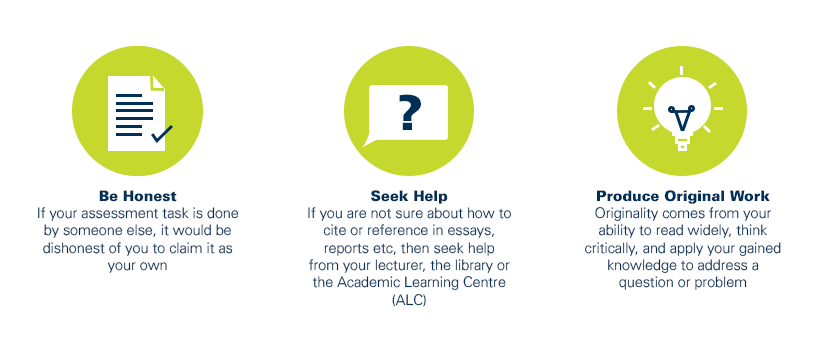
As a CQUniversity student you are expected to act honestly in all aspects of your academic work.
Any assessable work undertaken or submitted for review or assessment must be your own work. Assessable work is any type of work you do to meet the assessment requirements in the unit, including draft work submitted for review and feedback and final work to be assessed.
When you use the ideas, words or data of others in your assessment, you must thoroughly and clearly acknowledge the source of this information by using the correct referencing style for your unit. Using others’ work without proper acknowledgement may be considered a form of intellectual dishonesty.
Participating honestly, respectfully, responsibly, and fairly in your university study ensures the CQUniversity qualification you earn will be valued as a true indication of your individual academic achievement and will continue to receive the respect and recognition it deserves.
As a student, you are responsible for reading and following CQUniversity’s policies, including the Student Academic Integrity Policy and Procedure. This policy sets out CQUniversity’s expectations of you to act with integrity, examples of academic integrity breaches to avoid, the processes used to address alleged breaches of academic integrity, and potential penalties.
What is a breach of academic integrity?
A breach of academic integrity includes but is not limited to plagiarism, self-plagiarism, collusion, cheating, contract cheating, and academic misconduct. The Student Academic Integrity Policy and Procedure defines what these terms mean and gives examples.
Why is academic integrity important?
A breach of academic integrity may result in one or more penalties, including suspension or even expulsion from the University. It can also have negative implications for student visas and future enrolment at CQUniversity or elsewhere. Students who engage in contract cheating also risk being blackmailed by contract cheating services.
Where can I get assistance?
For academic advice and guidance, the Academic Learning Centre (ALC) can support you in becoming confident in completing assessments with integrity and of high standard.
What can you do to act with integrity?