Overview
Blockchain is a decentralised digital ledger with a growing list of records called blocks, which contain timestamp data, cryptographic information and transaction details. The use of blockchain technologies in cryptocurrency has grown rapidly in recent years. Besides cryptocurrencies in the financial industry, the potential for blockchain technologies in other industries is huge. In terms of achieving sustainability, blockchain has the ability to drive business process efficiency and transparency across industries, which in turn ensures better usage of resources and creates value. This unit will introduce you to the fundamentals and impact of blockchain technologies on businesses, relevant architectures, blockchain applications, and security implications. This unit aims to provide you with a solid theoretical foundation while also providing you with an opportunity to develop your own blockchain application for solving a real-world sustainability problem in relation to one of social, economic, environmental or technological issues.
Details
Pre-requisites or Co-requisites
Pre-requisite: COIT20246
Important note: Students enrolled in a subsequent unit who failed their pre-requisite unit, should drop the subsequent unit before the census date or within 10 working days of Fail grade notification. Students who do not drop the unit in this timeframe cannot later drop the unit without academic and financial liability. See details in the Assessment Policy and Procedure (Higher Education Coursework).
Offerings For Term 3 - 2026
Attendance Requirements
All on-campus students are expected to attend scheduled classes - in some units, these classes are identified as a mandatory (pass/fail) component and attendance is compulsory. International students, on a student visa, must maintain a full time study load and meet both attendance and academic progress requirements in each study period (satisfactory attendance for International students is defined as maintaining at least an 80% attendance record).
Recommended Student Time Commitment
Each 6-credit Postgraduate unit at CQUniversity requires an overall time commitment of an average of 12.5 hours of study per week, making a total of 150 hours for the unit.
Class Timetable
Assessment Overview
| Assessment Task | Part Weighting (% of assessment) |
Assessment Security Level | Gen AI Guidance Levels |
|---|---|---|---|
| 1. Solidity Practical Quiz (20% of unit ) | |||
| Solidity Practical Quiz (Online Quiz(zes)) | 100% of 20% | Low | AI-Assisted (Guided Collaboration) |
| 2. Group Presentation: Blockchain Business Case (25% of unit ) | |||
| Group Presentation: Blockchain Business Case (Presentation) | 100% of 25% | Medium | AI-Assisted (Guided Collaboration) |
| 3. Solution Development: Smart Voting Application (55% of unit ) | |||
| Solution Development: Smart Voting Application (Group Work) | 100% of 55% | Medium | AI-Assisted (Guided Collaboration) |
Assessment Grading
This is a graded unit: your overall grade will be calculated from the marks or grades for each assessment task, based on the relative weightings shown in the table above. You must obtain an overall mark for the unit of at least 50%, or an overall grade of 'pass' in order to pass the unit. If any 'pass/fail' tasks are shown in the table above they must also be completed successfully ('pass' grade). You must also meet any minimum mark requirements specified for a particular assessment task, as detailed in the 'assessment task' section (note that in some instances, the minimum mark for a task may be greater than 50%). Consult the University's Grades and Results Policy for more details of interim results and final grades.
All University policies are available on the CQUniversity Policy site.
You may wish to view these policies:
- Grades and Results Policy
- Assessment Policy and Procedure (Higher Education Coursework)
- Review of Grade Procedure
- Student Academic Integrity Policy and Procedure
- Academic Progression Policy and Procedure
- Student Refund and Credit Balance Policy and Procedure
- Complaints Policy and Procedure
- Information and Communications Technology Acceptable Use Policy and Procedure
This list is not an exhaustive list of all University policies. The full list of University policies are available on the CQUniversity Policy site.
Feedback, Recommendations and Responses
Every unit is reviewed for enhancement each year. At the most recent review, the following staff and student feedback items were identified and recommendations were made.
Feedback from Unit coordinator's reflection and Teaching Team feedback.
Students with no programming background struggled with programming content.
Introduce students to basic-level Solidity programming, then guide them in developing blockchain applications.
Feedback from In-class student feedback
Students were unable to install and configure blockchain tools on the lab PCs.
Identify and use online tools to avoid the need for installing and configuring blockchain tools on lab PCs.
- Evaluate key concepts of blockchain technologies
- Analyse the benefits of blockchain technologies and their applications for promoting sustainability
- Evaluate the legal, regulatory and ethical concerns in relation to blockchain technologies
- Critically analyse infrastructure and tools for building blockchain applications
- Develop a blockchain application that solves a real-world sustainability problem
- Evaluate future directions and industry outlooks on blockchain technology and its role in sustainability.
The Australian Computer Society (ACS), the professional association for Australia's ICT sector, recognises the Skills Framework for the Information Age (SFIA). SFIA is adopted by organisations, governments, and individuals in many countries, providing a widely used and consistent definition of ICT skills. SFIA is increasingly being used when developing job descriptions and role profiles. ACS members can use the tool MySFIA to build a skills profile.
This unit contributes to the following workplace skills as defined by SFIA 9 (the SFIA code is included):
- Sustainability (SUST)
- Business Process Improvement (BPRE)
- Innovation management (INOV)
- Information Security (SCTY)
- Technology service management (ITMG)
Alignment of Assessment Tasks to Learning Outcomes
| Assessment Tasks | Learning Outcomes | |||||
|---|---|---|---|---|---|---|
| 1 | 2 | 3 | 4 | 5 | 6 | |
|
1.
Assessment 1
(20% of unit )
Online Quiz(zes)
|
||||||
|
2.
Assessment 2
(25% of unit )
Presentation
|
||||||
|
3.
Assessment 3
(55% of unit )
Group Work
|
||||||
Alignment of Graduate Attributes to Learning Outcomes
| Graduate Attributes | Learning Outcomes | |||||
|---|---|---|---|---|---|---|
| 1 | 2 | 3 | 4 | 5 | 6 | |
| 1 - Knowledge | ||||||
| 2 - Communication | ||||||
| 3 - Cognitive, technical and creative skills | ||||||
| 4 - Research | ||||||
| 5 - Self-management | ||||||
| 6 - Ethical and Professional Responsibility | ||||||
| 7 - Leadership | ||||||
| 8 - First Nations Knowledges | ||||||
| 9 - Aboriginal and Torres Strait Islander Cultures | ||||||
Textbooks
There are no required textbooks.
IT Resources
- CQUniversity Student Email
- Internet
- Unit Website (Moodle)
All submissions for this unit must use the referencing style: Harvard (author-date)
For further information, see the Assessment Tasks.
m.elkhodr@cqu.edu.au
Week 1
Begin Date: 09 Nov 2026Module/Topic
Introduction to Blockchain Technology
Chapter
Events and Submissions/Topic
Week 2
Begin Date: 16 Nov 2026Module/Topic
Types of Blockchain
Chapter
Events and Submissions/Topic
Week 3
Begin Date: 23 Nov 2026Module/Topic
Cryptography
Chapter
Events and Submissions/Topic
Week 4
Begin Date: 30 Nov 2026Module/Topic
Blockchain Network
Chapter
Events and Submissions/Topic
Week 5
Begin Date: 07 Dec 2026Module/Topic
Blockchain Development
Chapter
Events and Submissions/Topic
Solidity practical activities in Remix
Week 6
Begin Date: 14 Dec 2026Module/Topic
Smart Contracts
Chapter
Events and Submissions/Topic
Week 6 tutorial: SimpleVote smart contract, the starting point for Assessment 3. Solidity practical activities in Remix.
Mid-Term Break
Begin Date: 21 Dec 2026Module/Topic
Chapter
Events and Submissions/Topic
Week 7
Begin Date: 04 Jan 2027Module/Topic
Blockchain Applications
Chapter
Events and Submissions/Topic
Week 8
Begin Date: 11 Jan 2027Module/Topic
Blockchain and Cloud Computing
Chapter
Events and Submissions/Topic
Week 9
Begin Date: 18 Jan 2027Module/Topic
Blockchain and Other Emerging Technologies - I
Chapter
Events and Submissions/Topic
Week 10
Begin Date: 25 Jan 2027Module/Topic
Blockchain and Other Emerging Technologies - II
Chapter
Events and Submissions/Topic
Week 11
Begin Date: 01 Feb 2027Module/Topic
Blockchain Best Practices
Chapter
Events and Submissions/Topic
Week 12
Begin Date: 08 Feb 2027Module/Topic
Solution Development
Chapter
Events and Submissions/Topic
Exam Week
Begin Date: 15 Feb 2027Module/Topic
Chapter
Events and Submissions/Topic
Unit Coordinator: Dr Mahmoud Elkhodr
m.elkhodr@cqu.edu.au
1. Solidity Practical Quiz ( 20% of unit )
Online Quiz(zes)
This is an individual practical assessment delivered as a Solidity practical quiz through Moodle.
Students complete three practical checks in Remix, using the Remix VM and test Ether only, and submit screenshot evidence of their own execution for each check. Personalised quiz values, derived from the student identification number, are used so that the required evidence is specific to each student.
The quiz assesses the foundational Solidity and Remix skills developed in the Week 5 and Week 6 practical activities, namely creating, compiling, deploying and interacting with a smart contract. Each screenshot must clearly show the required contract, result, error message or other evidence.
Only one attempt is permitted. Further instructions are provided in the quiz on the unit Moodle site.
Week 7 Friday (8 Jan 2027) 11:59 pm AEST
Week 7. The quiz is completed individually in Moodle under the conditions stated in the quiz instructions.
Week 9 Friday (22 Jan 2027)
The quiz is assessed on whether each of the three practical checks has been completed correctly in Remix.
Marks are awarded for a correct contract, deployment or interaction as specified in each check, for screenshots that clearly show the required evidence (the contract, result, error message or other output), and for evidence that originates from the student's own Remix execution using the personalised quiz values.
No written explanation is required unless a check specifically requests one.
- Evaluate key concepts of blockchain technologies
- Analyse the benefits of blockchain technologies and their applications for promoting sustainability
- Critically analyse infrastructure and tools for building blockchain applications
- Evaluate future directions and industry outlooks on blockchain technology and its role in sustainability.
2. Group Presentation: Blockchain Business Case ( 25% of unit )
Presentation
This is a group assessment in which groups of up to four students select a real or realistic problem in a business, industry, workplace or community setting and decide, with justification, whether blockchain is a sensible way to solve it. The group presents its position as a recorded presentation of 8 to 10 minutes supported by approximately 8 to 10 slides.
The presentation covers the problem and its context, the current process and stakeholders, why blockchain might help, an honest comparison with a conventional database or cloud system using a supplied template, the feasibility and direction of a possible solution, and the risks, limitations and assumptions. Concluding that blockchain is not a good fit is an acceptable result provided the reasoning is sound. Each group selects and reads one anchor source from a supplied bank, or an equivalent credible source, and uses it as a fixed reference point for judging any generative AI output.
Generative AI use is permitted provided the SAGE process is followed and recorded in a short SAGE log with a reflection. Each group submits the recorded presentation, the slides, a reference list in Harvard (author-date) style, a contribution statement, and the SAGE log and reflection.
All members are expected to contribute to the research, the slides and the recording.
Week 9 Friday (22 Jan 2027) 11:59 pm AEST
The recorded presentation, slides, reference list, contribution statement, and SAGE log and reflection are submitted together.
Week 11 Friday (5 Feb 2027)
The presentation is assessed on problem definition and context, including a specific and realistic case with clear stakeholders; blockchain suitability, including a reasoned comparison with a simpler database alternative tested against the chosen anchor source; research quality and use of the anchor, including credible sources and no unverified or invented references; the realism and feasibility of the solution direction; the quality of the recorded presentation, including structure, delivery, readable slides, sensible timing and contributions from all members; and the group contribution statement and SAGE log, which show that the group tested generative AI output against its anchor and owned the decisions.
- Evaluate key concepts of blockchain technologies
- Analyse the benefits of blockchain technologies and their applications for promoting sustainability
- Evaluate the legal, regulatory and ethical concerns in relation to blockchain technologies
- Critically analyse infrastructure and tools for building blockchain applications
- Develop a blockchain application that solves a real-world sustainability problem
3. Solution Development: Smart Voting Application ( 55% of unit )
Group Work
This is a group practical development project in which groups of four students build a Solidity smart contract for a smart voting application in Remix. Using the Remix VM and its supplied test accounts, the contract must support at least three voting options, one vote per blockchain address, rejection of invalid options, a voting period governed by block time, a contract owner, owner-controlled early closure, the reporting of current results, and winner and tie handling.
Each group evidences the contract through ten required tests, with screenshots recorded in a supplied Answer Template, and explains the design of the contract in a written submission of approximately 800 to 1,000 words.
Part A (30 marks) assesses the working solution and the written submission.
Part B (20 marks) assesses a recorded demonstration of the solution in Remix, in which every group member presents a part of the work, so that individual understanding and contribution are verified. Generative AI may be used for guidance, syntax support, troubleshooting, explanation and code review, provided that the SAGE process is applied and briefly recorded in the Answer Template and that the group can explain everything it submits.
Each group submits the completed Answer Template, the final Solidity source file and the recorded demonstration. Marks are not awarded for interface design, visual polish or the quantity of code.
Week 12 Friday (12 Feb 2027) 11:59 pm AEST
The completed Answer Template, the final Solidity source file and the recorded demonstration are submitted together by the due date.
Exam Week Friday (19 Feb 2027)
On grade certification day
The assessment is marked out of 50, comprising Part A (30 marks) and Part B (20 marks), and the result is weighted at 55% of the unit mark. Part A assesses required functionality across the eight requirements (10 marks), smart contract quality including validation, access control, reason strings and comments (10 marks), testing evidence for the ten required tests (5 marks), and the Answer Template and SAGE section (5 marks).
Part B assesses the recorded demonstration on application overview and structure (5 marks), code walkthrough and understanding (5 marks), deployment and operation in Remix (5 marks), and the demonstration of behaviour and individual contribution (5 marks). Individual contribution is assessed through the recording, and a member who does not appear in it cannot be awarded the marks associated with Part B.
- Evaluate the legal, regulatory and ethical concerns in relation to blockchain technologies
- Develop a blockchain application that solves a real-world sustainability problem
- Evaluate future directions and industry outlooks on blockchain technology and its role in sustainability.
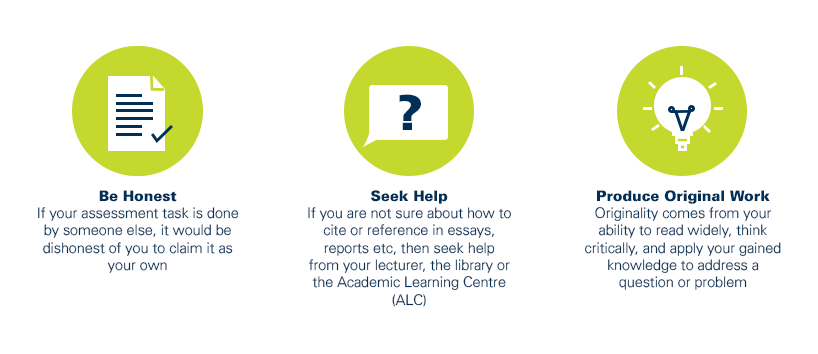
As a CQUniversity student you are expected to act honestly in all aspects of your academic work.
Any assessable work undertaken or submitted for review or assessment must be your own work. Assessable work is any type of work you do to meet the assessment requirements in the unit, including draft work submitted for review and feedback and final work to be assessed.
When you use the ideas, words or data of others in your assessment, you must thoroughly and clearly acknowledge the source of this information by using the correct referencing style for your unit. Using others’ work without proper acknowledgement may be considered a form of intellectual dishonesty.
Participating honestly, respectfully, responsibly, and fairly in your university study ensures the CQUniversity qualification you earn will be valued as a true indication of your individual academic achievement and will continue to receive the respect and recognition it deserves.
As a student, you are responsible for reading and following CQUniversity’s policies, including the Student Academic Integrity Policy and Procedure. This policy sets out CQUniversity’s expectations of you to act with integrity, examples of academic integrity breaches to avoid, the processes used to address alleged breaches of academic integrity, and potential penalties.
What is a breach of academic integrity?
A breach of academic integrity includes but is not limited to plagiarism, self-plagiarism, collusion, cheating, contract cheating, and academic misconduct. The Student Academic Integrity Policy and Procedure defines what these terms mean and gives examples.
Why is academic integrity important?
A breach of academic integrity may result in one or more penalties, including suspension or even expulsion from the University. It can also have negative implications for student visas and future enrolment at CQUniversity or elsewhere. Students who engage in contract cheating also risk being blackmailed by contract cheating services.
Where can I get assistance?
For academic advice and guidance, the Academic Learning Centre (ALC) can support you in becoming confident in completing assessments with integrity and of high standard.
What can you do to act with integrity?