In the "Assessment Tasks" section:
1. Assignment 2, in the "Task Description", "Weighting: 35%" has changed to "Weighting: 30%".
2. Assignment 3, in the "Task Description", "Weighting: 40%" has changed to "Weighting: 45%".
Overview
This unit introduces object-oriented software design and implementation, including the use of complex data structures and algorithms.You will learn data structures, algorithms, and both theoretical and practical aspects of software engineering. The theory will focus on software processes, requirements engineering, modelling, architectural design, design patterns, software development methodology, testing, and quality assurance. You will also be introduced to the principles of software reuse, and development code management. You will develop multi-tiered software application consisting of presentation, application, and data persistence tiers. You will also learn test-driven software application development using appropriate tools, thus building solid foundations for software development.
Details
Pre-requisites or Co-requisites
Pre-requisites: (COIT11134 and COIT11237) OR (COIT11134 and COIT12167).
Important note: Students enrolled in a subsequent unit who failed their pre-requisite unit, should drop the subsequent unit before the census date or within 10 working days of Fail grade notification. Students who do not drop the unit in this timeframe cannot later drop the unit without academic and financial liability. See details in the Assessment Policy and Procedure (Higher Education Coursework).
Offerings For Term 2 - 2026
Attendance Requirements
All on-campus students are expected to attend scheduled classes - in some units, these classes are identified as a mandatory (pass/fail) component and attendance is compulsory. International students, on a student visa, must maintain a full time study load and meet both attendance and academic progress requirements in each study period (satisfactory attendance for International students is defined as maintaining at least an 80% attendance record).
Recommended Student Time Commitment
Each 6-credit Undergraduate unit at CQUniversity requires an overall time commitment of an average of 12.5 hours of study per week, making a total of 150 hours for the unit.
Class Timetable
Assessment Overview
Assessment Grading
This is a graded unit: your overall grade will be calculated from the marks or grades for each assessment task, based on the relative weightings shown in the table above. You must obtain an overall mark for the unit of at least 50%, or an overall grade of 'pass' in order to pass the unit. If any 'pass/fail' tasks are shown in the table above they must also be completed successfully ('pass' grade). You must also meet any minimum mark requirements specified for a particular assessment task, as detailed in the 'assessment task' section (note that in some instances, the minimum mark for a task may be greater than 50%). Consult the University's Grades and Results Policy for more details of interim results and final grades.
All University policies are available on the CQUniversity Policy site.
You may wish to view these policies:
- Grades and Results Policy
- Assessment Policy and Procedure (Higher Education Coursework)
- Review of Grade Procedure
- Student Academic Integrity Policy and Procedure
- Academic Progression Policy and Procedure
- Student Refund and Credit Balance Policy and Procedure
- Complaints Policy and Procedure
- Information and Communications Technology Acceptable Use Policy and Procedure
This list is not an exhaustive list of all University policies. The full list of University policies are available on the CQUniversity Policy site.
Feedback, Recommendations and Responses
Every unit is reviewed for enhancement each year. At the most recent review, the following staff and student feedback items were identified and recommendations were made.
Feedback from Student evaluations, feedback from the teaching team and informal feedback from students.
The new unit materials were relevant and helped student learning
Continue to provide teaching materials of a similar standard.
Feedback from Student feedback. Feedback from the teaching team.
Assessments gave students relevant, practical experience with the concepts taught in the unit. Students found their tutorials and practical assignments engaging and helpful.
Continue with similar assessment tasks.
Feedback from Student feedback
Assessment feedback was useful and helped students to learn and to improve the quality of their work.
Continue to aim for high-quality feedback that helps students improve the quality of their work.
Feedback from Student feedback
A new LTS version of Java (25) has now been released. Students have asked when the new LTS version will be used in the university.
It is recommended that, if possible, the transition to the new LTS version be made in Term 2 or Term 3 of 2026.
- Create a software requirements specification in accordance with the principles of requirements engineering
- Apply modelling techniques to document architectural and system models as per the requirements specification
- Use complex data structures and algorithms in software application development
- Design and implement a multi-tiered software application consisting of presentation, application and data persistence tiers
- Conduct test-driven development, validation, verification testing, software project testing, and design walkthroughs in small teams.
Australian Computer Society (ACS) recognises the Skills Framework for the Information Age (SFIA). SFIA is a widely used and consistent definition of ICT skills. SFIA is increasingly being used when developing job descriptions and role profiles. ACS members can use the tool MySFIA to build a skills profile at
https://www.acs.org.au/professionalrecognition/mysfia-b2c.html.
This unit contributes to the following workplace skills as defined by SFIA 8. The SFIA code is included:
- Requirements Definition and management (REQM)
- User Experience Analysis (UNAN)
- Software Design (SWDN)
- System Integration and Build (SINT)
- Programming/Software Development (PROG)
- Database Design (DBDS)
- Testing (TEST)
- Quality Assurance(QUAS)
- Quality Management (QUMG)
Alignment of Assessment Tasks to Learning Outcomes
| Assessment Tasks | Learning Outcomes | ||||
|---|---|---|---|---|---|
| 1 | 2 | 3 | 4 | 5 | |
| 1 - Practical and Written Assessment - 25% | |||||
| 2 - Practical and Written Assessment - 30% | |||||
| 3 - Project (applied) - 45% | |||||
Alignment of Graduate Attributes to Learning Outcomes
| Graduate Attributes | Learning Outcomes | ||||
|---|---|---|---|---|---|
| 1 | 2 | 3 | 4 | 5 | |
| 1 - Communication | |||||
| 2 - Problem Solving | |||||
| 3 - Critical Thinking | |||||
| 4 - Information Literacy | |||||
| 5 - Team Work | |||||
| 6 - Information Technology Competence | |||||
| 7 - Cross Cultural Competence | |||||
| 8 - Ethical practice | |||||
| 9 - Social Innovation | |||||
| 10 - First Nations Knowledges | |||||
| 11 - Aboriginal and Torres Strait Islander Cultures | |||||
Textbooks
Engineering Software Products: An Introduction to Modern Software Engineering
- Edition: 1st (2019)
- Authors: Ian Sommerville
- Pearson Higher Ed
- USA
- ISBN: 9780135210642
- Binding: Paperback
Java How to Program (EarlyObjects, Global Edition)
- Edition: 11th (2018)
- Authors: Paul Deitel & Harvey Deitel
- Pearson
- USA
- ISBN: 978-1292223858
- Binding: eBook
IT Resources
- CQUniversity Student Email
- Internet
- Unit Website (Moodle)
- Modelling software such as Microsoft Visio
- MySQL Community Server 8.06 or higher (https://dev.mysql.com/downloads/windows/installer/8.0.html)
- JUnit 5
- JDK 21, NetBeans IDE (Java EE version) 20
- GlassFish Application Server 5 or a higher version
All submissions for this unit must use the referencing style: Harvard (author-date)
For further information, see the Assessment Tasks.
m.che@cqu.edu.au
Week 1
Begin Date: 13 Jul 2026Module/Topic
Introduction
Software Processes
Chapter
Sommerville, Chapter 1 & 2
Events and Submissions/Topic
Tutorial exercises
Introduction to MySQL Server 8.0
Week 2
Begin Date: 20 Jul 2026Module/Topic
Requirement Engineering
Chapter
Sommerville, Chapter 4
Events and Submissions/Topic
Tutorial exercises
Installing MySQL driver for NetBeans
Week 3
Begin Date: 27 Jul 2026Module/Topic
System Modelling
Chapter
Sommerville, Chapter 5
Events and Submissions/Topic
Tutorial exercises
Case Study
Week 4
Begin Date: 03 Aug 2026Module/Topic
Architectural Design
Chapter
Sommerville, Chapter 6
JDBC Overview
Events and Submissions/Topic
Tutorial exercises
Case Study
Week 5
Begin Date: 10 Aug 2026Module/Topic
Design & Implementation
Chapter
Sommerville, Chapter 7
Introduction to java GUI building
GUI Building in the Netbeans IDE
Events and Submissions/Topic
Tutorial exercises
Case Study
Assignment 1 Due: Week 5 Friday, 11:59 pm AEST
Assignment 1 Due: Week 5 Friday (14 Aug 2026) 11:59 pm AEST
Week 6
Begin Date: 17 Aug 2026Module/Topic
Agile Software Development
Chapter
Sommerville, Chapter 3
Events and Submissions/Topic
Tutorial exercises
Case study
Vacation Week
Begin Date: 24 Aug 2026Module/Topic
Mid-term break
Chapter
Events and Submissions/Topic
Week 7
Begin Date: 31 Aug 2026Module/Topic
Software Testing
Chapter
Sommerville, Chapter 8
Events and Submissions/Topic
Tutorial exercises
JUnit 5
Week 8
Begin Date: 07 Sep 2026Module/Topic
Software Evolution & Reuse
Chapter
Sommerville, Chapter 9 & 15
Events and Submissions/Topic
Tutorial exercises
Week 9
Begin Date: 14 Sep 2026Module/Topic
Quality Management
Chapter
Sommerville, Chapter 24
Events and Submissions/Topic
Tutorial exercises
Week 10
Begin Date: 21 Sep 2026Module/Topic
Configuration Management
Chapter
Sommerville, Chapter 25
Events and Submissions/Topic
Tutorial exercises
Assignment 2 Due: Week 10 Friday, 11:59 pm AEST
Assignment 2 Due: Week 10 Friday (25 Sept 2026) 11:59 pm AEST
Week 11
Begin Date: 28 Sep 2026Module/Topic
Dependable Systems
Chapter
Sommerville, Chapter 10
Events and Submissions/Topic
Tutorial exercises
Week 12
Begin Date: 05 Oct 2026Module/Topic
Security Engineering
Chapter
Sommerville, Chapter 13
Events and Submissions/Topic
Tutorial exercises
Exam Week
Begin Date: 12 Oct 2026Module/Topic
Project Submission Due
Chapter
Events and Submissions/Topic
Project Due: Review/Exam Week Friday, 11:59 pm AEST
Project Due: Exam Week Friday (16 Oct 2026) 11:59 pm AEST
Vacation/Exam Week
Begin Date: 19 Oct 2026Module/Topic
Chapter
Events and Submissions/Topic
Unit Coordinator: Dr Meiru Che
CQUniversity Brisbane, 160 Ann St, Brisbane City QLD 4000
Phone: +61 7 3228 4838
Email: m.che@cqu.edu.au
1 Practical and Written Assessment
Assignment 1
Due date: Friday of Week 5. 11:59 pm AEST
Weighting: 25%
Length: NA
Objectives
The purpose of this assessment item is to assess your skills attributable to the following learning outcomes.
Prepare software requirements specification following requirements engineering.
Apply modelling techniques to document architectural and system models as per the requirements specification.
Your task in this assessment is to analyse the given case study, understand the user requirements, develop the necessary requirement specification, and design documentation for a software system. Case study will be available on Unit Moodle site.
You should submit a report containing the following sections as listed below.
1. System Requirements: Provide functional and non-functional system requirements.
2. System Architecture: Provide a package diagram for the MVP or MVC design showing all the classes involved.
3. Use Case Diagrams: Use UML to develop use case diagrams clearly showing the users (actors) and the main functions of the system
4. UML Class Diagrams: Identify the classes based on the descriptions and the functions required. Show clearly public, private access and associations between classes.
5. Sequence Diagrams: Provide two sequence diagrams with annotations for update and search operations. Develop the sequence diagrams clearly showing the user interactions and the different layers of the system.
6. Data Design: Provide database table design with column names and types
7. GUI design: Develop the GUI design based on the use cases and the sequence diagrams. You can be creative and only an indicative GUI is required. Developers are free to use this design as is or to do things differently. Note: You can use the NetBeans Forms/or JavaFX to develop a GUI design.
8. Requirements Matrix
9.Template File: Use the ‘Assignment1Template.dot’ file available from the Unit website under the Assessment folder for creating your report document file. Download the template and save it in your directory. Locate the file in your directory using File explorer and double click on it. This will create a document file named ‘document1’ by default. You can save it assigning the name you prefer and continue writing the report.
10.Report Submission: You should submit only the word document using the Assignment 1 submission link available from the Unit website.
Week 5 Friday (14 Aug 2026) 11:59 pm AEST
Week 7 Friday (4 Sept 2026)
Students will be assessed based on their knowledge & understanding about how to:
- Analyze the given case study, identify system and user requirements
- Elicit functional & non-functional requirements following formal requirements engineering procedures
- Create a requirements specification document
- Apply modeling techniques to develop models of the system
- Use complex data structures and algorithms in software application development
2 Practical and Written Assessment
Assignment 2
Due date: Friday of Week 10. 11:59 pm AEST
Weighting: 35%
Length: NA
Objectives
The purpose of this assessment item is to assess your skills attributable to the following learning outcomes.
Design and implement a multi-tiered software application consisting of presentation, application and data persistence tiers.
Conduct test-driven development, validation and verification testing.
Discuss quality management in a range of different design and development scenarios.
Your tasks for this assessment.
• Provide the complete implementation and testing for the given case study project designed in the first assignment. The implementation should adhere to MVP (model view presenter) or MVC (model view controller) pattern with data persisted to a relational database using MySQL Server.
• Write a paragraph on version control as discussed on Unit Moodle site.
Week 10 Friday (25 Sept 2026) 11:59 pm AEST
Week 12 Friday (9 Oct 2026)
Students will be assessed based on their knowledge & understanding about how to:
- Design a software application following the requirement specification developed in Assignment 1.
- Document software application design & test plans.
- Implement a software application.
- Develop a retrospective quality plan that would have been created to deliver the application meeting quality requirements.
- Conduct test-driven development & validation testing.
- Create a software requirements specification in accordance with the principles of requirements engineering
- Apply modelling techniques to document architectural and system models as per the requirements specification
- Design and implement a multi-tiered software application consisting of presentation, application and data persistence tiers
3 Project (applied)
Assignment 3 - Project
Due date: Friday of Review/Exam Week. 11:59 pm AEST
Weighting: 40%
Length: NA
Objectives
The purpose of this assessment item is to assess your skills attributable to the following learning outcomes.
Prepare software requirements specification following requirements engineering.
Apply modelling techniques to document architectural and system models as per the requirements specification.
Design and implement a multi-tiered software application consisting of presentation, application and data persistence tiers.
Conduct test-driven development, validation and verification testing.
Discuss quality management in a range of different design and development scenarios.
Work independently and collaboratively in small teams.
Assessment Task - Project
In this project, your task is to design and implement a Java desktop application software as specified on Unit Moodle site with a team consisting of maximum three students. The assessment task includes design, implementation and testing the application software.
More details on the task requirements are described as follows.
(1) Document Design and Test Provide a comprehensive design & test document that addresses the following requirements.
(i) Requirements specification Analyze the given case-study and application scenario, specify the functional and non— functional requirements.
(ii) The architectural design Provide the system architectural design.
(iii) UML class diagram (MVC or MVP pattern) Identify the classes and develop a UML class diagram with all necessary classes and interfaces to be implemented in your development.
(iv) User interface design Describe your design on user interface. Particularly explain button events and the functionalities.
(v) Database schemas and design Include an E-R diagram, tables & attributes, primary keys and foreign keys, labelling the relationships. Provide sample data in three tables in this document (these data are also required to populate into your database), and SQL scripts to create database tables and insert sample data.
(vi) Testing After completing your implementation, thoroughly test your programs to show the programs do what they should do as specified. Report any anomalies, errors or some functionalities that don’t work properly. Discuss possible reasons for the functionalities that may not work. Provide a test plan with sample data used, expected results and actual results. Include evidence of testing by providing screen shots. You should include test data for correct and incorrect input.
(2) Implementation Provide the complete implementation and testing for the software system as required. The implementation should adhere to MVC or MVP design pattern and data persisted to a relational database using MySQL Server. Provide the entire NetBeans project (Zipped NetBeans Ant Project file) containing the source code.
Exam Week Friday (16 Oct 2026) 11:59 pm AEST
Vacation/Exam Week Friday (23 Oct 2026)
Students will be assessed based on their knowledge & understanding about how to:
- Work as a small team collaborating in all aspects of software development.
- Analyse the given case study and identify system & user requirements.
- Document requirement specification containing functional & non-functional requirements.
- Implement the software application and develop a test plan & design documents.
- Create a quality plan to meet the software quality requirements.
- Conduct tests & verification using software tools.
- Create a software requirements specification in accordance with the principles of requirements engineering
- Apply modelling techniques to document architectural and system models as per the requirements specification
- Use complex data structures and algorithms in software application development
- Design and implement a multi-tiered software application consisting of presentation, application and data persistence tiers
- Conduct test-driven development, validation, verification testing, software project testing, and design walkthroughs in small teams.
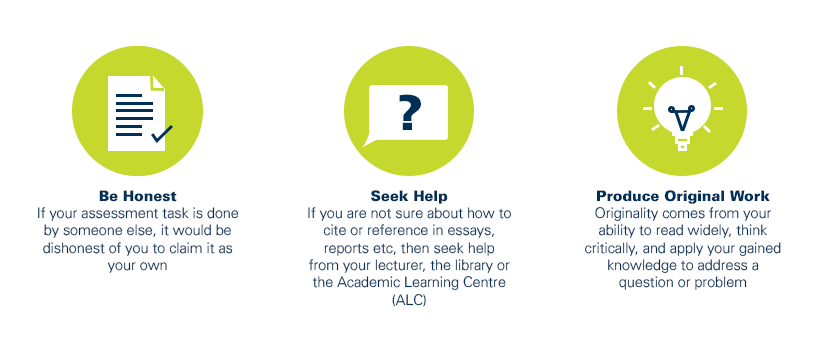
As a CQUniversity student you are expected to act honestly in all aspects of your academic work.
Any assessable work undertaken or submitted for review or assessment must be your own work. Assessable work is any type of work you do to meet the assessment requirements in the unit, including draft work submitted for review and feedback and final work to be assessed.
When you use the ideas, words or data of others in your assessment, you must thoroughly and clearly acknowledge the source of this information by using the correct referencing style for your unit. Using others’ work without proper acknowledgement may be considered a form of intellectual dishonesty.
Participating honestly, respectfully, responsibly, and fairly in your university study ensures the CQUniversity qualification you earn will be valued as a true indication of your individual academic achievement and will continue to receive the respect and recognition it deserves.
As a student, you are responsible for reading and following CQUniversity’s policies, including the Student Academic Integrity Policy and Procedure. This policy sets out CQUniversity’s expectations of you to act with integrity, examples of academic integrity breaches to avoid, the processes used to address alleged breaches of academic integrity, and potential penalties.
What is a breach of academic integrity?
A breach of academic integrity includes but is not limited to plagiarism, self-plagiarism, collusion, cheating, contract cheating, and academic misconduct. The Student Academic Integrity Policy and Procedure defines what these terms mean and gives examples.
Why is academic integrity important?
A breach of academic integrity may result in one or more penalties, including suspension or even expulsion from the University. It can also have negative implications for student visas and future enrolment at CQUniversity or elsewhere. Students who engage in contract cheating also risk being blackmailed by contract cheating services.
Where can I get assistance?
For academic advice and guidance, the Academic Learning Centre (ALC) can support you in becoming confident in completing assessments with integrity and of high standard.
What can you do to act with integrity?