Overview
Building upon the foundational knowledge of how the immune system functions gained in Foundations of Immunology you will now examine the consequences of a malfunctioning immune system including immune deficiencies and autoimmunity. This will include a case-based learning approach and practical laboratory sessions to explore immune dysfunction.
Details
Pre-requisites or Co-requisites
Prerequisites BMSC11012 Foundations of Immunology
Important note: Students enrolled in a subsequent unit who failed their pre-requisite unit, should drop the subsequent unit before the census date or within 10 working days of Fail grade notification. Students who do not drop the unit in this timeframe cannot later drop the unit without academic and financial liability. See details in the Assessment Policy and Procedure (Higher Education Coursework).
Offerings For Term 1 - 2026
Attendance Requirements
All on-campus students are expected to attend scheduled classes - in some units, these classes are identified as a mandatory (pass/fail) component and attendance is compulsory. International students, on a student visa, must maintain a full time study load and meet both attendance and academic progress requirements in each study period (satisfactory attendance for International students is defined as maintaining at least an 80% attendance record).
Recommended Student Time Commitment
Each 6-credit Undergraduate unit at CQUniversity requires an overall time commitment of an average of 12.5 hours of study per week, making a total of 150 hours for the unit.
Class Timetable
Assessment Overview
Assessment Grading
This is a graded unit: your overall grade will be calculated from the marks or grades for each assessment task, based on the relative weightings shown in the table above. You must obtain an overall mark for the unit of at least 50%, or an overall grade of 'pass' in order to pass the unit. If any 'pass/fail' tasks are shown in the table above they must also be completed successfully ('pass' grade). You must also meet any minimum mark requirements specified for a particular assessment task, as detailed in the 'assessment task' section (note that in some instances, the minimum mark for a task may be greater than 50%). Consult the University's Grades and Results Policy for more details of interim results and final grades.
All University policies are available on the CQUniversity Policy site.
You may wish to view these policies:
- Grades and Results Policy
- Assessment Policy and Procedure (Higher Education Coursework)
- Review of Grade Procedure
- Student Academic Integrity Policy and Procedure
- Academic Progression Policy and Procedure
- Student Refund and Credit Balance Policy and Procedure
- Complaints Policy and Procedure
- Information and Communications Technology Acceptable Use Policy and Procedure
This list is not an exhaustive list of all University policies. The full list of University policies are available on the CQUniversity Policy site.
Feedback, Recommendations and Responses
Every unit is reviewed for enhancement each year. At the most recent review, the following staff and student feedback items were identified and recommendations were made.
Feedback from SUTE
The written assessment was effective in assessing knowledge; however, students felt it was excessively long.
Review the written assessment to ensure its length and scope are appropriate while still effectively assessing student knowledge and learning outcomes.
Feedback from Student feedback
Students appreciated the flipped classroom model with worksheets and interactive tutorials as they strongly supported student engagement and understanding of complex topics
Continue the use of the flipped classroom model and interactive tutorials to encourage student engagement and success.
- Discuss immune function and dysfunction at the molecular and cellular levels
- Explain how aberrations in immune regulation underlie autoimmunity, immunodeficiency, allergy and cancer
- Explain how aberrations in immune regulation can be measured in the laboratory and corrected by directed therapeutics
- Discuss the application of the principles of immunology to the development of vaccines and diagnostic techniques
- Demonstrate competence in the use of primary resource material for experimental and research assignment purposes.
Alignment of Assessment Tasks to Learning Outcomes
| Assessment Tasks | Learning Outcomes | ||||
|---|---|---|---|---|---|
| 1 | 2 | 3 | 4 | 5 | |
| 1 - Online Test - 20% | |||||
| 2 - Laboratory/Practical - 0% | |||||
| 3 - Oral Examination - 40% | |||||
| 4 - Examination - 40% | |||||
Alignment of Graduate Attributes to Learning Outcomes
| Graduate Attributes | Learning Outcomes | ||||
|---|---|---|---|---|---|
| 1 | 2 | 3 | 4 | 5 | |
| 1 - Communication | |||||
| 2 - Problem Solving | |||||
| 3 - Critical Thinking | |||||
| 4 - Information Literacy | |||||
| 5 - Team Work | |||||
| 6 - Information Technology Competence | |||||
| 7 - Cross Cultural Competence | |||||
| 8 - Ethical practice | |||||
| 9 - Social Innovation | |||||
| 10 - First Nations Knowledges | |||||
| 11 - Aboriginal and Torres Strait Islander Cultures | |||||
Textbooks
There are no required textbooks.
IT Resources
- CQUniversity Student Email
- Internet
- Unit Website (Moodle)
All submissions for this unit must use the referencing style: Harvard (author-date)
For further information, see the Assessment Tasks.
j.steel@cqu.edu.au
d.rathnayakemudiyanselage@cqu.edu.au
Week 1
Begin Date: 09 Mar 2026Module/Topic
Hypersensitivity and Allergy I
Chapter
Events and Submissions/Topic
Tutorial 1: Introduction to Applied Immunology/ Revision
Week 2
Begin Date: 16 Mar 2026Module/Topic
Hypersensitivity and Allergy II
Chapter
Events and Submissions/Topic
Tutorial 2: Hypersensitivity and Allergy I
Week 3
Begin Date: 23 Mar 2026Module/Topic
Autoimmune Diseases I
Chapter
Events and Submissions/Topic
Tutorial 3: Hypersensitivity and Allergy II
Week 4
Begin Date: 30 Mar 2026Module/Topic
Autoimmune Diseases II
Chapter
Events and Submissions/Topic
Tutorial 4: Autoimmune Diseases I
Week 5
Begin Date: 06 Apr 2026Module/Topic
Immunology of Cancers I
Chapter
Events and Submissions/Topic
Tutorial 5: Autoimmune Diseases II
MID-SESSION online test opens 9am: 10/04/2026
Week 6
Begin Date: 13 Apr 2026Module/Topic
Immunology of Cancers II
Chapter
Events and Submissions/Topic
Tutorial 6: Immunology of Cancers I
MID-SESSION ONLINE TEST Due: Week 6 Monday (13 Apr 2026) 11:45 pm AEST
Vacation Week
Begin Date: 20 Apr 2026Module/Topic
No formal teaching
Chapter
Events and Submissions/Topic
Week 7
Begin Date: 27 Apr 2026Module/Topic
Immunology of Cancers III
Chapter
Events and Submissions/Topic
Tutorial 7: Immunology of Cancers II
Bundaberg Res School: 28/04/2026 to 29/04/2026
Week 8
Begin Date: 04 May 2026Module/Topic
Immunodeficiencies I
Chapter
Events and Submissions/Topic
Tutorial 8: Immunology of Cancers III
Rockhampton Res School: 08/05/2026 to 09/05/2026
Week 9
Begin Date: 11 May 2026Module/Topic
Immunodeficiencies II
Chapter
Events and Submissions/Topic
Tutorial 9: Immunodeficiencies I
Oral Case-Based Assessment scheduled
Week 10
Begin Date: 18 May 2026Module/Topic
Chapter
Events and Submissions/Topic
Tutorial 10: Immunodeficiencies II
Oral Case-Based Assessment scheduled
Week 11
Begin Date: 25 May 2026Module/Topic
Self-directed study/ Exam revision
Chapter
Events and Submissions/Topic
Week 12
Begin Date: 01 Jun 2026Module/Topic
Self-directed study/ Exam revision
Chapter
Events and Submissions/Topic
Exam Week
Begin Date: 08 Jun 2026Module/Topic
Chapter
Events and Submissions/Topic
Assessment 3: An invigilated examination will be scheduled in the examination period
LECTURERS
The unit will be delivered by Dr. Jason Steel (Unit Coordinator: j.steel@cqu.edu.au or 07 4930 6391) and Dr. Charmaine Ramlogan-Steel (c.ramlogan-steel@cqu.edu.au or 07 4920 6393).
Dr. Steel is a Rockhampton-based senior lecturer with over 20 years of research and teaching experience in the field of immunology. Dr Ramlogan-Steel is a medically trained academic and Head of Course for CG93. She has over 20 years of experience in medicine, research and teaching.
REQUIRED KNOWLEDGE
General immunology knowledge is required for this unit. There is no prescribed textbook for the unit but all students should have access to Basic Immunology 6th Edition (2019) by Abul Abbas, Andrew Lichtman, Shiv Pillai for revision of basic immunology.
LECTURES
All lectures have been pre-recorded by Dr Jason Steel and Dr Charmaine Ramlogan-Steel and are available on the Moodle site. Students are to watch the lectures and complete the weekly worksheet prior to the weekly tutorials.
TUTORIALS
Tutorials are delivered live each week in ROK (link to BDG and online via zoom). Students must engage with both live tutorials and pre-recorded lectures to obtain all the necessary information for the unit.
RESIDENTIAL SCHOOL
All students MUST attend one residential school (either in Rockhampton or Bundaberg)
WORK EXPECTATIONS
As per Australian educational standards, you are expected to commit 150 hours of engagement to your study of this unit. A recommended breakdown of study hours is given below:
3 - 5 hours per week watching pre-recorded lectures and revising the content through study notes.
2 - 3 hours per week completing the weekly study questions while revising the content.
2 - 3 hours per week attending the weekly tutorials and reflecting on your answers to the weekly revision worksheets.
2 - 3 hours per week preparing for your assessments and end of term exam.
1 Online Test
This assessment will examine your comprehension of the learning objectives and activities carried out from weeks 1 - 5 inclusive in the unit, including any pre-tutorial/lectorial learning materials such as the weekly lecture notes and related resources, peer-reviewed articles and other relevant resources provided with the unit content and covered during scheduled classes. The assessment may include (but not be limited to) short answer questions, terminology questions, process and arrangement questions and long answer questions.
You will be provided with support and examples of the types of questions you are likely to encounter in this assessment during your scheduled classes; this will assist you in learning and understanding the expectations of this assessment. You are therefore strongly encouraged to regularly attend and actively participate in the weekly scheduled classes, ask questions where you are uncertain and ensure you come prepared for each class by having reviewed any pre-class learning material. If you still have questions or areas you do not understand following each weekly tutorial class you will be encouraged to address these promptly by posting your questions on the Discussion forum and engaging in discussion on this/these topics with fellow students and academics, and the Unit coordinators. Doing this will ensure you 'arrive' to this assessment well prepared and give yourself the best possibilities of performing well in and from this assessment.
Note: This is an individual assessment task. No collusion or teamwork is permitted when answering the quiz questions.
The 72-hour grace period does not apply to this assessment.
Generative artificial intelligence (Gen AI) is not approved for use in this online test.
Week 6 Monday (13 Apr 2026) 11:45 pm AEST
2 weeks after submission
Questions will be marked correct or incorrect at the completion of the online test. Part marks may be awarded for partially correct answers.
- Discuss immune function and dysfunction at the molecular and cellular levels
- Explain how aberrations in immune regulation underlie autoimmunity, immunodeficiency, allergy and cancer
- Explain how aberrations in immune regulation can be measured in the laboratory and corrected by directed therapeutics
- Discuss the application of the principles of immunology to the development of vaccines and diagnostic techniques
2 Laboratory/Practical
Students need to attend one of the Residential School/Laboratory sessions in Rockhampton or Bundaberg. Attendance at the practical component is mandatory to pass the unit as assessment of various immunological practical skills will be completed during the residential school. You will be required to submit your laboratory manual at the completion of the residential school.
Generative artificial intelligence (Gen AI) is not approved for use in this assessment.
The 72-hour grace period does not apply to this assessment.
On completion of Residential School
2 weeks after submission
Students will be assessed on their laboratory competence in the following techniques: ELISA for the screening of Allergen specific IgE, Latex Agglutination assays for the detection of autoimmune antibodies and qPCR for the detection of immunological markers on cancer.
Students will be required to answer questions relating to the experiments they are performing and show calculations for the results obtained. This is a Pass/Fail Assessment (50% to Pass). Students must pass this assessment to pass the unit.
- Demonstrate competence in the use of primary resource material for experimental and research assignment purposes.
3 Oral Examination
Topics: Allergy and Hypersensitivity, Autoimmune Disease, Cancer
Format: Individual oral examination
Duration: 15 minutes per student
Weighting: 40%
Assessment Rationale
This assessment evaluates students’ ability to apply immunological principles to clinically relevant scenarios. Through structured case discussion, students demonstrate conceptual understanding, clinical reasoning, and the ability to communicate scientific information clearly and professionally.
Assessment Structure (Examiner-Led)
Students will be presented with three short clinical case vignettes during the oral examination:
1. Allergy and Hypersensitivity
2. Autoimmune Disease
3. Cancer and Tumour Immunology
Each case will be discussed for approximately 3–5 minutes, with examiner-guided prompts.
The examiner may ask follow-up questions to probe depth of understanding or clarify responses.
Case Design Principles
Each case is designed to assess:
- Understanding of core immunological mechanisms
- Ability to interpret clinical or experimental information
- Application of theory to practice
- Scientific communication under time constraints
Cases will be novel but syllabus-aligned, ensuring no advantage from memorisation.
Examples will be posted in Moodle during the term.
Oral Presentations will be scheduled in weeks 9 and 10.
Marks will be provided within 2 weeks of presentation.
Oral Case-Based Assessment Criteria
1. Understanding of Immunological Mechanisms
Demonstrates accurate understanding of the immune pathways underlying allergy and hypersensitivity, autoimmune disease, and cancer.
2. Application to Clinical Scenarios
Applies immunological knowledge appropriately to interpret case information and explain disease processes.
3. Analytical and Reasoning Skills
Analyses information logically, justifies conclusions, and responds appropriately to follow-up questions.
4. Clarity and Accuracy of Scientific Communication
Communicates immunological concepts clearly, using correct terminology and a logical structure.
5. Professional Oral Presentation
Presents responses confidently, coherently, and within the allotted time.
A Marking Rubric will be provided.
No submission method provided.
- Discuss immune function and dysfunction at the molecular and cellular levels
- Explain how aberrations in immune regulation underlie autoimmunity, immunodeficiency, allergy and cancer
- Explain how aberrations in immune regulation can be measured in the laboratory and corrected by directed therapeutics
- Discuss the application of the principles of immunology to the development of vaccines and diagnostic techniques
- Demonstrate competence in the use of primary resource material for experimental and research assignment purposes.
Examination
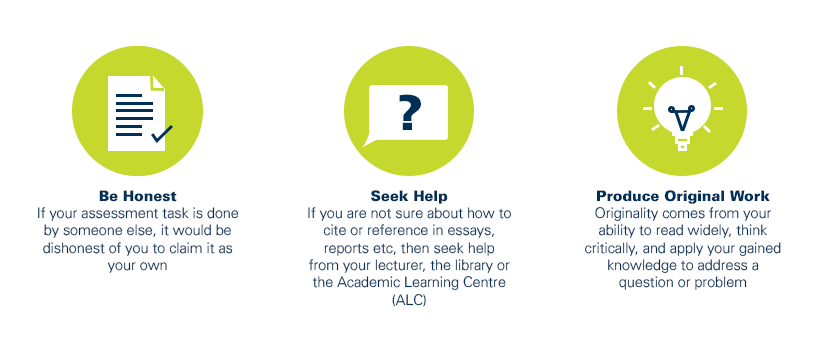
As a CQUniversity student you are expected to act honestly in all aspects of your academic work.
Any assessable work undertaken or submitted for review or assessment must be your own work. Assessable work is any type of work you do to meet the assessment requirements in the unit, including draft work submitted for review and feedback and final work to be assessed.
When you use the ideas, words or data of others in your assessment, you must thoroughly and clearly acknowledge the source of this information by using the correct referencing style for your unit. Using others’ work without proper acknowledgement may be considered a form of intellectual dishonesty.
Participating honestly, respectfully, responsibly, and fairly in your university study ensures the CQUniversity qualification you earn will be valued as a true indication of your individual academic achievement and will continue to receive the respect and recognition it deserves.
As a student, you are responsible for reading and following CQUniversity’s policies, including the Student Academic Integrity Policy and Procedure. This policy sets out CQUniversity’s expectations of you to act with integrity, examples of academic integrity breaches to avoid, the processes used to address alleged breaches of academic integrity, and potential penalties.
What is a breach of academic integrity?
A breach of academic integrity includes but is not limited to plagiarism, self-plagiarism, collusion, cheating, contract cheating, and academic misconduct. The Student Academic Integrity Policy and Procedure defines what these terms mean and gives examples.
Why is academic integrity important?
A breach of academic integrity may result in one or more penalties, including suspension or even expulsion from the University. It can also have negative implications for student visas and future enrolment at CQUniversity or elsewhere. Students who engage in contract cheating also risk being blackmailed by contract cheating services.
Where can I get assistance?
For academic advice and guidance, the Academic Learning Centre (ALC) can support you in becoming confident in completing assessments with integrity and of high standard.
What can you do to act with integrity?