Overview
The development of new therapeutic products for the medical biotechnology industry requires comprehensive knowledge of techniques used to investigate their effects on various biological pathways at a cellular level. This unit will provide you with an opportunity to apply theoretical and practical knowledge of medical biotechnology, drug development and pre-clinical testing of a new therapeutic product for industry commercialisation. You will develop new practical skills and gain experience in experimental models used to study human disease and apply these in a simulated industry environment. Your practical skills and demonstration of professional knowledge, attitude and compliance with relevant safety protocols will be assessed in a laboratory environment. Attendance at the practical activities at a compulsory residential school is a requirement of this unit. You will also develop the skills to communicate your findings to a broader audience in the medical biotechnology industry through both written reports and oral presentations.
Details
Pre-requisites or Co-requisites
Pre-requisite: BMSC12010 Clinical Biochemistry
Important note: Students enrolled in a subsequent unit who failed their pre-requisite unit, should drop the subsequent unit before the census date or within 10 working days of Fail grade notification. Students who do not drop the unit in this timeframe cannot later drop the unit without academic and financial liability. See details in the Assessment Policy and Procedure (Higher Education Coursework).
Offerings For Term 1 - 2026
Attendance Requirements
All on-campus students are expected to attend scheduled classes - in some units, these classes are identified as a mandatory (pass/fail) component and attendance is compulsory. International students, on a student visa, must maintain a full time study load and meet both attendance and academic progress requirements in each study period (satisfactory attendance for International students is defined as maintaining at least an 80% attendance record).
Recommended Student Time Commitment
Each 6-credit Undergraduate unit at CQUniversity requires an overall time commitment of an average of 12.5 hours of study per week, making a total of 150 hours for the unit.
Class Timetable
Assessment Overview
Assessment Grading
This is a graded unit: your overall grade will be calculated from the marks or grades for each assessment task, based on the relative weightings shown in the table above. You must obtain an overall mark for the unit of at least 50%, or an overall grade of 'pass' in order to pass the unit. If any 'pass/fail' tasks are shown in the table above they must also be completed successfully ('pass' grade). You must also meet any minimum mark requirements specified for a particular assessment task, as detailed in the 'assessment task' section (note that in some instances, the minimum mark for a task may be greater than 50%). Consult the University's Grades and Results Policy for more details of interim results and final grades.
All University policies are available on the CQUniversity Policy site.
You may wish to view these policies:
- Grades and Results Policy
- Assessment Policy and Procedure (Higher Education Coursework)
- Review of Grade Procedure
- Student Academic Integrity Policy and Procedure
- Academic Progression Policy and Procedure
- Student Refund and Credit Balance Policy and Procedure
- Complaints Policy and Procedure
- Information and Communications Technology Acceptable Use Policy and Procedure
This list is not an exhaustive list of all University policies. The full list of University policies are available on the CQUniversity Policy site.
Feedback, Recommendations and Responses
Every unit is reviewed for enhancement each year. At the most recent review, the following staff and student feedback items were identified and recommendations were made.
Feedback from Unit coordinator
Students appeared unprepared for the residential school, even though they had received the lab manual in advance and had access to tutorial support to assist their preparation.
An assessment will be considered for future offerings to support preparation for the residential school and to foster students’ confidence in applying critical thinking skills.
Feedback from Head of Course
The unit is highly relevant to biotechnology students, particularly in supporting their understanding of drug development, clinical trials, and translational research.
Continue to offer this unit as a core unit for biotechnology students, while regularly updating content to reflect current advances and emerging technologies in the biotechnology field.
- Conduct molecular or cell-based tests used to study human disease
- Display professional behaviour consistent with the safety and ethical practices of the laboratory
- Critically analyse current scientific literature
- Think critically to solve problems during the development and testing of therapeutics
- Effectively communicate experimental findings to industry professionals through written reports and oral presentations.
Alignment of Assessment Tasks to Learning Outcomes
| Assessment Tasks | Learning Outcomes | ||||
|---|---|---|---|---|---|
| 1 | 2 | 3 | 4 | 5 | |
| 1 - Oral Examination - 20% | |||||
| 2 - Practical Assessment - 0% | |||||
| 3 - Report - 40% | |||||
| 4 - Presentation - 40% | |||||
Alignment of Graduate Attributes to Learning Outcomes
| Graduate Attributes | Learning Outcomes | ||||
|---|---|---|---|---|---|
| 1 | 2 | 3 | 4 | 5 | |
| 1 - Communication | |||||
| 2 - Problem Solving | |||||
| 3 - Critical Thinking | |||||
| 4 - Information Literacy | |||||
| 5 - Team Work | |||||
| 6 - Information Technology Competence | |||||
| 7 - Cross Cultural Competence | |||||
| 8 - Ethical practice | |||||
| 9 - Social Innovation | |||||
| 10 - First Nations Knowledges | |||||
| 11 - Aboriginal and Torres Strait Islander Cultures | |||||
Textbooks
There are no required textbooks.
IT Resources
- CQUniversity Student Email
- Internet
- Unit Website (Moodle)
All submissions for this unit must use the referencing styles below:
For further information, see the Assessment Tasks.
n.jarbou@cqu.edu.au
Week1
Begin Date: 09 Mar 2026Module/Topic
Pharmaceutical Industry, Drivers and Stages of Drug Development
Chapter
Events and Submissions/Topic
Week 2
Begin Date: 16 Mar 2026Module/Topic
From Diseases to Drugs
Chapter
Events and Submissions/Topic
Week 3
Begin Date: 23 Mar 2026Module/Topic
Preclinical & Toxicology
Chapter
Events and Submissions/Topic
Week 4
Begin Date: 30 Mar 2026Module/Topic
Clinical Phase I Trials
Chapter
Events and Submissions/Topic
Week 5
Begin Date: 06 Apr 2026Module/Topic
Regulatory Agencies & Quality Regulations
Chapter
Events and Submissions/Topic
Week 6
Begin Date: 13 Apr 2026Module/Topic
Phase II Clinical Trials - Informed Patient Consent & Pharmacovigilance
Chapter
Events and Submissions/Topic
By this week you should have made a decision on which therapeutic preclinical topic you will focus on for your Assessment 1 report.
If you are still unsure or would like guidance in refining your topic, you are welcome to contact the Unit Coordinator for support.
Break Week
Begin Date: 20 Apr 2026Module/Topic
Chapter
Events and Submissions/Topic
Week 7
Begin Date: 27 Apr 2026Module/Topic
Phase II Clinical Trials - Roles and Responsibilities
Chapter
Events and Submissions/Topic
By this week, please confirm a suitable time for Assessment 2 (Oral Examination), which must be completed before the Residential School (Week 10).
Week 8
Begin Date: 04 May 2026Module/Topic
Drug Manufacturing
Chapter
Events and Submissions/Topic
Assessment 1: Pre-clinical Therapeutic Development Report is due by the end of this week.
If you are experiencing any difficulties or would like support with your topic selection or report structure, please reach out to the Unit Coordinator as soon as possible.
Pre-clinical Therapeutic Development Report Due: Week 8 Friday (8 May 2026) 11:45 pm AEST
Week 9
Begin Date: 11 May 2026Module/Topic
Clinical Phase III Trials - Part 1
Chapter
Events and Submissions/Topic
Assessment 2 (Oral Examination) is due this week.
Week 10
Begin Date: 18 May 2026Module/Topic
Residential School
Chapter
Events and Submissions/Topic
Week 11
Begin Date: 25 May 2026Module/Topic
Clinical Phase III Trials- Part 2
Chapter
Events and Submissions/Topic
Week 12
Begin Date: 01 Jun 2026Module/Topic
Clinical Phase III Trials Part3 & Ethics, Consultants and Medical Advisory Boards
Chapter
Events and Submissions/Topic
Revision/Exam Week
Begin Date: 08 Jun 2026Module/Topic
Chapter
Events and Submissions/Topic
Exam Week
Begin Date: 15 Jun 2026Module/Topic
Chapter
Events and Submissions/Topic
Unit Coordinator: Dr. Noor Jarbou
Email: n.jarbou@cqu.edu.au
Location: North Rockhampton Campus, Building 6, L2.35
Unit Delivery Instructions:
- Lectures – Prerecorded and accessible at students’ convenience.
- Tutorials – These will be scheduled according to student cohort availability and conducted live, with recordings made available for later access.
- Residential School – Attendance is mandatory on the Rockhampton campus.
1 Report
This assessment requires students to develop a written pre-clinical therapeutic development report focused on the design and evaluation of a novel therapeutic intervention for a specific disease. The report assesses students’ ability to integrate disease biology, experimental design, and pre-clinical research principles within a pharmaceutical or biotechnology context.
The report must address the following sections:
Part A: Identification of the target patient population and a detailed description of the disease characteristics that the proposed therapeutic aims to target, including relevant molecular, genetic, or biochemical features where applicable.
Part B: Proposal and justification of appropriate pre-clinical disease models to evaluate the therapeutic’s efficacy.
Part C: Design of a pre-clinical toxicity study, outlining methodology, endpoints, and considerations relevant to safety assessment.
The report must be 2,000–2,500 words in length and presented in a clear scientific format using standard word processing software. Figures, diagrams, and tables may be included where appropriate. All scientific claims must be supported by peer-reviewed literature and referenced using Harvard or APA referencing style.
In accordance with CQUniversity guidelines, the use of Gen AI is permitted for:
- Developing literature search strategies
- Guidance on argument structure
- Formatting and grammar assistance
A detailed marking rubric for this assessment will be provided on the unit Moodle site.
Level of GenAI use allowed:
Level 3: You may use Al to assist with specific tasks such as drafting text, refining and evaluating your work. You
must critically evaluate and modify any Al-generated content you use.
Week 8 Friday (8 May 2026) 11:45 pm AEST
Week 10 Friday (22 May 2026)
Students will be assessed on the following:
1- Disease and patient population characterizations
2- Therapeutic rationale and scientific justification
3- Selection and justification of pre-clinical disease models
4- Design and scientific rigor of pre-clinical toxicity study
5- Critical analysis and integration of scientific literature
6- Structure, clarity, and scientific communication
7- Referencing accuracy and academic integrity
- Critically analyse current scientific literature
- Think critically to solve problems during the development and testing of therapeutics
- Effectively communicate experimental findings to industry professionals through written reports and oral presentations.
2 Oral Examination
During the examination, students will be required to demonstrate their understanding of key laboratory concepts, including the RES protocols, techniques, safety procedures, and the scientific rationale underpinning the experiments outlined in the laboratory manual.
The oral examination will be conducted across two tutorial sessions. Each student will be allocated 15–20 minutes, consisting of a brief presentation followed by 2–5 structured questions.
Further details will be provided on Moodle.
To be completed within one week prior to residential school
Assessment will be returned within two weeks of the due date.
1- Understanding of Laboratory Concepts
- Demonstrates clear understanding of RES protocols and experimental procedures.
- Explains the scientific rationale behind experiments.
- Accurately identifies key techniques and methods.
2- Demonstrating knowledge of Laboratory Safety protocols
3- Clarity and Organization of Professional Presentation
- Presents information logically and concisely within the allotted time.
- Uses appropriate terminology and visual aids (if applicable).
4- Application of scientific knowledge
- Answers questions accurately and clearly
- Uses relevant scientific knowledge to explain responses
- Demonstrates confidence in linking theory to practice
- Critically analyse current scientific literature
- Think critically to solve problems during the development and testing of therapeutics
- Effectively communicate experimental findings to industry professionals through written reports and oral presentations.
3 Practical Assessment
During the Residential School, students are provided with a pharmaceutical agent to assess its activity against cervical cancer. The task requires students to undertake a series of cell-based experiments (as outlined in the Laboratory Manual on the unit Moodle site) to explore the anti-cancer properties and potential mechanism of action of this treatment
Students are required to complete each technique according to the Laboratory Manual, with assessment based on the quality of experimental outcomes.
If the initial attempt does not meet the minimum passing criteria, a ONE subsequent attempt is permitted for that technique.
A detailed marking rubric for this assessment will be made available on the unit Moodle site.
Week 10 Monday (18 May 2026) 11:45 pm AEST
Week 11 Monday (25 May 2026)
Students are assessed on the following:
1- Performing aseptic cell culture techniques
2- Capturing and presenting immunofluorescence microscopy images
3- Conducting quantitative real-time PCR (qRT-PCR) and interpreting the results
4- Performing an MTS assay and interpreting the results
5- Performing a TUNEL assay and interpreting the results
6- Appropriate labelling of all experimental samples
Scoring and Passing Requirements:
- Each technique is scored according to the rubric provided on Moodle.
- A minimum of 70% of total marks is required to pass this assessment.
No submission method provided.
- Conduct molecular or cell-based tests used to study human disease
- Display professional behaviour consistent with the safety and ethical practices of the laboratory
4 Presentation
This assessment requires students to present research findings on experimental data that were used during the residential school. The presentation should begin with your experimental results obtained during the residential school and progress through to the design of logical, subsequent experiments aimed at further elucidating the drug’s mechanism of action.
Students are expected to integrate peer-reviewed scientific literature to justify proposed experimental approaches and anticipated outcomes. The scope and depth of experimental findings presented (both completed and proposed) should be equivalent to that required for publication in a scientific journal (approximately 6–8 figures).
The assessment is to be delivered as a 10–15 minute recorded oral presentation, prepared using standard presentation software (e.g. PowerPoint or Keynote), and submitted via the unit Moodle site.
The presentation must include the following components:
- Introduction outlining the discovery of the drug and the target patient population
- Summary of experimental methods used during the residential school
- Presentation and interpretation of experimental results generated during the residential school
- Description of proposed subsequent experiments with anticipated results
- Conclusions drawn from existing experimental data and proposed investigations
A detailed marking rubric for this assessment will be available on the unit Moodle site.
Level of GenAI use allowed:
Level 3: You may use Al to assist with specific tasks such as drafting text, refining and evaluating your work. You
must critically evaluate and modify any Al-generated content you use.
Week 12 Friday (5 June 2026) 11:45 pm AEST
Wii
Vacation/Exam Week Thursday (18 June 2026)
Assessment will be returned within two weeks of the due date.
Students will be assessed on the following criteria:
1- Scientific background and context
2- Methodological understanding
3- Presentation of experimental data
4- Quality and interpretation of microscopy data
5- Data analysis and critical interpretation
6- Experimental design and scientific reasoning
7- Conclusions and scientific insight
8- Use of scientific literature
- Critically analyse current scientific literature
- Think critically to solve problems during the development and testing of therapeutics
- Effectively communicate experimental findings to industry professionals through written reports and oral presentations.
As a CQUniversity student you are expected to act honestly in all aspects of your academic work.
Any assessable work undertaken or submitted for review or assessment must be your own work. Assessable work is any type of work you do to meet the assessment requirements in the unit, including draft work submitted for review and feedback and final work to be assessed.
When you use the ideas, words or data of others in your assessment, you must thoroughly and clearly acknowledge the source of this information by using the correct referencing style for your unit. Using others’ work without proper acknowledgement may be considered a form of intellectual dishonesty.
Participating honestly, respectfully, responsibly, and fairly in your university study ensures the CQUniversity qualification you earn will be valued as a true indication of your individual academic achievement and will continue to receive the respect and recognition it deserves.
As a student, you are responsible for reading and following CQUniversity’s policies, including the Student Academic Integrity Policy and Procedure. This policy sets out CQUniversity’s expectations of you to act with integrity, examples of academic integrity breaches to avoid, the processes used to address alleged breaches of academic integrity, and potential penalties.
What is a breach of academic integrity?
A breach of academic integrity includes but is not limited to plagiarism, self-plagiarism, collusion, cheating, contract cheating, and academic misconduct. The Student Academic Integrity Policy and Procedure defines what these terms mean and gives examples.
Why is academic integrity important?
A breach of academic integrity may result in one or more penalties, including suspension or even expulsion from the University. It can also have negative implications for student visas and future enrolment at CQUniversity or elsewhere. Students who engage in contract cheating also risk being blackmailed by contract cheating services.
Where can I get assistance?
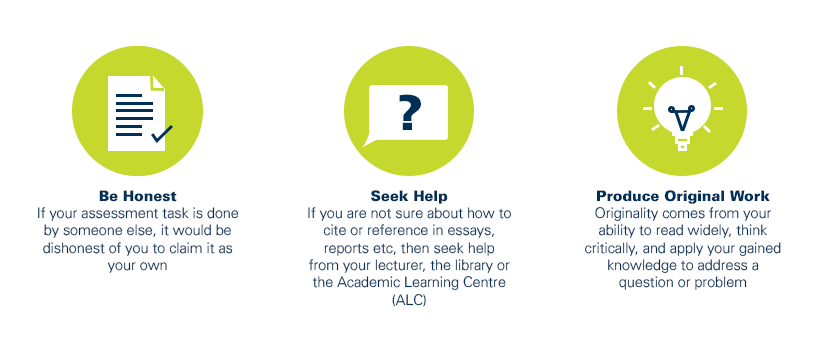
For academic advice and guidance, the Academic Learning Centre (ALC) can support you in becoming confident in completing assessments with integrity and of high standard.
What can you do to act with integrity?