Overview
In Construction Risk Management you will learn the construction-specific nuances of risk management. You will also learn why standard insurance programs have unique implications for contractors and how to evaluate effective strategies for managing construction risks. Viewed through the lens of the construction risk and insurance framework, this unit provides you with an understanding of the strategies for mitigating, transferring, and insuring construction risks. You will learn how risks are commonly allocated in a construction project and how to identify variances between a contractor’s insurance coverage and the total project risks. You will gain the knowledge to monitor and identify statutory changes and judicial rulings that impact the contractor’s liabilities as well as the coverage they have in place to mitigate potential liabilities.
Details
Pre-requisites or Co-requisites
There are no requisites for this unit.
Important note: Students enrolled in a subsequent unit who failed their pre-requisite unit, should drop the subsequent unit before the census date or within 10 working days of Fail grade notification. Students who do not drop the unit in this timeframe cannot later drop the unit without academic and financial liability. See details in the Assessment Policy and Procedure (Higher Education Coursework).
Offerings For Term 2 - 2026
Attendance Requirements
All on-campus students are expected to attend scheduled classes - in some units, these classes are identified as a mandatory (pass/fail) component and attendance is compulsory. International students, on a student visa, must maintain a full time study load and meet both attendance and academic progress requirements in each study period (satisfactory attendance for International students is defined as maintaining at least an 80% attendance record).
Recommended Student Time Commitment
Each 6-credit Postgraduate unit at CQUniversity requires an overall time commitment of an average of 12.5 hours of study per week, making a total of 150 hours for the unit.
Class Timetable
Assessment Overview
Assessment Grading
This is a graded unit: your overall grade will be calculated from the marks or grades for each assessment task, based on the relative weightings shown in the table above. You must obtain an overall mark for the unit of at least 50%, or an overall grade of 'pass' in order to pass the unit. If any 'pass/fail' tasks are shown in the table above they must also be completed successfully ('pass' grade). You must also meet any minimum mark requirements specified for a particular assessment task, as detailed in the 'assessment task' section (note that in some instances, the minimum mark for a task may be greater than 50%). Consult the University's Grades and Results Policy for more details of interim results and final grades.
All University policies are available on the CQUniversity Policy site.
You may wish to view these policies:
- Grades and Results Policy
- Assessment Policy and Procedure (Higher Education Coursework)
- Review of Grade Procedure
- Student Academic Integrity Policy and Procedure
- Academic Progression Policy and Procedure
- Student Refund and Credit Balance Policy and Procedure
- Complaints Policy and Procedure
- Information and Communications Technology Acceptable Use Policy and Procedure
This list is not an exhaustive list of all University policies. The full list of University policies are available on the CQUniversity Policy site.
Feedback, Recommendations and Responses
Every unit is reviewed for enhancement each year. At the most recent review, the following staff and student feedback items were identified and recommendations were made.
Feedback from SUTE
The marking was done by a teacher that did not conduct our lectures, which in my opinion, created a list of expectations that this teacher had that we were not aware of regarding Assessment 1.
Regardless of who marks the assessments, we will ensure strict adherence to the marking rubric and conduct moderation to maintain consistency and fairness across all submissions.
Feedback from SUTE
Some students experienced a different teaching style from their home country and found it really beneficial.
We will continue to incorporate diverse teaching approaches and examples from different educational contexts to enrich learning experiences.
- Identify and evaluate project risks and opportunities within various construction procurement contexts
- Critically analyse the main forces which drive business strategy as they relate to risk
- Identify and evaluate management strategies for mitigating, transferring, and insuring construction risk
- Effectively communicate business risks and their implications on insurance to various stakeholders.
Alignment of Assessment Tasks to Learning Outcomes
| Assessment Tasks | Learning Outcomes | |||
|---|---|---|---|---|
| 1 | 2 | 3 | 4 | |
| 1 - Written Assessment - 30% | ||||
| 2 - Research Assignment - 50% | ||||
| 3 - Online Test - 20% | ||||
Alignment of Graduate Attributes to Learning Outcomes
| Graduate Attributes | Learning Outcomes | |||
|---|---|---|---|---|
| 1 | 2 | 3 | 4 | |
| 1 - Knowledge | ||||
| 2 - Communication | ||||
| 3 - Cognitive, technical and creative skills | ||||
| 4 - Research | ||||
| 5 - Self-management | ||||
| 6 - Ethical and Professional Responsibility | ||||
| 7 - Leadership | ||||
| 8 - First Nations Knowledges | ||||
| 9 - Aboriginal and Torres Strait Islander Cultures | ||||
Alignment of Assessment Tasks to Graduate Attributes
| Assessment Tasks | Graduate Attributes | ||||||||
|---|---|---|---|---|---|---|---|---|---|
| 1 | 2 | 3 | 4 | 5 | 6 | 7 | 8 | 9 | |
| 1 - Written Assessment - 30% | |||||||||
| 2 - Research Assignment - 50% | |||||||||
| 3 - Online Test - 20% | |||||||||
Textbooks
There are no required textbooks.
IT Resources
- CQUniversity Student Email
- Internet
- Unit Website (Moodle)
- Personal Computer
- Zoom access
All submissions for this unit must use the referencing style: Harvard (author-date)
For further information, see the Assessment Tasks.
o.ogunmakinde@cqu.edu.au
Week 1
Begin Date: 13 Jul 2026Module/Topic
Introduction to risk and risk management concepts
Chapter
Recommended reading textbooks: Edwards & Bowen Chapter 2 and other resources provided on the weekly Moodle learning site.
Events and Submissions/Topic
Introduction to Assessment 1 (30%)
This assignment engages students in learning topics from Weeks 1 to 4 and consists of:
Part 1) Research and critical analysis on the concepts of risk, risk identification, and risk management in construction projects (10%)
Part 2) Recorded video summarising the concepts of risk, risk identification, and risk management in construction projects (10%)
Part 3) Learning reflection on topics week 1 to 4 (5%).
Part 4) Appropriate use of CQU Harvard referencing style (3%)
Part 5) Contributions to discussions in-class and discussion forum (2%)
Week 2
Begin Date: 20 Jul 2026Module/Topic
Risk management in construction projects
Chapter
Recommended reading textbooks: Edwards & Bowen Chapter 2 and other resources provided on the weekly Moodle learning site.
Events and Submissions/Topic
Week 3
Begin Date: 27 Jul 2026Module/Topic
Risk identification
Chapter
Recommended reading textbook: Edwards & Bowen Chapter 5, and other resources provided on the weekly Moodle learning site.
Events and Submissions/Topic
Week 4
Begin Date: 03 Aug 2026Module/Topic
Qualitative risk analysis methods
Chapter
Recommended reading textbook: Edwards & Bowen Chapter 7 and other resources provided on the weekly Moodle learning site.
Events and Submissions/Topic
Introduction to Assessment 2 (50%).
This major research assignment consists of:
Part 1: Preparation of a risk breakdown structure for a project (20%)
Part 2: Development a risk register for the identified risks (15%)
Part 3: Oral presentation (15%)
Week 5
Begin Date: 10 Aug 2026Module/Topic
Quantitative risk analysis methods
Chapter
Recommended reading textbook: Edwards & Bowen Chapter 7, and other resources provided on the weekly Moodle learning site.
Events and Submissions/Topic
Assignment 1 Due: Week 5 Monday
Assessment 1 Due: Week 5 Monday (10 Aug 2026) 11:45 pm AEST
Week 6
Begin Date: 17 Aug 2026Module/Topic
Risk management through contract procurement and insurance
Chapter
Recommended reading textbooks: Edwards & Bowen Chapter 8, and other resources provided on the weekly Moodle learning site.
Events and Submissions/Topic
Vacation Week
Begin Date: 24 Aug 2026Module/Topic
Lecture-free week
Chapter
Events and Submissions/Topic
Week 7
Begin Date: 31 Aug 2026Module/Topic
Construction health and safety risk management
Chapter
Recommended reading materials are available on the weekly Moodle learning site.
Events and Submissions/Topic
Week 8
Begin Date: 07 Sep 2026Module/Topic
Financial project risk management
Chapter
Recommended reading textbooks: Edwards & Bowen Chapter 9 and other resources provided on the weekly Moodle learning site.
Events and Submissions/Topic
Week 9
Begin Date: 14 Sep 2026Module/Topic
Corporate risk and value management in construction
Chapter
Recommended reading textbooks: Edwards & Bowen Chapter 10 and other resources provided on the weekly Moodle learning site.
Events and Submissions/Topic
Week 10
Begin Date: 21 Sep 2026Module/Topic
Professionalism and ethics in construction management
Advances in construction risk management research
Chapter
Recommended reading materials are available on the weekly Moodle learning site.
Events and Submissions/Topic
Assignment 2 Due: Week 10 Monday
Assessment 2 Due: Week 10 Monday (21 Sept 2026) 11:45 pm AEST
Week 11
Begin Date: 28 Sep 2026Module/Topic
In-Class Presentation for Assessment 2
Chapter
Events and Submissions/Topic
In-Class Presentation for Assessment 2
Week 12
Begin Date: 05 Oct 2026Module/Topic
In-Class Presentation for Assessment 2 and Unit Learning Review
Chapter
Events and Submissions/Topic
Assessment 3 (20%)
This is an online quiz consisting of multiple-choice questions that will be completed in class.
Assessment 3 Due: Week 12 Friday (9 Oct 2026) 11:45 pm AEST
Exam Week
Begin Date: 12 Oct 2026Module/Topic
Chapter
Events and Submissions/Topic
Vacation/Exam Week
Begin Date: 19 Oct 2026Module/Topic
Chapter
Events and Submissions/Topic
Use of Generative Artificial Intelligence (AI) in Learning Resources and Assessments
Generative artificial intelligence (AI) tools may have been used by educators in the development of learning resources and assessments (for example, for initial drafting, content organisation, activity generation, image creation, editing, summarisation, accessibility support, rubric development, or feedback scaffolding) in this unit. Any AI-assisted resources have been critically reviewed, refined, and contextualised by academic staff. The final learning resources, assessments and guidance provided reflect academic judgement and align with CQUniversity learning, teaching, accessibility, and academic integrity requirements.
1 Written Assessment
This assignment engages students in learning topics from Weeks 1 to 4 and consists of:
Part 1) Research and critical analysis on the concepts of risk, risk identification, and risk management in construction projects (10%)
Part 2) Recorded video summarising the concepts of risk, risk identification, and risk management in construction projects (10%)
Part 3) Learning reflection on topics week 1 to 4 (5%).
Part 4) Appropriate use of CQU Harvard referencing style (3%)
Part 5) Contributions to discussions in-class and discussion forum (2%)
AI Assessment Scale: AI Planning (You may use Al for planning, idea development, and research. Your final submission should show how you have developed and refined these ideas).
Please ensure that you upload your completed work by the nominated due date. Follow the step-by-step instructions provided on-screen during the submission process. Once uploaded, your work will be automatically checked using Turnitin, a tool that detects text similarity to identify possible instances of plagiarism. You are encouraged to review your Turnitin report and, if necessary, revise your work to address any issues before the deadline.
It is essential that your submission is entirely your own. If you use any sources, they must be appropriately cited in accordance with the CQU Harvard referencing style, as outlined in the CQU Harvard referencing guide.
Additional guidance and information about the assessment requirements can be found on the unit's Moodle site.
Week 5 Monday (10 Aug 2026) 11:45 pm AEST
Your submission must be done via the assessment link in Moodle by uploading your file following the on-screen instructions.
Week 7 Monday (31 Aug 2026)
Via Moodle
The assignment will be assessed on quality of work submitted, relevance, and coherence to the specific question and tasks. This includes clear argumentation and use of quality references (in-text and bibliography). The content prepared is to expand beyond the learning material provided and demonstrates the student's development of the unit learning outcomes and graduate attributes. Students will work with a marking rubric for self-review and receive formative and summative feedback.
- Identify and evaluate project risks and opportunities within various construction procurement contexts
- Critically analyse the main forces which drive business strategy as they relate to risk
- Knowledge
- Communication
- Cognitive, technical and creative skills
- Ethical and Professional Responsibility
2 Research Assignment
This major research assignment consists of:
Part 1: Preparation of a risk breakdown structure for a project (20%)
Part 2: Development a risk register for the identified risks (15%)
Part 3: Oral presentation (15%)
AI Assessment Scale: AI Collaboration (You may use Al to assist with specific tasks such as drafting text, refining and evaluating your work. You must critically evaluate and modify any Al-generated content you use).
Please ensure that you upload your completed work by the nominated due date. Follow the step-by-step instructions provided on-screen during the submission process. Once uploaded, your work will be automatically checked using Turnitin, a tool that detects text similarity to identify possible instances of plagiarism. You are encouraged to review your Turnitin report and, if necessary, revise your work to address any issues before the deadline.
It is essential that your submission is entirely your own. If you use any sources, they must be appropriately cited in accordance with the CQU Harvard referencing style, as outlined in the CQU Harvard referencing guide.
Additional guidance and information about the assessment requirements can be found on the unit's Moodle site.
Week 10 Monday (21 Sept 2026) 11:45 pm AEST
Your submission must be done via the assessment link in Moodle by uploading your file following the on-screen instructions.
Week 12 Friday (9 Oct 2026)
Via Moodle
The assignment will be assessed on quality of work submitted, relevance, and coherence to the specific question and tasks. This includes clear argumentation and use of quality references (in-text and bibliography). The content prepared is to expand beyond the learning material provided and demonstrates the student's development of the unit learning outcomes and graduate attributes. Students will work with a marking rubric for self-review and receive formative and summative feedback.
- Identify and evaluate management strategies for mitigating, transferring, and insuring construction risk
- Effectively communicate business risks and their implications on insurance to various stakeholders.
- Knowledge
- Communication
- Cognitive, technical and creative skills
- Research
- Self-management
- Ethical and Professional Responsibility
3 Online Test
This is an online quiz consisting of multiple-choice questions, which will be completed in class.
AI Assessment Scale = No AI (You must not use Al at any point during the assessment. You must demonstrate your core skills and knowledge).
This assessment is exempted from the 72-hour submission grace period and must be completed by the stated submission date/time.
Week 12 Friday (9 Oct 2026) 11:45 pm AEST
Via Moodle
Exam Week Wednesday (14 Oct 2026)
Marks and feedback will be provided prior to the University's Grade Certification meeting.
The assignment will be assessed automatically by the system. The coordinator will review the grades.
- Identify and evaluate project risks and opportunities within various construction procurement contexts
- Critically analyse the main forces which drive business strategy as they relate to risk
- Identify and evaluate management strategies for mitigating, transferring, and insuring construction risk
- Effectively communicate business risks and their implications on insurance to various stakeholders.
- Knowledge
- Self-management
As a CQUniversity student you are expected to act honestly in all aspects of your academic work.
Any assessable work undertaken or submitted for review or assessment must be your own work. Assessable work is any type of work you do to meet the assessment requirements in the unit, including draft work submitted for review and feedback and final work to be assessed.
When you use the ideas, words or data of others in your assessment, you must thoroughly and clearly acknowledge the source of this information by using the correct referencing style for your unit. Using others’ work without proper acknowledgement may be considered a form of intellectual dishonesty.
Participating honestly, respectfully, responsibly, and fairly in your university study ensures the CQUniversity qualification you earn will be valued as a true indication of your individual academic achievement and will continue to receive the respect and recognition it deserves.
As a student, you are responsible for reading and following CQUniversity’s policies, including the Student Academic Integrity Policy and Procedure. This policy sets out CQUniversity’s expectations of you to act with integrity, examples of academic integrity breaches to avoid, the processes used to address alleged breaches of academic integrity, and potential penalties.
What is a breach of academic integrity?
A breach of academic integrity includes but is not limited to plagiarism, self-plagiarism, collusion, cheating, contract cheating, and academic misconduct. The Student Academic Integrity Policy and Procedure defines what these terms mean and gives examples.
Why is academic integrity important?
A breach of academic integrity may result in one or more penalties, including suspension or even expulsion from the University. It can also have negative implications for student visas and future enrolment at CQUniversity or elsewhere. Students who engage in contract cheating also risk being blackmailed by contract cheating services.
Where can I get assistance?
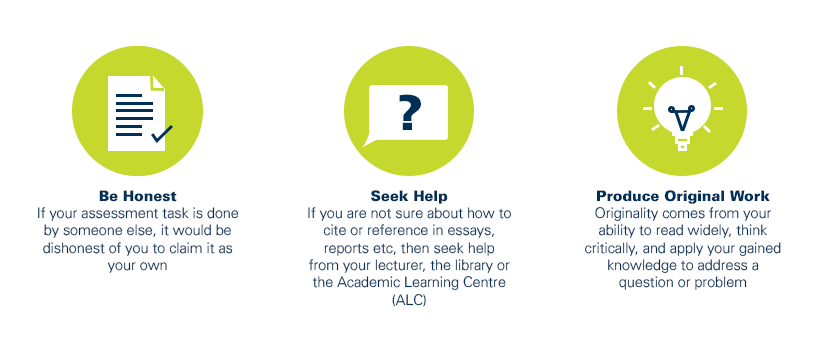
For academic advice and guidance, the Academic Learning Centre (ALC) can support you in becoming confident in completing assessments with integrity and of high standard.
What can you do to act with integrity?