Overview
In this unit you will explore a range of fundamental principles and topics within the life sciences discipline. In Life Science Fundamentals you will study and develop an understanding of cell structure and function, genetics and inheritance, evolutionary processes, and the anatomy and function of common living organisms, including bacteria and viruses. This unit will prepare you for more specialised study and help you understand the important role that life science plays in the scientific study or management of organisms, ecosystems, and animal or plant production. This unit includes a practical component that develops the necessary skills required to study organisms and undertake scientific inquiry in a university context and beyond.
Details
Pre-requisites or Co-requisites
Anti-requisite BIOL11099 Living Systems
Important note: Students enrolled in a subsequent unit who failed their pre-requisite unit, should drop the subsequent unit before the census date or within 10 working days of Fail grade notification. Students who do not drop the unit in this timeframe cannot later drop the unit without academic and financial liability. See details in the Assessment Policy and Procedure (Higher Education Coursework).
Offerings For Term 1 - 2026
Attendance Requirements
All on-campus students are expected to attend scheduled classes - in some units, these classes are identified as a mandatory (pass/fail) component and attendance is compulsory. International students, on a student visa, must maintain a full time study load and meet both attendance and academic progress requirements in each study period (satisfactory attendance for International students is defined as maintaining at least an 80% attendance record).
Recommended Student Time Commitment
Each 6-credit Undergraduate unit at CQUniversity requires an overall time commitment of an average of 12.5 hours of study per week, making a total of 150 hours for the unit.
Class Timetable
Assessment Overview
Assessment Grading
This is a graded unit: your overall grade will be calculated from the marks or grades for each assessment task, based on the relative weightings shown in the table above. You must obtain an overall mark for the unit of at least 50%, or an overall grade of 'pass' in order to pass the unit. If any 'pass/fail' tasks are shown in the table above they must also be completed successfully ('pass' grade). You must also meet any minimum mark requirements specified for a particular assessment task, as detailed in the 'assessment task' section (note that in some instances, the minimum mark for a task may be greater than 50%). Consult the University's Grades and Results Policy for more details of interim results and final grades.
All University policies are available on the CQUniversity Policy site.
You may wish to view these policies:
- Grades and Results Policy
- Assessment Policy and Procedure (Higher Education Coursework)
- Review of Grade Procedure
- Student Academic Integrity Policy and Procedure
- Academic Progression Policy and Procedure
- Student Refund and Credit Balance Policy and Procedure
- Complaints Policy and Procedure
- Information and Communications Technology Acceptable Use Policy and Procedure
This list is not an exhaustive list of all University policies. The full list of University policies are available on the CQUniversity Policy site.
Feedback, Recommendations and Responses
Every unit is reviewed for enhancement each year. At the most recent review, the following staff and student feedback items were identified and recommendations were made.
Feedback from 2025 SUTE Evaluations
Staff fostered an inclusive and interactive learning environment. Building on this, greater attention to the diversity of student backgrounds could further strengthen engagement.
Staff should continue to build on the inclusive environment established in this unit by more deliberately integrating diverse student perspectives and experiences into learning activities and resources.
- Describe the principles of cell theory, energetics, and metabolism.
- Apply knowledge of genetics and inheritance to the evolution of populations, conservation, and captive breeding.
- Demonstrate understanding of evolution by natural selection and biological diversity.
- Describe the basic principles of plant and animal form and function.
- Safely and proficiently perform various laboratory activities and techniques, such as the use of microscopes, biological identification keys, thin layer chromatography, gel electrophoresis, and the dissection of plants and animals.
- Synthesise information from life science information sources and communicate scientific information to general audiences.
Alignment of Assessment Tasks to Learning Outcomes
| Assessment Tasks | Learning Outcomes | |||||
|---|---|---|---|---|---|---|
| 1 | 2 | 3 | 4 | 5 | 6 | |
| 1 - Online Quiz(zes) - 20% | ||||||
| 2 - Presentation - 30% | ||||||
| 3 - Laboratory/Practical - 30% | ||||||
| 4 - Written Assessment - 20% | ||||||
Alignment of Graduate Attributes to Learning Outcomes
| Graduate Attributes | Learning Outcomes | |||||
|---|---|---|---|---|---|---|
| 1 | 2 | 3 | 4 | 5 | 6 | |
| 1 - Communication | ||||||
| 2 - Problem Solving | ||||||
| 3 - Critical Thinking | ||||||
| 4 - Information Literacy | ||||||
| 5 - Team Work | ||||||
| 6 - Information Technology Competence | ||||||
| 7 - Cross Cultural Competence | ||||||
| 8 - Ethical practice | ||||||
| 9 - Social Innovation | ||||||
| 10 - First Nations Knowledges | ||||||
| 11 - Aboriginal and Torres Strait Islander Cultures | ||||||
Textbooks
Campbell Biology, Australian and New Zealand Edition
- Edition: 12th (2021)
- Authors: Wasserman, Steven. A., et al.
- Pearson Education
- ISBN: 9781488626241
Additional Textbook Information
CQU students can access the online ebook version of Campbell Biology at ProQuest Ebook Central via the CQU Library.
If you prefer your own paper copy, you can purchase at the University Shop here: https://shop.cqu.edu.au/
IT Resources
- CQUniversity Student Email
- Internet
- Unit Website (Moodle)
All submissions for this unit must use the referencing style: Harvard (author-date)
For further information, see the Assessment Tasks.
a.carton@cqu.edu.au
Week 1
Begin Date: 09 Mar 2026Module/Topic
Introduction to Unit
Unifying Themes of Biology
The Cell
Tutorial Q and A
Chapter
Events and Submissions/Topic
Week 2
Begin Date: 16 Mar 2026Module/Topic
Genetics
Tutorial Q and A
Chapter
Events and Submissions/Topic
Week 3
Begin Date: 23 Mar 2026Module/Topic
Mechanisms of Evolution
Biological Diversity
Tutorial Q and A
Chapter
Events and Submissions/Topic
Week 4
Begin Date: 30 Mar 2026Module/Topic
Plant Diversity, Form and Function I
Chapter
Events and Submissions/Topic
Week 5
Begin Date: 06 Apr 2026Module/Topic
Plant Diversity, Form and Function II
Tutorial Q and A
Chapter
Events and Submissions/Topic
Week 6
Begin Date: 13 Apr 2026Module/Topic
Prokaryotes
Eukaryotes
Tutorial Q and A
Chapter
Events and Submissions/Topic
Vacation Week (Mid-term break)
Begin Date: 20 Apr 2026Module/Topic
Chapter
Events and Submissions/Topic
Quiz 1 Due: Vacation Week Sunday (26 Apr 2026) 11:55 pm AEST.
Week 7
Begin Date: 27 Apr 2026Module/Topic
Animal Diversity
Animal Form and Function
Tutorial Q and A
Chapter
Events and Submissions/Topic
Residential School A (Thursday to Sunday).
Week 8
Begin Date: 04 May 2026Module/Topic
Lophotrochozoans
Ecdysozoans
Tutorial Q and A
Chapter
Events and Submissions/Topic
Scientific Research Report Due: Week 8
Sunday (10 May 2026) 11:55 pm AEST (for Residential School A participants).
Week 9
Begin Date: 11 May 2026Module/Topic
Animal Diversity
Animal Form and Function
Tutorial Q and A
Chapter
Events and Submissions/Topic
Residential School B (Monday to Thursday).
Week 10
Begin Date: 18 May 2026Module/Topic
Insects
Chordates
Tutorial Q and A
Chapter
Events and Submissions/Topic
Scientific Research Report Due: Week 10
Thursday (21 May 2026) 11:55 pm AEST (for Residential School B participants).
Week 11
Begin Date: 25 May 2026Module/Topic
The Origin of Vertebrates
The Tetrapods
Tutorial Q and A
Chapter
Events and Submissions/Topic
Week 12
Begin Date: 01 Jun 2026Module/Topic
Mammals, Primates, and Humans
Tutorial Q and A
Chapter
Events and Submissions/Topic
Quiz 2 Due: Week 12 Sunday (7 Jun 2026) 11:55 pm AEST.
1 Online Quiz(zes)
This assessment is exclusively based on lecture, study, and reading material associated with Weeks 1-6 (Quiz 1), and Weeks 7-12 (Quiz 2).
Each quiz is limited to twenty (20) minutes and must be submitted after completion. You have one attempt per quiz. Questions can be a mix of true/false, multiple choice, mix-and-match, drag and drop, short answers, and other formats. Do not share your questions or answers with other students as this may disadvantage other students, such behaviour will be considered a breach of academic integrity and may result in academic misconduct.
Level of GenAI use allowed:
Level 1: The use of Generative Artificial Intelligence (Gen AI) in this assessment is not permitted and is thus unacceptable, if you use Gen AI in this assessment it will be considered Academic Misconduct.
The 72-hour grace period does not apply to this assessment.
Quiz 1 due 11:55pm Sunday of Vacation week; Quiz 2 11:55pm Sunday of Week 12.
Immediately following online submission of the quiz.
Answers will be assessed on their completeness, relevance, depth and correct application of life sciences knowledge as covered in the unit materials.
Please note a minimum achievement level is set for this assessment activity (i.e., you must equal or exceed this set minimum achievement level for you to be considered for a passing grade for this unit overall, irrespective of your achievement in other assessment components in this unit).
- Describe the principles of cell theory, energetics, and metabolism.
- Apply knowledge of genetics and inheritance to the evolution of populations, conservation, and captive breeding.
- Demonstrate understanding of evolution by natural selection and biological diversity.
- Describe the basic principles of plant and animal form and function.
2 Presentation
This assessment task requires you to produce a video presentation detailing a recent biological event, discovery, or break-through that occurred between the years 2015 to 2026. Your goal is to move beyond the initial general public news report and provide a deeper, technically accurate explanation of the biological mechanism(s) involved, the significance of the discovery, event or break-through, and outline why this matters to the scientific community.
Your video presentation should be five (5) minutes (±10%) long.
There will be three broad components to consider for this assessment:
1. Choice of suitable biological discovery, break-through, or event (this must have occurred between 2015-2026 and be a small enough topic that it can be adequately covered in 5 minutes, but also significant enough to fill the 5 minute presentation);
2. Being scientific and dispassionate in your approach to presentation content (no scientific jargon or value-laden language), inclusion and use of the relevant scientific concepts/terms, and explanations where needed; and
3. Production of a reasonable quality video, audio, and associated presentation.
Level of GenAI use allowed:
Level 2: You may use Generative Artificial Intelligence (GenAI) for planning, idea development, and initial research. Your final submission should show how you have developed and refined these ideas beyond GenAI. If you use GenAI you must include the GenAI model and all GenAI prompts used in a separate document when submitting your video file. You may not use GenAI to generate imagery or scripts.
Week 6 Monday (13 Apr 2026) 11:55 pm AEST
Week 7 Friday (1 May 2026)
Assessment, feedback and marking rubric returned via the unit Moodle site.
Submissions will be assessed on the criteria in the table below. A more detailed rubric can be found on the Moodle.
| Criteria | Weight |
| 1. Scientific accuracy | 20% |
| 2. Context and significance | 15% |
| 3. Information relevance | 30% |
| 4. Structure and flow | 15% |
| 5. Communication and Audio-visual | 20% |
You will need to find, use and cite at least three primary peer-reviewed information sources (e.g., Nature, Science) in your presentation and include a reference list of information sources used at the end of the presentation. You are also required to complete and submit an Assessment Self-Reflection and Metadata Sheet.
Please note a minimum achievement level is set for this assessment activity (i.e., you must equal or exceed this set minimum achievement level for you to be considered for a passing grade for this unit overall, irrespective of your achievement in other assessment components in this unit).
- Describe the principles of cell theory, energetics, and metabolism.
- Apply knowledge of genetics and inheritance to the evolution of populations, conservation, and captive breeding.
- Demonstrate understanding of evolution by natural selection and biological diversity.
- Describe the basic principles of plant and animal form and function.
- Synthesise information from life science information sources and communicate scientific information to general audiences.
3 Laboratory/Practical
You will demonstrate a range of biological skills and complete a series of assessments during your attendance at the Residential School.
Assessment activities will address competence in the use of microscopes and preparation of biological slides, plant and
animal dissection, identification of plant and animal organs, tissues, and structures, use of dichotomous and lucid keys
for plant and insect identification, and short quizzes based on the material covered during practical laboratory
sessions.
Level of GenAI use allowed:
Level 1: The use of Generative Artificial Intelligence (Gen AI) in this assessment is not permitted and is thus unacceptable, if you
use Gen AI in this assessment it will be considered Academic Misconduct.
The 72-hour grace period does not apply to this assessment.
Residential School Week (Residential School A - Week 7, Residential School B - Week 9)
Residential School Week
Competency and performance of residential school assessment tasks will be evaluated on the correctness, comprehensiveness and
relevance of the response. Specific details regarding Residential School assessment tasks will be available on the Moodle
two weeks prior to the the residential school (see Week 7 and 9) and be explained prior to undertaking the relevant
practical laboratory session.
Please note a minimum achievement level is set for this assessment activity (i.e., you must equal or exceed this set minimum achievement level for you to be considered for a passing grade for this unit overall, irrespective of your achievement in other assessment components in this unit).
- Safely and proficiently perform various laboratory activities and techniques, such as the use of microscopes, biological identification keys, thin layer chromatography, gel electrophoresis, and the dissection of plants and animals.
4 Written Assessment
In this assessment, you will transition from a student in the laboratory to a contributing scientist. Based on the data collected during one of the Residential School practical sessions, you are required to write a formal scientific paper. Your goal is to communicate the findings of your experiment with clarity, precision, and objectivity, while adhering to standard academic conventions in life sciences. Your report must include the following six sections:
Abstract - a concise summary of the entire paper;
Introduction - providing the necessary background information and defining the biological concepts being tested;
Materials and Methods - a description of how the experiment was conducted;
Results - objective presentation of your findings;
Discussion - interpretation of your results.
Level of GenAI use allowed:
Level 2: You may use Al for planning, idea development, and initial research. Your final submission should show how you have developed and refined these ideas beyond GenAI. You may not use GenAI to generate imagery or graphics. If you use GenAI you must include the GenAI model and GenAI prompts used in a separate document when submitting your report. When using references you must include the the relevant page and line number within the referenced document.
Seven (7) days after the conclusion of the residential school. For Residential School A this is 11:55pm, Sunday of Week 8. For Residential School B this is 11:55pm, Thursday of Week 10.
Vacation/Exam Week Friday (19 June 2026)
Assessment, feedback and marking rubric returned via the unit Moodle site.
Submissions will be assessed on the criteria in the table below. A more detailed rubric can be found on the Moodle.
| Criteria | Weight |
| Scientific Accuracy: Correct interpretation of life sciences principles. | 25% |
| Flow and Structure: Proper use of the AIMRaD (Abstract, Introduction, Methods, Results, and Discussion) format. | 20% |
| Data Presentation: Clarity, relevance and professional standard of data presentation (figures and tables). | 15% |
| Academic Integrity and Analysis: Critical evaluation of the data and results, accurate and consistent referencing. | 25% |
| Communication and Grammar: Correct use of grammatical conventions for readability, clarity and comprehension. | 15% |
You will need to find, use and cite at least three primary peer-reviewed information sources (e.g., Nature, Science) in your report.
Please note a minimum achievement level is set for this assessment activity (i.e., you must equal or exceed this set minimum achievement level for you to be considered for a passing grade for this unit overall, irrespective of your achievement in other assessment components in this unit).
- Safely and proficiently perform various laboratory activities and techniques, such as the use of microscopes, biological identification keys, thin layer chromatography, gel electrophoresis, and the dissection of plants and animals.
- Synthesise information from life science information sources and communicate scientific information to general audiences.
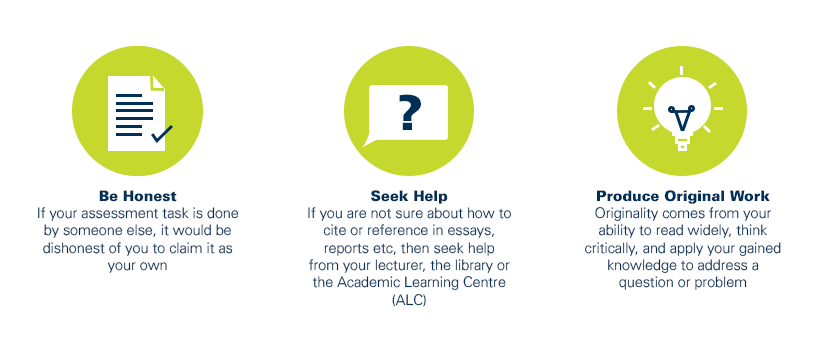
As a CQUniversity student you are expected to act honestly in all aspects of your academic work.
Any assessable work undertaken or submitted for review or assessment must be your own work. Assessable work is any type of work you do to meet the assessment requirements in the unit, including draft work submitted for review and feedback and final work to be assessed.
When you use the ideas, words or data of others in your assessment, you must thoroughly and clearly acknowledge the source of this information by using the correct referencing style for your unit. Using others’ work without proper acknowledgement may be considered a form of intellectual dishonesty.
Participating honestly, respectfully, responsibly, and fairly in your university study ensures the CQUniversity qualification you earn will be valued as a true indication of your individual academic achievement and will continue to receive the respect and recognition it deserves.
As a student, you are responsible for reading and following CQUniversity’s policies, including the Student Academic Integrity Policy and Procedure. This policy sets out CQUniversity’s expectations of you to act with integrity, examples of academic integrity breaches to avoid, the processes used to address alleged breaches of academic integrity, and potential penalties.
What is a breach of academic integrity?
A breach of academic integrity includes but is not limited to plagiarism, self-plagiarism, collusion, cheating, contract cheating, and academic misconduct. The Student Academic Integrity Policy and Procedure defines what these terms mean and gives examples.
Why is academic integrity important?
A breach of academic integrity may result in one or more penalties, including suspension or even expulsion from the University. It can also have negative implications for student visas and future enrolment at CQUniversity or elsewhere. Students who engage in contract cheating also risk being blackmailed by contract cheating services.
Where can I get assistance?
For academic advice and guidance, the Academic Learning Centre (ALC) can support you in becoming confident in completing assessments with integrity and of high standard.
What can you do to act with integrity?